



Designtech startup Fanusta Global may have started as an initiative to bring local artisans of Jaipur to contemporary spaces, but its inception was quite accidental.
In a conversation with YourStory, Founder-CEO-Director Shailander Kumar recollects, “I was working a corporate job and needed a wall painting for my personal office. I contacted a friend of mine who is a painter and a dance teacher, who did a fantastic painting. But when I inquired about how he prices his work, he just said that he just charges for the material and for labour hours. Eventually, I understood that local artists like him don’t know how to sell their artwork apart from taking part in an occasional exhibition.”
That was over a decade ago. To further examine the widespread ignorance of commerce in art, Kumar toured five states—Uttar Pradesh, Madhya Pradesh, Chattisgarh, Gujarat and Assam—over the course of nine months and confirmed his suspicions.
Eventually he set up Fanusta Global as a B2B and B2C startup in 2016 in J aipur. Today, the company has a pool of over 130+ artisans (both permanent and freelance) and 250+ vendors, and a team of 52 design and execution professionals. The founding team consists of Kumar and COO Dinesh Raut.
The growing period
Fanusta Global offers a variety of services from product design like home decor and utility products all the way to furniture design and turnkey projects. In fact, the company started getting noticed amongst the crowd due to their turnkey initiative Indesign—where the company approaches interior designing from a holistic perspective and completely customisable as per the client’s requirements.
“What separates us from the crowd is that we are pure turnkey from the first step. The client selects the material with which the project would be built directly from our offices. We usually prefer to use locally sourced materials but since we are fully customisable, we can import specific materials as well depending on our clients.”
.thumbnailWrapper{
width:6.62rem !important;
}
.alsoReadTitleImage{
min-width: 81px !important;
min-height: 81px !important;
}
.alsoReadMainTitleText{
font-size: 14px !important;
line-height: 20px !important;
}
.alsoReadHeadText{
font-size: 24px !important;
line-height: 20px !important;
}
}
“Since we are customisable, we are not restricted to any catalog. Our artisanal input also gives us a competitive edge,” he says, adding that the startup has completed over 1,533+ turnkey projects across India.
Fanusta started Indesign in 2018 but it became completely operational from 2021. The first major client to work with the startup were Taj Hotels.
Fanusta is now registered as a national vendor for Taj, Kumar shares, adding that their first project with the hotel chain was a four feet brass lamp.
Some of the other top brands in Fanusta’s clientele include ITC Hotels and Burman Estate IIM, among 80 other corporates.
They also have an ecommerce space from their website, where people can buy some of their home decor products, which also allows them to function as a D2C business. Headquartered in Jaipur, Fanusta also operates in Pune and Sikar—Kumar’s hometown.
<figure class="image embed" contenteditable="false" data-id="574421" data-url="https://images.yourstory.com/cs/2/94a03c40169611f0b4b0c5b62b4900c2/2K4A60832-1749534983635.jpg" data-alt="Fanusta Design" data-caption="
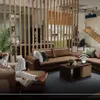
Representation of an interior design project by Fanusta Global made with locally-sourced material. Credit: Fanusta Global
” align=”center”> Representation of an interior design project by Fanusta Global made with locally-sourced material. Credit: Fanusta Global
The company charges only Rs 100 for the ideating period where the artisans and the designers come up a blueprint to pitch their client.
Pricing varies from project to project. For example, if the team is working on a turkey project in a 2.5-3 BHK space, they charge somewhere between Rs 20-25 lakh for it. Artisans receive 40% of the total project value.
The anganwadi project and work with tech
Recently, Kumar initiated a project to upgrade the conditions of anganwadis. The company shared its proposal with the governments of Rajasthan and Maharashtra, along with corporates as a CSR initiative.
“As of now, most anganwadis are just a place to take care of children and feed them. But we want to revolutionise them. Our team visited anganwadis in Rajasthan, Delhi, and in Kochi. The latter has set the standard by setting up smart anganwadis alongside Ahmedabad. In our advanced model, we have created interactive products for children there to get access to education the way a child in an urban environment gets,” shares Kumar, adding that, by the end of June, they hope to start executing their vision. They also plan to design the interiors of the anganwadis in a way that is suitable to children.
Once Fanusta gets some corporates on board, the company is planning to start its work with at least 100 centres. But Kumar vents that while the anganwadi work with corporates is at an advanced stage, the work with the government bodies seems to be taking a lot longer.
The company has always been open to incorporating technology, including artificial intelligence. “Using generative AI tools has shortened our operational time by a lot. We used to take a minimum of 25 days to manually build the design models to show our clients. Using AI tools like Zoho projects has cut that time down to only 15 days,” he says.
.thumbnailWrapper{
width:6.62rem !important;
}
.alsoReadTitleImage{
min-width: 81px !important;
min-height: 81px !important;
}
.alsoReadMainTitleText{
font-size: 14px !important;
line-height: 20px !important;
}
.alsoReadHeadText{
font-size: 24px !important;
line-height: 20px !important;
}
}

Of late, there has been some conflict in the digital zeitgeist over AI creating art. But Kumar doesn’t look at it as a threat. “We don’t look at it like a threat. Instead, it can help us create design models quicker. Anyway for us, the main work has to be done physically.”
Funding
Bootstrapped for almost nine years with a cumulative Rs 9 crore, the startup is now hoping to raise Rs 20 crore in a seed round in June. It had earlier tried to raise funding in 2017, but met with disappointment.
“We had just launched our ecommerce space where we had over 2,000 products in our portfolio. But as I had said before, things took a turn for us when we started providing turnkey projects, so we hope this time we will be more successful,” explains Kumar.
In the rapidly evolving interior design ecosystem in India, Fanusta shares a unique place as it offers both products and services. But simply put, it competes with the Jaipur-based Anantaya Works for products and with the New Delhi-based Studio Lotus in design solutions.
The company is planning to expand to two other centres in currently undisclosed locations in the country and further increase their artisanal pool.
Edited by Jyoti Narayan
