

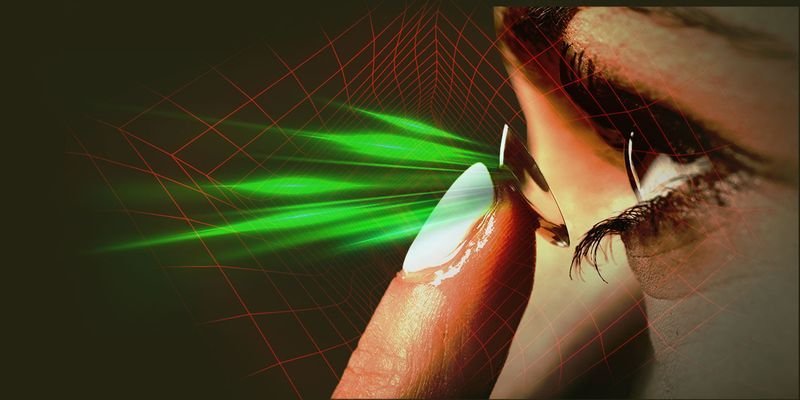
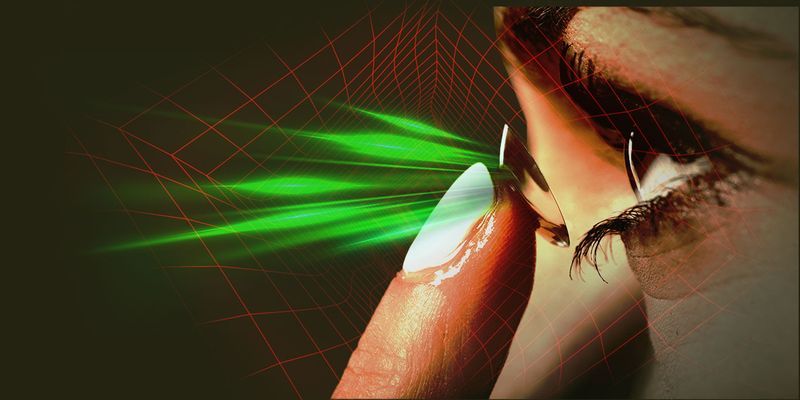
Imagine a future where you could see in complete darkness — not through bulky night vision goggles, but with nothing more than a pair of soft contact lenses. That future may be closer than you think. In a breakthrough that sounds like it belongs in a superhero origin story, scientists have developed infrared-powered contact lenses that allow users to see in the dark, even with their eyelids shut.
The science of turning the invisible into visible
These next-generation contact lenses work on a remarkable principle of upconversion nanotechnology. Packed with millions of nanoparticles made from rare-earth metals like ytterbium and erbium, the lenses can convert infrared light — which is normally invisible to the human eye — into visible light.
The underlying process is called photon upconversion. Here’s how it works: ambient infrared photons, which are weak and typically undetectable, are absorbed by these nanoparticles. The particles then combine the energy of multiple IR photons to emit a single higher-energy photon in the visible light spectrum. This is similar to merging two dim beams of light into one strong one that our eyes can perceive.
But the most astonishing part? This phenomenon doesn’t just work with your eyes open. It actually works better with your eyes closed.
Seeing through your eyelids: How is that possible?
It all comes down to physics. Infrared light has longer wavelengths than visible light, allowing it to pass through objects more easily — including biological tissue like skin and eyelids. While your eyelids are excellent at blocking visible light, they offer little resistance to IR radiation.
This means that even with your eyes closed, infrared light can pass through your eyelids, reach the nanoparticles in the lens, and get converted into visible light. It’s akin to how radio waves penetrate walls while visible light cannot. In early experiments, test subjects wearing these lenses could detect blinking infrared LEDs and even decode Morse code patterns — all with their eyes shut.
From the lab to the real world: What the tests reveal
The development comes from a team of Chinese scientists at the University of Science and Technology of China, and initial tests have shown impressive results. Lab mice equipped with the lenses showed clear pupil contractions in response to IR light and even demonstrated behavioral changes when exposed to IR-lit environments — confirming real vision was taking place.
In human trials, users could detect directional IR light and even distinguish between different infrared wavelengths by using color-coded nanoparticle configurations. Researchers were able to tune the particles so that 980 nm light appeared blue, 808 nm green, and 1,532 nm red — essentially giving users color vision in the infrared spectrum.
What’s the catch?
Like any breakthrough technology, the current iteration has its limitations. The lenses require bright infrared sources, such as high-powered IR LEDs, to function effectively. They cannot yet detect the faint IR radiation emitted by warm bodies, which is a key feature of traditional night vision goggles.
Additionally, because the lenses sit directly on the eye without external focusing lenses, the image quality is currently blurry. Researchers are working on solutions such as overlay glasses to help sharpen the images and expand field of view, but these improvements are still in development.
So, while we’re not quite at the point of seeing people’s heat signatures in pitch darkness, these lenses already represent a major leap forward.
A glimpse into future applications
This isn’t just a novel scientific achievement — it has the potential to redefine multiple industries:
- Military and security: Silent, wearable night vision without headsets or helmet mounts.
- Search and rescue: In fog, smoke, or collapsed structures where visibility is compromised, IR light can guide responders.
- Encrypted communication: Blink-based patterns only visible through IR light could create new ways to send secret messages.
- Healthcare and accessibility: Assistive technologies for the visually impaired or those with color blindness could benefit from this form of spectral augmentation.
The lens race is heating up
These lenses also raise questions about the future of AR/VR, biometric surveillance, and optical enhancement. As research progresses and the technology becomes miniaturised and commercialised, it could disrupt the $16 billion night vision market, which is currently dominated by bulky, power-hungry devices.
With advancements in nanoparticle sensitivity, image clarity, and thermal IR conversion, future versions of these lenses may make full-body heat vision or real-time IR overlays part of everyday life.
Final thoughts
The notion of seeing in the dark with your eyes shut once sounded absurd. But with this development, science is edging closer to turning that dream into a reality. These infrared contact lenses, still in their experimental phase, already outperform expectations and hint at a near future where super-vision is no longer fictional — it’s wearable.
This is the kind of innovation that redefines what’s possible with the human body. Vision, it turns out, is no longer limited to what nature gave us — it’s being rewritten, one photon at a time.
