

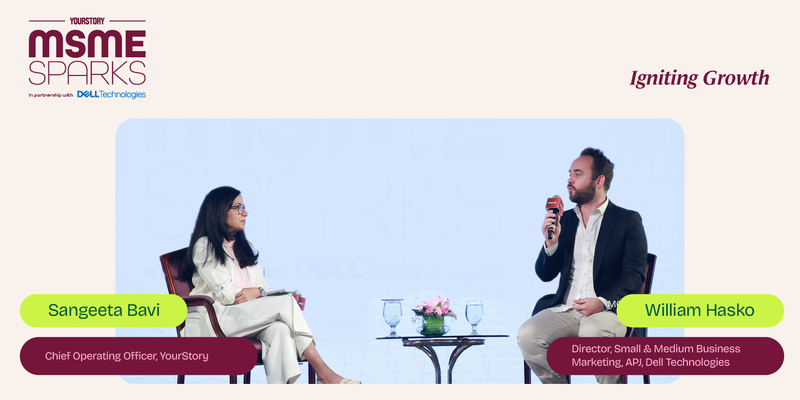
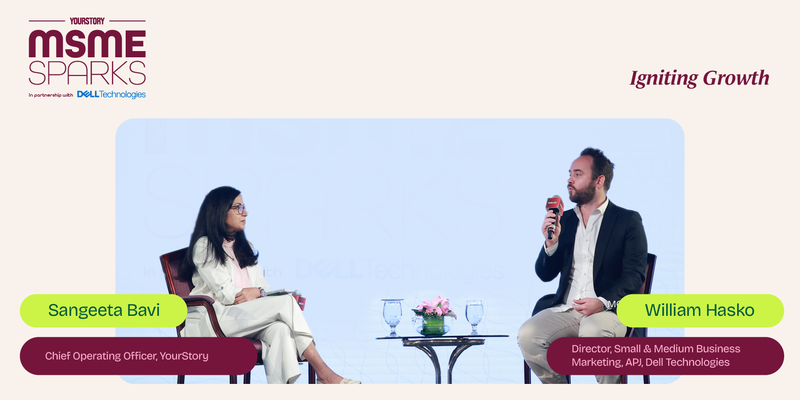
What does it really take to scale a business today, without losing sight of what you’re building, who you’re building it for, and why? At the MSME Sparks 2025 finale, William Hasko, Director – SMB Marketing, APJ at Dell Technologies, brought a sharp, empathetic lens to that question. In a candid conversation with YourStory COO Sangeeta Bavi, he challenged growth myths, unpacked the realities of funding, and offered practical frameworks for small businesses navigating uncertainty.
Hasko opened the session by acknowledging the enormous, often underappreciated, weight carried by MSME founders. For him, small and medium businesses form the foundation of any economy.
“The fabric of society is built by small businesses. That includes your local dosa stand, but also the startups solving the kinds of problems no one else can,” he said.
Across Asia-Pacific and beyond, he noted, MSMEs are creators of impact, culture, and community. It’s this belief that informs Dell Technologies’ work with the segment; not just selling to them, but building with them.
When you thrive, we thrive: Why MSMEs are now central to corporate strategy
A decade ago, MSMEs were often treated as peripheral segments within large corporations, served by dedicated but small teams, typically with limited influence. That’s changing rapidly, Hasko said, as large organisations begin to recognize just how critical MSMEs are to their own growth.
“If you go back a decade, big companies might have had a small business department, or it may have just been one person in a team. Now, companies know their growth is attached to how well they connect with and work with SMBs.”
This shift is also visible in market strategy. He pointed to how billboards and B2B marketing in major cities like Bengaluru increasingly speak directly to small businesses, something that was rare even 10 years ago, when consumer brands dominated the visual landscape.
“The value of the SMB segment, and the recognition of how big it is, and how big it will be over the next decade, is driving decisions at the most senior levels of the world’s largest companies.”
For Dell, this means not only designing products and services with small business users in mind, but also treating them as critical innovation partners, companies that may be small in size but punch far above their weight in impact and potential.
From transactional to transformational
A key shift Hasko discussed was the way Dell has evolved its engagement with small businesses. Once considered a pure hardware company, Dell now positions itself as a partner offering end-to-end solutions including scalable infrastructure and long-term guidance.
“We’re in the technology business, not just the hardware business. That means stepping above the transaction and into the conversation,” he shared.
He encouraged founders to treat their technology vendors the same way they treat banks, landlords, or financial advisors as long-term partners in growth. The aim is to help businesses build infrastructure that doesn’t just serve today’s needs but also supports tomorrow’s scale.
The myth of the funding finish line
Hasko challenged the common perception that raising investment is the defining marker of success. “Funding isn’t the end. It’s just another step. What’s more important is maintaining the momentum after the cheque clears,” he said.
He observed that many founders expend enormous energy securing their first round, only to lose steam once the goal is achieved. His advice: view funding as fuel, not as a finish line. The real challenge lies in sustaining clarity and drive long after the milestone.
The conversation also focused on single-promoter and bootstrapped MSMEs; those growing without the safety net of external capital. Hasko stressed that in such setups, the wellbeing of the founder is directly tied to the health of the business.
“If you’re not happy, not progressing, not growing, your business won’t either… So, take care of yourself too.” He urged founders to pause and acknowledge their own effort. Celebrating small wins or taking a break isn’t indulgence; it’s essential for longevity and sustainable leadership.
Small teams, smart growth: The shift from scale to precision
As conversations around AI and automation gain momentum, Hasko pointed out a critical opportunity: MSMEs don’t need massive teams to scale anymore. With the right tools and clarity of purpose, even compact teams can achieve enterprise-level outcomes.
He shared an example of a startup in Australia, Airspeeder Ltd that’s developing flying cars—not to sell them to consumers, but to solve complex technology challenges in navigation and autonomous systems. Their lean team, powered by focused thinking and the right tech stack, is solving problems at a global scale.
“You don’t need big teams to grow. You need clarity about your value, and the right tech and talent to scale smart,” he reiterated.
Hasko also highlighted a fundamental truth that even the most groundbreaking ideas need a viable path to revenue. Many innovations fail not because the product lacks merit, but because the business model isn’t clear.
“No matter how futuristic your idea is, you need to understand how it generates a return. Passion is great, but clarity around monetisation is critical.”
On the topic of AI adoption, Hasko encouraged MSMEs to avoid chasing trends blindly. Instead, he suggested that AI should be deployed in alignment with the organisation’s values and long-term goals. “AI should start with what your company stands for. Choose the part of your business you’re comfortable attaching your legacy to, and begin there,” he said.
He also underlined the importance of identifying internal champions—the team members most willing and capable of embracing change. AI initiatives, he said, are far more likely to succeed when they’re built around people who believe in the potential of the technology.
Why tech adoption can’t be delayed
When asked about the pressure MSMEs feel to digitise, Hasko acknowledged that not every business needs to embrace every trend, but they cannot afford to ignore how quickly things are changing.
“If your business relies on data, technology is central, whether you realise it or not,” he said.
Rather than trying to transform everything at once, he advised businesses to start small. Pick one area—like operations, customer experience, or marketing—and explore how a tech upgrade could make it better. That initial step, he said, often opens the door to bigger, smarter changes.
Women founders bring new dimensions to business thinking
A consistent advocate for gender balance in entrepreneurship, Hasko used the platform to highlight the grit, resilience, and clarity he sees in women founders.
“Women think differently, and most of the time, think better. But we don’t currently play on an equal field. The gap, not the perspective, is the problem,” he observed.
He called on the ecosystem to create environments where women feel they can build and lead, not just be included. From funding to mentorship, equitable access remains a barrier that requires systemic change.
Take the next step, even if it’s a new direction
Closing the session, Hasko returned to a simple but powerful piece of advice for MSMEs and startups alike: “You’ve already taken the first big step by starting. Don’t be afraid to take the next one, even if it means changing course.”
In a world that’s changing rapidly, being flexible, grounded, and self-aware may be the most strategic moves of all.
