

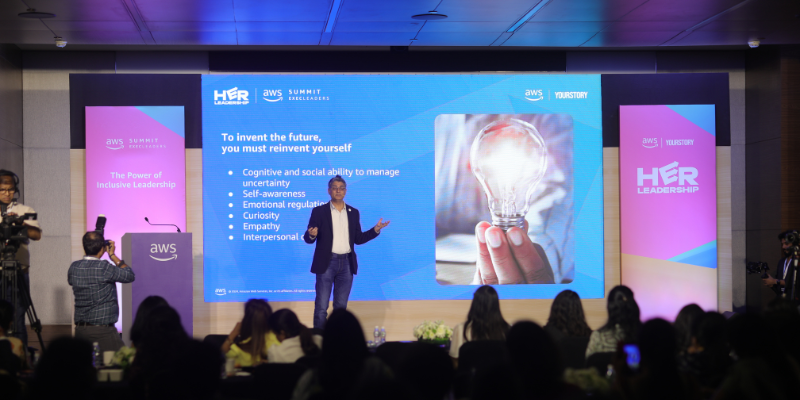

What does leadership look like in the age of AI? How do you future-proof not just your business, but your people? And how can empathy, not ego, become your biggest competitive advantage? At the AWS ExecLeaders Summit 2025, Chandra Prakash Balani, Head of AWS Industries in India, delivered a compelling closing keynote that tied everything together. Drawing from over 12 years at Amazon and deep partnerships with India’s largest Global Capability Centres (GCCs), he made one thing clear: the future belongs to inclusive, emotionally intelligent leaders who lead with possibility, not control.
HER Leadership: Where it all began
Chandra began by sharing the origin story of HER Leadership, an initiative that started as a video series during the pandemic to spotlight women leaders navigating complex systems and thriving in leadership roles. The tagline was simple yet resonant: “What you can see, you can be.”
Featuring 11 senior women leaders in India, including Padma Shri awardee Arundhati Bhattacharya, Chairperson of Salesforce India Private Limited, the series has since evolved into a powerful community and platform for knowledge and shared learning. What began in 2022 as a digital community has grown into a live, on-ground connect, coming together at ExecLeaders @ AWS Summit Mumbai.
Transformation isn’t just about tech
As the conversation shifted to AI and innovation, Chandra made a crucial distinction: the biggest barrier to transformation isn’t technology or digital literacy, it’s people. He pointed out that while digital skills matter, true transformation depends on human qualities like adaptability, curiosity, creativity, and comfort with ambiguity.
Too often, digital transformation fails not because the tools are inadequate, but because teams aren’t prepared to change. The solution, Chandra said, lies in evolving leadership, not just adopting technologies like GenAI, but creating the conditions to empower people through inclusive, emotionally intelligent leadership.
The empathy advantage
Chandra’s keynote wasn’t just about data and strategy; it was about emotional intelligence. He said that in an increasingly automated world, empathy is a real differentiator, not just a leadership add-on.
“Are we emotionally intelligent? Are we self-aware? Are we curious about the people around us?” he asked. “Because if we want to lead in this new world, we have to start with ourselves.”
He also pointed to a common leadership trap: the comfort of agreement. Innovation often fails not because ideas are weak, but because no one challenges them early. Leaders need to build teams that are confident enough to raise objections and create cultures where it’s safe to do so.
Challenge your assumptions — Even the good ones
Chandra went on to explore one of the more subtle leadership traps: the tendency to act too quickly on ideas that receive early validation. When everyone agrees, it’s easy to move forward without questioning further.
“It’s when you get an idea, everyone agrees, you feel great, and then you just run with it,” he said. “I’ve learned to pause. Now, when I think I’ve got something great, I ask my team to poke holes in it.”
He underlined the importance of creating space for challenge, reflection, and diverse input, especially when ideas seem obvious or widely accepted.
The culture of candor
In some organisations, silence comes from politeness. In others, it comes from fear. Neither supports innovation. Amazon encourages a culture of candor. Through the leadership principle of “Have Backbone, Disagree and Commit,” teams are expected to debate ideas openly, then move forward together once a decision is made.
This principle of generative disagreement enables organisations to challenge ideas without making it personal and ensures stronger outcomes through open dialogue.
EPIC leadership and the road ahead
Chandra closed the keynote by sharing an internal leadership model used at Amazon: EPIC (Empathy, Purpose, Inspiration, and Connection). He explained that these are not soft skills but critical skills for building resilient, forward-looking organisations, especially in the era of AI.
In a room full of CXOs, founders, and enterprise leaders, Chandra didn’t talk about strategy decks or innovation pipelines. He focused on what often gets left out: emotional resilience, inclusive leadership, and human connection.
At the end of the summit, the message was clear: the future of business won’t be built by those with the fastest tech; it will be led by those who lead with empathy, challenge with candor, and listen like it matters.
