

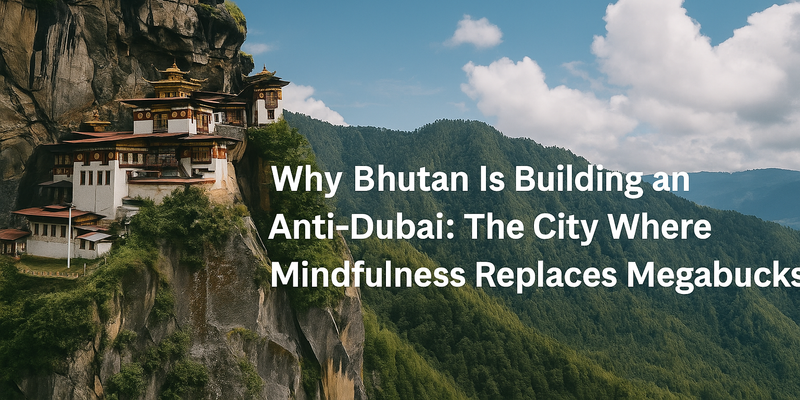
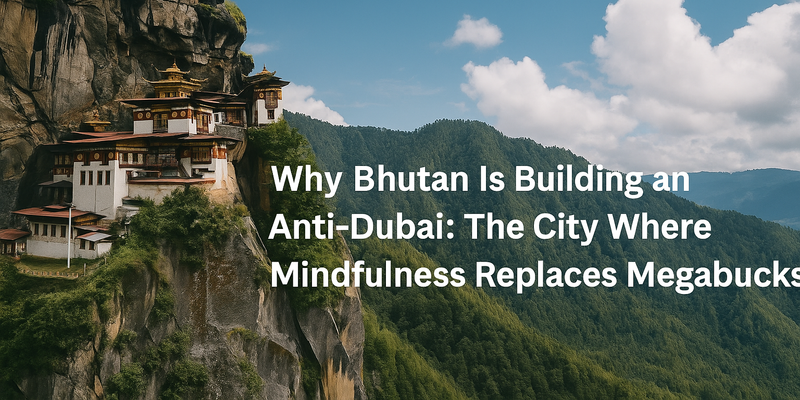
Imagine a country where happiness is written into the constitution, where GDP isn’t king, and where hospitals, schools, and nature are all free to roam. That’s Bhutan the Land of the Thunder Dragon, a nation tucked high in the Himalayas that’s known for its spiritual roots, lush forests, and a national policy of Gross National Happiness (GNH). But behind the idyllic postcard lies a modern dilemma: Bhutan is losing its youth.
Despite prioritising spiritual well-being over material wealth, a large number of Bhutanese youth are leaving in search of better job opportunities and higher incomes. This growing exodus has prompted a bold experiment from the throne itself. In an unexpected move, Bhutan’s King Jigme Khesar Namgyel Wangchuck has launched an urban project that’s less about capitalism and more about contemplation. Meet Gelephu Mindfulness City — Bhutan’s answer to modern urbanisation and what many are calling the “anti-Dubai.”
The philosophy: Happiness over high-rises
Where most nations chase economic indicators like GDP, Bhutan focuses on GNH — a holistic index that includes environmental preservation, cultural values, mental well-being, and good governance. This isn’t just a slogan. The GNH is embedded in Bhutan’s constitution and education system. It means that urban planning, policymaking, and even business are driven not by profit margins but by the question: “Will this make our people happier?”
And yet, this ethos has its limits. Bhutan’s economy remains largely agrarian and youth unemployment is a growing concern, hovering around 30% in recent years. While the spiritual quality of life is high, the lack of high-paying opportunities is pushing many Bhutanese to emigrate, especially to Australia, the US, and the Gulf.
The plan: Mindfulness meets modernity
To stop the brain drain and create a future-ready economy, Bhutan is building the Gelephu Mindfulness City (GMC) — a 2,500-square-kilometre urban zone near the Indian border, three times the size of Singapore. But unlike most new cities, this one won’t be filled with steel-and-glass skyscrapers. No skyline, no rush-hour chaos. Instead, GMC will be a network of low-rise towns connected by monumental “inhabited bridges,” each housing cultural institutions like temples, medical centres, and universities.
The architectural ethos is inspired by traditional Bhutanese dzongs — fortified monasteries — reimagined with modern materials like glulam timber, colourful local stones, and modular construction techniques. Even the city’s airport is being built on a bridge that flows over a river, with care taken not to disturb the aquatic ecosystem. This isn’t a place for Lamborghinis; it’s a place where elephants may still have the right of way.
Staying green while staying grounded
Unlike many “eco-friendly” cities that merely greenwash their concrete jungles, Gelephu is taking sustainability seriously. No building will rise higher than six storeys, reducing the use of carbon-intensive materials like steel and cement. The city’s location — nestled at the foot of the Himalayas — is prone to flooding during monsoons, but instead of engineering costly drainage systems, Bhutan is taking a natural approach: planting paddy fields and using permeable pavements to turn the city into a giant sponge.
Almost 99% of Bhutan’s current energy comes from hydroelectric power, making it one of the world’s few carbon-negative countries. Gelephu’s infrastructure builds on this legacy with plans for new dams, renewable energy centres, and even a hydro-dam with a Buddhist temple at its centre — an architectural and spiritual marvel.
More than a city — a classroom for the future
Bhutan openly admits it doesn’t yet have all the talent or technical skills required to build Gelephu alone. Instead of shutting the world out, it invites global experts to collaborate and train locals, with the goal that Bhutanese professionals will one day guide similar projects around the world.
Beyond infrastructure, the city is also an incubator for new ideas, including biotech, wellness tourism, and green finance. It’s not just about building jobs, but building purpose. As one official put it, “We’re not building a Dubai. We’re building a Bhutan.”
What makes it the anti-Dubai?
Where Dubai dazzles with glitz, height, and hyper-speed development, Bhutan’s Gelephu is anchored in slowness, silence, and sustainability. There are no supertalls, no vanity projects. Instead, there are modular timber, elephant crossings, and temples on dams. It’s not a city built to be seen — it’s a city designed to be felt.
This is not just Bhutan’s attempt to keep its youth. It’s a vision for an entirely new model of development — one that could quietly influence how the rest of the world approaches urbanisation in a climate-challenged era.
Edited by Rahul Bansal
