


In many Tier II cities in India, local shop owners struggle to get quality clothes at the right price. They often travel long distances to big cities like Delhi or Surat to buy stock, a process that takes time, money, and effort.
, a startup from Gurugram, is solving this problem by connecting retailers directly to manufacturers and helping them get what they need without leaving their city.
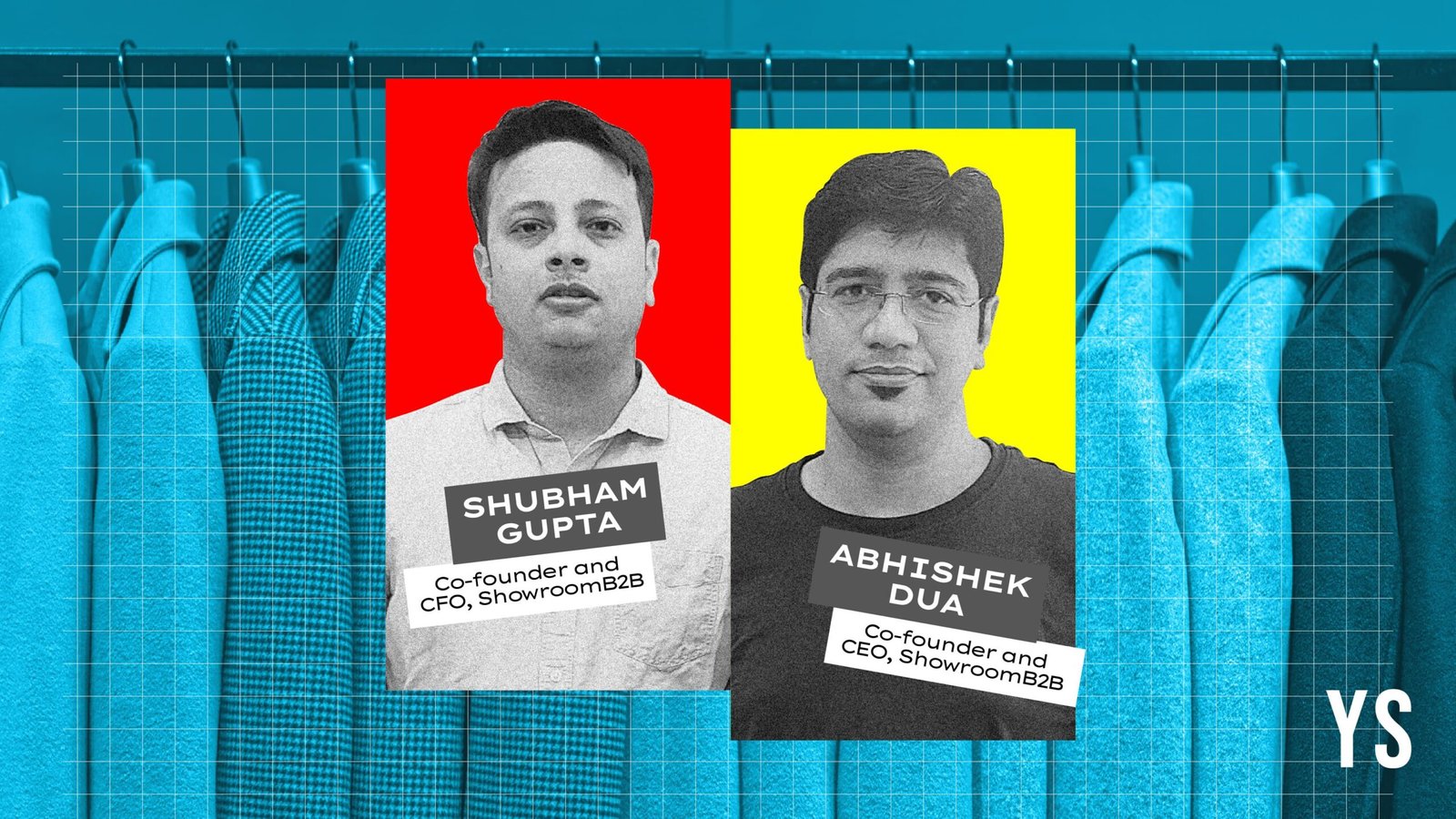
Founded in 2020 by Abhishek Dua and Shubham Gupta, Showroom B2B is building a smarter and faster way to buy and supply clothes. The company uses technology and experience centres to bridge the gap between suppliers and both small retailers and large fashion chains.
From furniture to fashion
Dua and Gupta met while pursuing their MBA at IIM Lucknow. Before Showroom B2B, Dua used to run a manufacturing business in engineered wood used in modular furniture. That business crossed Rs 100 crore in revenue. He exited in 2020 to build something more scalable and tech-driven.
The idea for Showroom B2B came when Abhishek and Shubham saw that fashion retailers in Tier II cities travelled far to source clothes. To solve this problem, the founders launched experience stores in cities like Lucknow, Kanpur, and Gorakhpur, where retailers could see the garments, scan what they like, and order through a website app, without having to travel to a different city.
How the model works
Showroom B2B runs two types of services. One is for small retailers who use the platform website and experience stores to choose and order clothes. The second is for large retail brands like Reliance Trends, Vishal Megamart, V-Mart, and Myntra.
“We help small shopkeepers find the right clothes at the right price. For big stores, we provide custom-made garments with the quality and designs they want,” says Dua.
In just four years, the company has served over 7,000 small retailers and about 20 large branded store chains.
The company relies heavily on technology. For smaller retailers, the platform works like an online store linked with physical experience centres. For large clients, the company uses a custom-built software system that tracks every stage of garment production.
AI is used to track production and to monitor quality. The company is using a hybrid approach, where some AI tools are built in-house, while others are from external providers. Its mix helps with forecasting, supplier matching, and planning, while keeping its system fast and flexible. “We’ve automated a lot of the work to make manufacturing faster and more efficient,” says Dua.
The company’s system also includes tools for managing designs, orders, stock, and delivery. This makes it easier to handle large orders and avoid delays, according to Dua.
Showroom B2B has two factories as well as works with 20-25 partner factories in cities like Delhi, Ludhiana, Kolkata, Jaipur, and Tiruppur.
Each area focuses on specific types of clothing, for example, Tirupur for t-shirts, Jaipur for ethnic wear, and Kolkata for kidswear.
The company mostly produces ethnic wear and denim. Where ethnic pieces cost between Rs 150-160, while denim starts at Rs 400 and goes up to Rs 750. All garments are made under the brand names of the client stores.
According to Dua, raw materials are sourced directly from mills in Erode, Coimbatore, and Delhi-NCR, with no middlemen. “By cutting out the middle layer, we give better value to our clients,” Dua says.
The company has raised about $6 million so far. Its pre-Series A round was led by Jungle Ventures in October 2023, with support from CISO Capital and Axilor Venture Labs.
The team has around 200 employees. The company operates mainly from its Gurugram head office and another office in Kanpur.
.thumbnailWrapper{
width:6.62rem !important;
}
.alsoReadTitleImage{
min-width: 81px !important;
min-height: 81px !important;
}
.alsoReadMainTitleText{
font-size: 14px !important;
line-height: 20px !important;
}
.alsoReadHeadText{
font-size: 24px !important;
line-height: 20px !important;
}
}

Growth and expansion
Today, the company supplies products to warehouses across India. For example, Vishal Megamart covers the north through Showroom B2B’s supply, while Reliance Retail gets goods delivered even to its Bangalore warehouse.
According to Dua, the company is also entering the global market. It currently serves customers in the US and the Middle East, with new leads coming in from Europe. “All these are inbound. We didn’t even reach out; people heard about us through others,” says Dua.
Market and challenges
Dua believes the market is big enough for many players. He says, “India’s garment industry is growing fast, expected to reach $180 billion in the next two years. There’s enough space for everyone.”
However, Dua added that traditional manufacturers are not seen as direct competitors. “The market is so big and growing so quickly that we’re not competing against each other. In many ways, we’re helping each other serve large buyers better,” Dua explains.
One of the main challenges for Showroom B2B is hiring skilled people. “Finding the right production managers and merchandisers is tough. It takes experience and attention to detail,” he says.
Dua and Gupta are hands-on co-founders. “We dive deep into the manufacturing process to see where we can improve,” Dua says. With both having an engineering background, the team focuses a lot on how to save time and reduce waste.
Edited by Affirunisa Kankudti
