

For decades, China has reigned supreme in the global toy industry, producing nearly 70% of all toys sold worldwide. But as global dynamics shift, rising import tariffs, stricter quality standards, and the push toward ‘China plus one’ sourcing strategies, brands are looking for alternate supply bases. India, bolstered by policy support, expanding manufacturing capability, and cost advantages, is emerging as a serious contender.
The Indian toy market, valued at $1.9 billion in 2024, is projected to grow at a 10% CAGR to reach $4.7 billion by 2033, according to the IMARC Group. On the export front, toy shipments from India surged 239% in FY 2022–23, as reported by the Toy Association of India. This shift opens doors for Indian manufacturers to play a more central role in the global toy supply chain.
Amid this transformation is Bengaluru-based , a B2B contract manufacturer focused on outdoor and mobility toys. It specialises in tricycles, scooters, baby walkers, and electric ride-ons. BIDSO aims to be the manufacturing backbone for both domestic and global toy brands.
Building India’s B2B toy manufacturing backbone
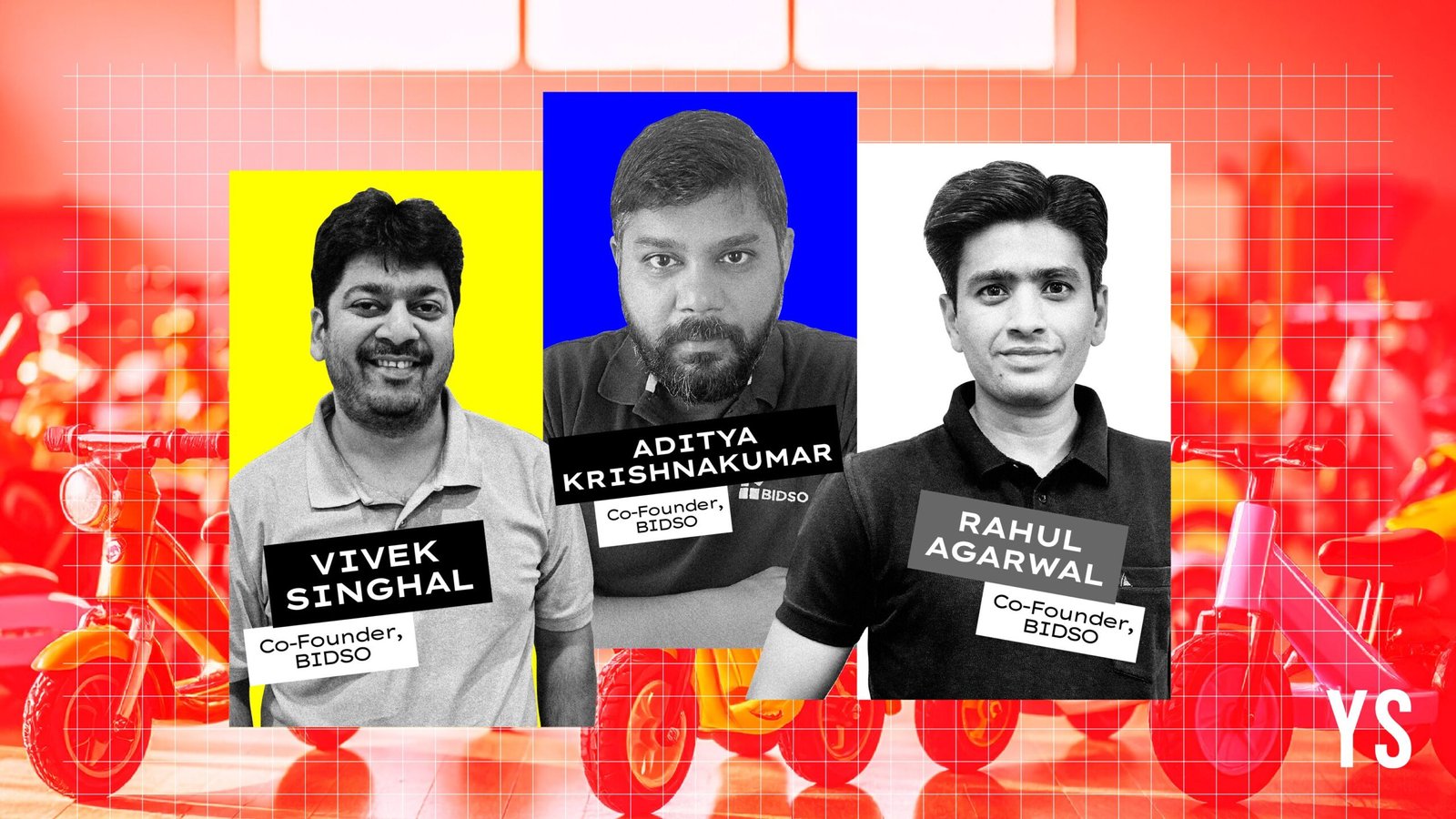
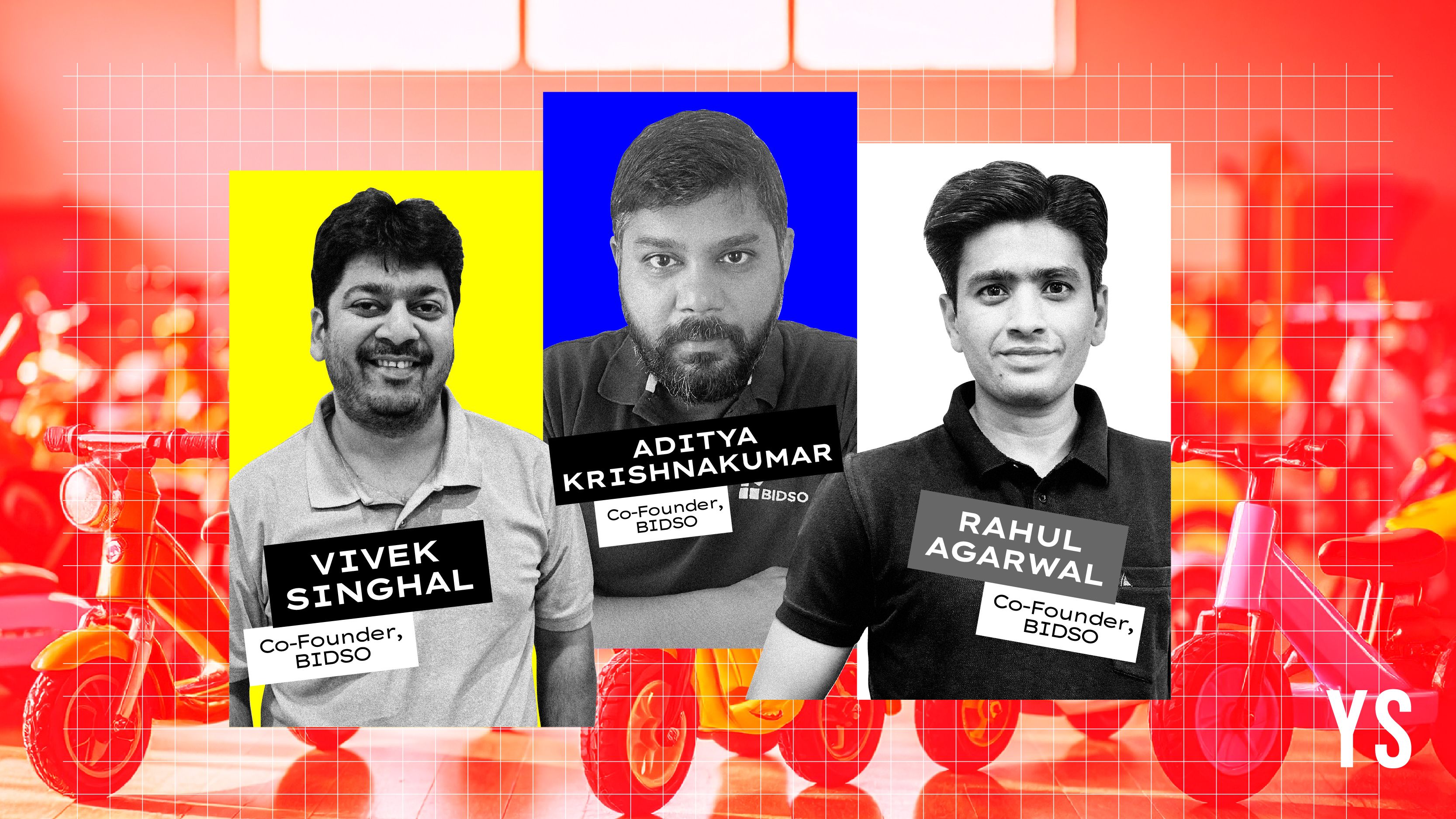
BIDSO was co-founded in 2022 by Vivek Singhal, Rahul Agarwal, and Aditya Krishnakumar, all alumni of XLRI Jamshedpur. Over a decade after graduation, the trio reunited, driven by shared experiences in supply chain and manufacturing inefficiencies during their tenures at companies like Flipkart and Udaan.
“The real bottleneck wasn’t distribution, it was manufacturing,” recalls Singhal, who led categories like sports and auto accessories at Flipkart. “Even large brands struggled to find reliable partners who could match global quality and timelines. That problem kept surfacing across product categories.”
Agarwal encountered similar problems at Udaan while leading sourcing for hardware and kitchenware. Fragmentation, lack of QC, and inconsistent delivery cycles were common issues. A casual conversation between the two revealed that the pain points were systemic, not circumstantial. Subsequently, the two joined hands to begin laying the groundwork for a new kind of manufacturing platform.
Soon after, Krishnakumar, who had just exited his previous venture, joined with deep operational and strategic expertise. “We didn’t need much convincing. We saw the same gaps, had complementary strengths, and trusted each other implicitly. It was the right team, right time, and the right problem to solve,” Singhal says.
From blueprint to production floor
Although BIDSO was formally incorporated in January 2023, its foundation was laid a year earlier. The founders bootstrapped the venture with Rs 1 crore of personal capital and took salary cuts of 20–25% over three years to build early infrastructure and validate their model before raising external capital.
Today, BIDSO operates across six manufacturing units—three in NCR, and one each in Rajasthan, Goa, and Kolkata, spanning over 1.75 lakh sq. ft. These units support a monthly production capacity of over 100,000 units across 1,000+ SKUs. The product range is tailored for children aged one to six, with wholesale pricing between Rs 500 and Rs 4,000.
“We’ve built BIDSO as a full-stack partner. From industrial design and prototyping to tooling and production, we manage everything. Our goal is to eliminate manufacturing complexity so brands can focus on marketing and distribution,” says Singhal.
BIDSO’s vertically integrated model is also supported by low minimum order quantities (MOQs) of 200–500 units per SKU, enabling brands to test and iterate new product lines without excessive inventory risk.
Customisation as a competitive edge
BIDSO offers customisation capabilities, catering to both OEM(Original Equipment Manufacturer) and ODM (Original Design Manufacturer) requirements. The brands can choose to modify existing ready-to-ship models or co-develop proprietary products from the ground up.
This includes advanced 3D modelling and prototyping for design validation, material flexibility across plastic, metal, or hybrid builds, and tailored branding and packaging with custom colour schemes and logo placements.
BIDSO also supports market-specific adaptations such as ergonomic enhancements, safety canopies, and adjustable components. Its full-stack ODM services extend to tooling, rapid prototyping, and ensuring compliance with regional certification standards.
The customisation is facilitated by a technology-driven workflow, utilising dashboards for real-time progress tracking, approval of samples, and review of multimedia QC reports to ensure design accuracy.
“Customisation is no longer optional—it’s expected. Whether it’s a new SKU or a localised variant, our system allows brands to experiment at speed and scale,” adds Singhal.
Technology, transparency, and trust
BIDSO’s proprietary Order Management System (OMS) is designed to give clients full visibility into every stage of the production lifecycle. From raw material sourcing and tooling to in-line quality check and dispatch tracking, clients have a transparent, dashboard-led view of operations.
“In traditional manufacturing, the absence of visibility creates friction and mistrust. We’ve reversed that dynamic. With our OMS, clients are part of the process—they see what’s happening in real time, almost like walking through the factory floor virtually,” Singhal explains.
The video-based inspections and 24-point QC reports, covering performance, aesthetics, packaging, and compliance, have contributed to low return rates and high client retention, even across BIDSO’s distributed production footprint.
In its early years, BIDSO had to build everything from the ground up—six factories, trained teams, and reliable raw material sources—all without an existing ecosystem to lean on. Unlike digital startups, nothing moved fast. “Every screw, every mould, you have to figure it out yourself. It takes months before you even see your first product,” Singhal adds.
Toy logistics brought their own headaches. Bulky products made storage costly and space-intensive. And winning trust from brands used to Chinese suppliers was a slow process. “In a market flooded with cheap imports, we had to prove ourselves, quietly, consistently, one batch at a time,” he adds.
IP-driven design and licensing strategy
Beyond production, BIDSO is investing heavily in product aesthetics and character-led design. Its 27-member in-house creative team is supported by a distributed network of freelance designers working across mechanical design, packaging, graphics, and finishing.
“Manufacturing today isn’t just about cost, it’s about emotion and identity. Especially in toys, characters and aesthetics drive purchase decisions,” he asserts.
The brand has signed multi-year licensing agreements with global IP holders like Disney, Warner Bros., Hasbro, Hello Kitty, and Chhota Bheem. This enables the company to produce officially licensed character-themed toys that comply with international IP standards.
.thumbnailWrapper{
width:6.62rem !important;
}
.alsoReadTitleImage{
min-width: 81px !important;
min-height: 81px !important;
}
.alsoReadMainTitleText{
font-size: 14px !important;
line-height: 20px !important;
}
.alsoReadHeadText{
font-size: 24px !important;
line-height: 20px !important;
}
}

“Licensing allows us to blend global appeal with Indian manufacturing agility. It’s a powerful combination that builds trust in both domestic and export markets,” he says.
Since launch, BIDSO has worked with over 30 brands, including Flipkart Private Labels, Lifelong, and FirstCry. A group of 8–9 anchor clients contributes 70% of monthly revenue, with repeat orders making up 80–87% of total business.
The brand currently clocks Rs 5 crore in monthly revenue, with average B2B order sizes ranging from Rs 10–15 lakh. The clients’ list spans emerging D2C brands to enterprise-scale players. While smaller brands get guidance on packaging and positioning, mid-tier partners experiment with SKUs, and large enterprises rely on BIDSO for managing scale and complexity.
Nearly 97–98% of raw materials, plastics, metals, and packaging are sourced domestically. Only 2% (mainly electronics) is imported from China. With in-house injection moulding and metal fabrication, BIDSO maintains strong control over timelines and quality.
Scaling Forward
In 2023, BIDSO raised $4.5 million in seed funding from Peer Capital and Maintenance DVC, along with strategic angels. The funds are being deployed to ramp up manufacturing capacity, deepen tech integration, and expand its IP portfolio.
“The first 18 months were about getting the building blocks right, design, tech, and trust. Now we’re entering the scale phase, exports, new categories, and deeper penetration into the toy ecosystem,” reflects Singhal.
Currently, BIDSO holds $5 million (Rs 41.75 crore) worth of confirmed export orders, with shipments to the US and Europe expected to begin by Q4 2025 or Q1 2026. Its mid-term roadmap includes adjacent categories like strollers, high chairs, and balance bikes, followed by entry into sanitary products and home appliances.
By 2027, the company is targeting 25 crore in monthly revenue, and aims to position itself as a trusted, tech-led manufacturing partner enabling brands to build design-led, resilient global supply chains from India.
The brand competes with players such as Funskool India Ltd. and Aequs. “Larger manufacturers are great at producing big volumes of standard products. But when it comes to making smaller batches, testing new designs, or responding quickly to changes, they often struggle. That’s the space we’re focused on, helping brands move faster without compromising on quality,” Singhal concludes.
Edited by Jyoti Narayan
