

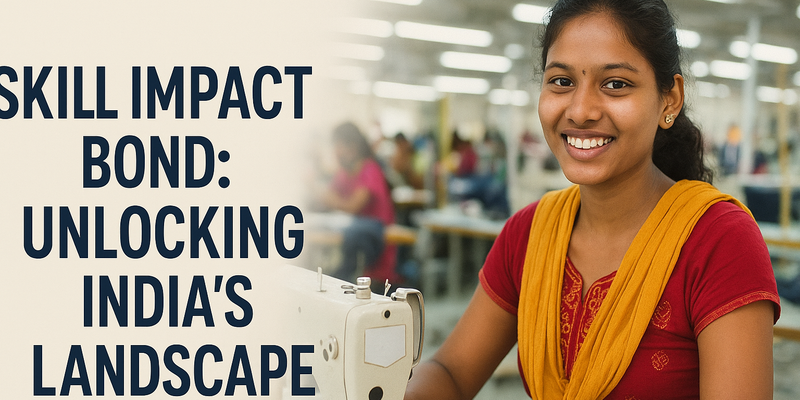
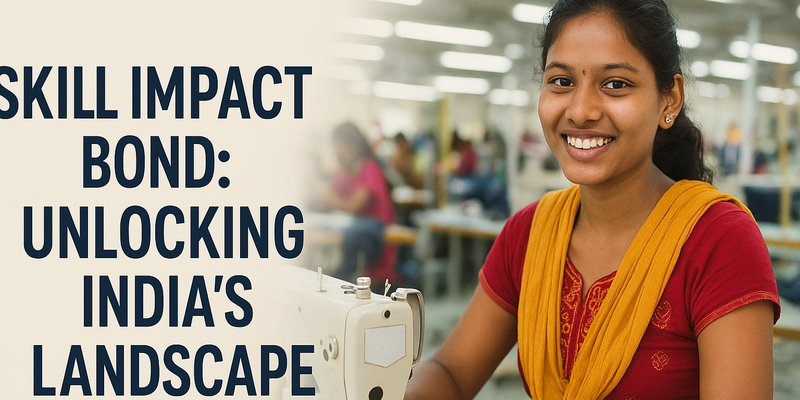
As India eyes its ambitious goal of becoming a $30-trillion economy by 2047, the focus on equipping its workforce with future-ready skills has never been sharper. Amidst traditional skilling schemes, one innovative model the Skill Impact Bond (SIB) is creating ripples by shifting the focus from enrolments to real job outcomes. Launched in 2021, this is India’s first Development Impact Bond (DIB) dedicated to skills training and job placement, with a special emphasis on women and marginalized communities.
What is the Skill Impact Bond (SIB)?
The Skill Impact Bond is a performance-based financing model where private investors bear the initial risk and outcome funders repay only if predefined goals are met. Partners such as the National Skill Development Corporation (NSDC), Michael & Susan Dell Foundation, and British Asian Trust have joined hands with funders like HSBC India, JSW Foundation, and Dubai Cares to make it happen. A third-party evaluator verifies every milestone, ensuring accountability and transparency.
Unlike traditional schemes that often measure success by the number of participants enrolled, SIB rewards placement and retention. Its objective is to skill 50,000 youth 60% of them women from rural or disadvantaged backgrounds—and ensure at least 30,150 retain jobs for over three months.
SIB 2025 Report: Key Findings
The 2025 Skill Impact Bond report showcases tangible progress. Jharkhand leads the enrolment tally with 27%, followed by Uttar Pradesh, Maharashtra, Odisha, and Telangana. Women dominate enrolment, particularly in apparel, but are also making inroads into retail, IT-enabled services (ITeS), and BFSI. Men are shifting away from construction and exploring automotive and telecom sectors.
Out of 23,700+ trainees, over 72% are women from vulnerable backgrounds. The female certification rate has touched 92%, and job placement stands at 81%. Self-employment among women has increased from 6% to 14%. Overall, 75% of all trainees secured jobs, with 60% staying employed beyond three months—well above the national average. Female employment rates have jumped from 35% to 48%.
However, the gender pay gap remains a challenge. Men earn between ₹12,400–15,700, while women earn ₹11,500–13,000, despite similar job outcomes.
Impact Beyond Numbers
The SIB story is as much about human transformation as it is about statistics. Puja from Bokaro now works as a CNC operator in Chennai. Ishrat balances a data entry job with her BA studies. Simran is on her way to becoming an air hostess. Sakshi from Jharkhand, once a school dropout, now earns ₹15,000 per month. These stories underline the program’s ability to turn training into tangible livelihood changes.
India’s Skilling Landscape: The Bigger Picture
Despite progress, the skilling ecosystem faces systemic challenges. According to the India Skills Report 2024, only 51.25% of youth assessed are employable. The Economic Survey 2023–24 shows that just 4.4% of youth are formally skilled, while 16.6% have informal training. ManpowerGroup’s 2025 Global Talent Shortage Survey found that 75% of employers globally struggle to find skilled workers. In India, there is a 60–73% demand-supply gap in roles such as machine learning engineers, data scientists, DevOps engineers, and data architects.
Underemployment is rampant, with over 50% of graduates and 44% of postgraduates working in low-skill jobs. Women, while constituting 40% of STEM students, make up only 14–27% of STEM professionals.
Challenges Holding Back Skilling in India
India’s skill development efforts are constrained by infrastructure and quality gaps, particularly in rural ITIs that lack trained instructors and modern equipment. There is a disconnect between industry needs and training curricula, with sectors like AI, green energy, and cybersecurity still underserved.
Private sector participation is limited, often hindered by regulatory hurdles, low incentives, and weak academia-industry linkages. Despite platforms like the Skill India Digital Hub (SIDH), skilling remains urban-centric, leaving rural India, home to 90% of the informal workforce—largely underserved. Only 10% of rural workers receive formal skill training.
Other Key Skilling Initiatives
India’s broader skilling landscape also includes initiatives like the Skill India Mission, PMKVY, PM-NAPS, India Skills Accelerator (ISA), PM Vishwakarma Yojana, SANKALP, STRIVE, DDU-GKY, and Recognition of Prior Learning (RPL). These programs aim to strengthen the country’s workforce, but their impact remains uneven without outcome-linked accountability.
What India Must Do Next
To truly transform skilling, India needs a Rural Skilling and Livelihood Mission that focuses on sectors like agri-tech, food processing, and crafts. Mobile training centres, digital literacy hubs, and village-level skilling models can bridge the rural gap.
The curriculum should align with Industry 4.0, green jobs, and the digital economy, with Sector Skill Councils co-designing courses for MSMEs and gig platforms. The Skill India Digital Hub must be expanded with AI-based multilingual content and 5G-enabled training hubs in smaller cities.
Women’s participation can be boosted through flexible training schedules, digital access, childcare facilities, grants, and mentorship. Vocational training should start at the school level under NEP 2020 and be linked to the National Credit Framework.
Finally, accountability must be central AI-driven dashboards, biometric attendance, and third-party audits can ensure transparency. Expanding outcome-based models like SIB across geographies and sectors can align funding with real employment impact.
The Skill Impact Bond proves that skilling is not merely about classroom hours—it’s about creating pathways to sustainable livelihoods. With a focus on measurable outcomes, gender inclusion, and community transformation, SIB is stitching together the pieces of a more equitable and future-ready India.
If scaled and adapted across sectors, it could be the blueprint for how India turns its demographic dividend into a demographic triumph.
