

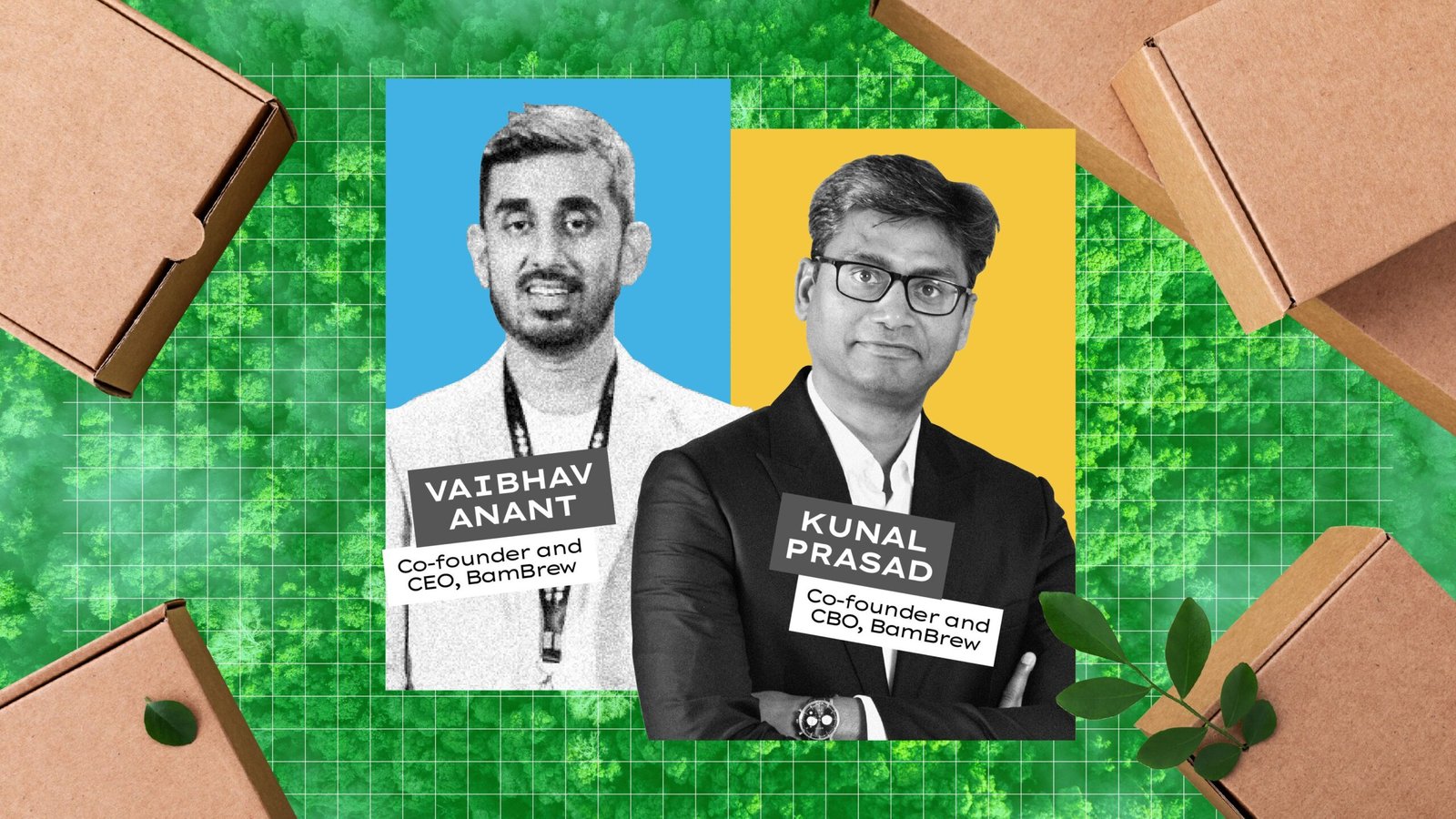

Bengaluru-based sustainable packaging provider began its journey in 2019 as a B2B company, offering ecommerce platforms and quick-commerce players alternatives to plastic packaging. Over time, it built a client base of over 100 companies, including Amazon and Flipkart.
Six years down the line, as regulations on plastic use tighten and consumer awareness of eco-friendly alternatives grows, Bambrew is ready to launch a consumer-facing line of products.
“We’ve worked with businesses for years; now it’s time to step into consumers’ homes,” says Kunal Prasad, Co-founder of Bambrew.
On August 15, the startup launched a direct-to-consumer (D2C) range including biodegradable garbage bags, bamboo paper towels, toilet rolls, sanitary disposal pouches, and pet waste bags, marking a new chapter in its sustainability journey.
Bambrew’s marketing campaign, called ‘Freedom from Plastic’, is a nod to both environmental responsibility and the symbolic importance of Independence Day. “We felt it was the right moment to start something that can impact homes across the country,” says Prasad.
He also says the company’s move into the consumer market is a natural next step as demand is growing at the individual level and people want to make sustainable choices at home.
The journey so far
Bambrew is led by Vaibhav Anant, Co-founder and CEO, along with Co-founder and CBO Prasad. In its early days, the company manufactured bamboo-based straws and small-scale paper alternatives. Over time, it shifted its focus in response to market needs.
“By 2020–21, we noticed a surge in ecommerce deliveries. Almost all of them used plastic mailer bags, courier sleeves, and packaging tape. We stepped in with paper-based solutions,” says Prasad.
The company’s growth has closely followed shifts in the market, from ecommerce to quick commerce, and now it’s ventured into items of everyday use.
“We’ve always tried to be aligned with where the industry is going and what gaps we can fill with eco-friendly materials,” explains Prasad.
Bambrew’s B2B products are available today in more than 10 countries. The company has a factory in Bengaluru. It also partners with other manufacturing units across India, which supply it with raw materials and manage production to optimise reach and reduce logistics costs.
.thumbnailWrapper{
width:6.62rem !important;
}
.alsoReadTitleImage{
min-width: 81px !important;
min-height: 81px !important;
}
.alsoReadMainTitleText{
font-size: 14px !important;
line-height: 20px !important;
}
.alsoReadHeadText{
font-size: 24px !important;
line-height: 20px !important;
}
}

Why D2C, and why now?
The decision to launch a consumer range wasn’t sudden; plans were afoot for more than a year.
“There were three major drivers,” Prasad explains. “First, increasing regulation on plastic use; second, growing awareness and interest from consumers; and third, the maturity of our material innovation.”
The D2C product line is designed around items of everyday use, which typically tend to be made of plastic in most Indian homes. These include garbage bags, kitchen towels, toilet rolls, and disposable pouches.
“These are daily consumption items. By replacing them with compostable or bamboo-based alternatives, even small changes can add up over time,” says Prasad.
Designed for function
Many sustainable products in the Indian market face criticism for being fragile or difficult to use. Prasad admits this is a challenge, and adds that Bambrew has tried to balance functionality with environmental impact as much as possible.
“Our garbage bags, for instance, are tested to hold eight to 10 litres of wet waste. We’ve done in-house lab testing and worked with third-party labs as well,” he says.
The startup’s R&D setup tests weight capacity, moisture resistance, and other factors that determine product performance in real-world settings.
Bambrew’s products use biophil, a proprietary biodegradable polymer, which is designed to break down fully into organic matter, unlike some so-called “eco” alternatives that disintegrate into microplastics, says Prasad.
“We don’t use PLA (polylactic acid) or similar compounds that are derived from food sources like corn or cassava, because they still degrade into nano-plastics,” he adds. “We aim to avoid plastics at the molecular level.”
The startup manufactures biophil in-house using raw materials as plant-based fibers and bio-based monomers sourced from partners in Europe, Japan, Southeast Asia, and India. The polymer can be adapted into at least 12 different forms, depending on the use case, offering both flexibility and cost efficiency.
Planning for scale and reach
Bambrew, which is currently valued at Rs 230 crore, raised Rs 90 crore in June this year in a Series B funding round led by Ashok Goyal Trust (run by the founder of EPL Global, formerly Essel Propack) and Japanese fund Asunaro.
The capital will be used for manufacturing upgrades, R&D, brand development, and customer outreach.
To meet its D2C goals, the startup is boosting its manufacturing, team, and distribution network. The company currently has a core team of 40 members and a floating workforce of 20-40 people at its factory. It plans to expand its workforce and infrastructure over the coming months.
Bambrew’s products are currently available on its website, as well as online marketplaces such as Amazon, Flipkart, and JioMart. The company also plans to sell its products through quick commerce platforms and reach customers directly through pop-up stalls in residential areas and office complexes.
“We are targeting Rs 100 crore in revenue over the next year, with 40% of that coming from the D2C side,” Prasad says.
Over three years, Bambrew plans to export its consumer products to Europe, Southeast Asia, the United States, and Japan.
.thumbnailWrapper{
width:6.62rem !important;
}
.alsoReadTitleImage{
min-width: 81px !important;
min-height: 81px !important;
}
.alsoReadMainTitleText{
font-size: 14px !important;
line-height: 20px !important;
}
.alsoReadHeadText{
font-size: 24px !important;
line-height: 20px !important;
}
}

Pricing and consumer awareness
Bambrew’s products cost 10–15% more than other biodegradable options.
Prasad says the company’s focus is on quality and durability. “We want customers to feel they’re getting value for their money. These aren’t meant to be luxury items; just better-designed everyday products.”
Consumer education and habit building are Bambrew’s priorities at the moment. It is running campaigns across social media, collaborating with sustainability influencers, and partnering with housing societies to spread awareness.
“Most people don’t switch because they don’t understand the difference, or they’ve had a poor experience with earlier products. We’re trying to address both,” says Prasad. “Once you start using an alternative that works, it changes your perspective. It becomes part of your routine,” he adds.
India’s biodegradable packaging market, which supports D2C sustainable products, was valued at about $3.51 billion in 2024 and is expected to reach $5.59 billion by 2033, according to a report by IMARC Group.
What’s next?
Bambrew’s longer-term plans include entering more segments such as dairy packaging, soap wrappers, and FMCG pouches, areas where plastic is still the norm. The company is also working on integrating recyclability into some of its materials, in addition to compostability.
Going forward, Prasad says India can become a global leader in affordable, functional sustainability. “We already live with a mindset of reuse and low waste in many parts of the country. If we back that with strong material innovation and manufacturing scale, there’s a lot we can offer to the world,” he says.
Bambrew’s goal is not just to be seen as an “eco-friendly” brand, but also to create products that work, last, and fit into everyday life. “We want sustainability to be invisible, in the sense that it just becomes normal,” Prasad signs off.
Edited by Swetha Kannan
