

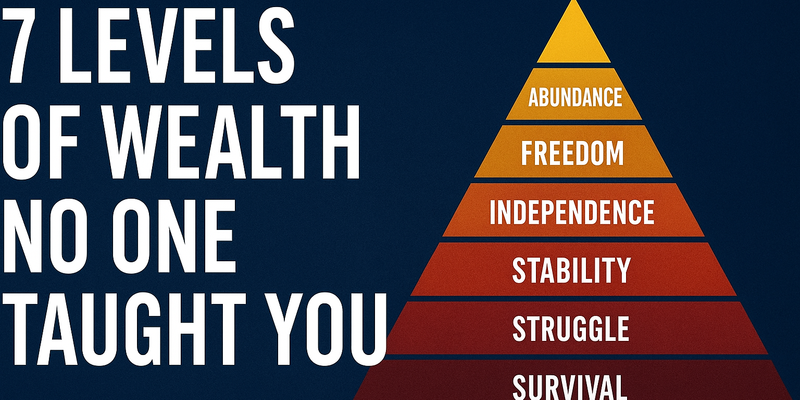
Why does money feel like a completely different game for each person? For some, it’s an endless grind just to afford the basics, while others earn millions in their sleep, wealth that can last generations. The truth is, we are not all playing the same game. Wealth exists in levels, and most people don’t even realise which level they’re currently in. Some rise, some fall, and many stay stuck somewhere in between, depending on circumstances, opportunities, and mindset. This guide breaks down the seven levels of wealth in a way that’s relatable, globally relevant in 2025, and rooted in real-world data.
Level 1: Survival
Survival is the most challenging level, where every day feels like a battle to make ends meet. Rent, bills, and food compete for limited income, and even the most frugal lifestyle isn’t enough to cover expenses. People in this level often come from families trapped in generational poverty, with limited access to education and few job opportunities. Many take on unstable, low-paying jobs or turn to borrowing sometimes at high interest rates only to fall deeper into debt.
According to the United Nations, as of 2025, 808 million people live in extreme poverty, surviving on less than $3 a day (PPP 2021). If we include those who earn slightly more but still lack essentials like food, clean water, and basic education, the number rises to over 1.1 billion. Escaping this stage is extremely difficult, but small steps such as basic budgeting, minimal saving, or upskilling can be the start. Ronald Read, a gas station attendant and janitor, proved this by living frugally and investing modestly for decades, eventually leaving behind $8 million at his death.
Level 2: Struggle
At the struggle stage, you are no longer drowning, but you’re still far from safe. You can cover basic expenses most months, and there may even be a little left over, but a single unexpected setback a medical bill, car repair, or job loss could push you back into survival. Many in this level still have debt, live on tight budgets, and avoid unnecessary purchases.
A 2025 financial report revealed that even high earners making over $200,000 annually often live paycheck to paycheck due to lifestyle inflation and poor financial planning. Struggle is as much a mindset challenge as a financial one; money is always at the back of your mind, and any disruption feels like a looming threat.
Level 3: Stability
Stability means finally having breathing room. You can pay bills, manage small emergencies without panic, and start building an emergency fund. Modest investments become possible whether in mutual funds, stocks, or digital assets and your lifestyle includes occasional luxuries like outings or small upgrades at home.
However, stability is not security. If you were to lose your job, your savings might last only a few months before you slide back into struggle. At this stage, the priority is building stronger financial buffers and diversifying income sources to protect against future instability.
Level 4: Security
Security is stability with a safety net. At this level, you’re not just afloat, you’re protected. You have more substantial savings, insurance coverage, and possibly own your home. Losing your job would not cause immediate panic because your emergency funds could sustain you for several years.
You’re actively investing, building passive income streams, and thinking about long-term goals like retirement or your children’s education. Lifestyle upgrades like buying quality furniture or replacing appliances before they break come without guilt. While you still work for a living, you’re no longer vulnerable to life’s sudden disruptions.
Level 5: Independence
Financial independence is when passive income through investments, rental properties, or other assets—can fully cover your living expenses. Work becomes optional rather than mandatory. Many in the FIRE (Financial Independence, Retire Early) movement aim for this stage, where daily decisions are no longer dictated by financial necessity.
At this level, you may not afford the extravagance of private jets, but you can live comfortably without checking price tags for everyday purchases. Your focus shifts from earning money to managing it wisely, optimising taxes, and protecting your wealth.
Level 6: Freedom
Freedom is the advanced form of independence. You have complete control over your time, choosing projects, travel, and hobbies purely for personal fulfilment. Luxury here is defined by choice rather than display flying first class, staying at five-star hotels, or retreating to a peaceful countryside because it brings you peace.
Wealthy individuals at this level often engage in philanthropy, passion projects, or creative ventures. Money stress disappears entirely, and the question, “Can I afford this?” is replaced by, “Do I even want this?”
Level 7: Abundance
Abundance is the pinnacle reserved for the ultra-wealthy, often the top 1% or even 0.01%. Wealth here translates into power: ownership of multiple businesses, global real estate portfolios, private equity stakes, and influence over markets or policies.
Individuals at this level have the resources to build legacies, fund large-scale social initiatives, or even shape political landscapes. The focus often shifts from personal gain to system-level change either publicly or behind the scenes. In 2025, as inequality reaches record highs, leaders at this level face growing calls to use their wealth for the collective benefit.
Global Wealth Context
While some climb to abundance, nearly half the world still lives in poverty. Poverty reduction has slowed in recent years, with Sub-Saharan Africa still recording poverty rates above 45%. Over 1.1 billion people experience multidimensional poverty—lacking access to healthcare, education, and sanitation. Climate change, inequality, and fragile economic growth threaten to widen these divides.
In this context, moving even from survival to stability can dramatically improve quality of life. Wealth is not solely about income; it’s about planning, resilience, and strategic growth.
Your wealth level is not fixed, it’s a spectrum that shifts with your decisions, opportunities, and external conditions. Moving from one level to the next is often less about sudden windfalls and more about consistent habits: saving regularly, managing debt, diversifying income, and investing with discipline.
You don’t need to reach abundance to live well; even a shift from struggle to security can change your life profoundly. As the saying goes: “If they say you can’t, they’re showing their limits—not yours.” Step by step, you can climb the wealth ladder—and maybe one day help redesign it for others.
