


India’s jewellery market is undergoing a glittering transformation, driven by the rise of lab-grown diamonds. Buyers today are looking beyond jewellery as an investment; they want affordable and sustainable pieces for everyday wear.
According to Precedence Research, the global lab-grown diamonds market is projected to grow from $29.73 billion in 2025 to nearly $97.85 billion by 2034, at a CAGR of 14.15%. The report noted that millennials and Gen Z are driving this growth, opting for eco-friendly alternatives to mined diamonds.
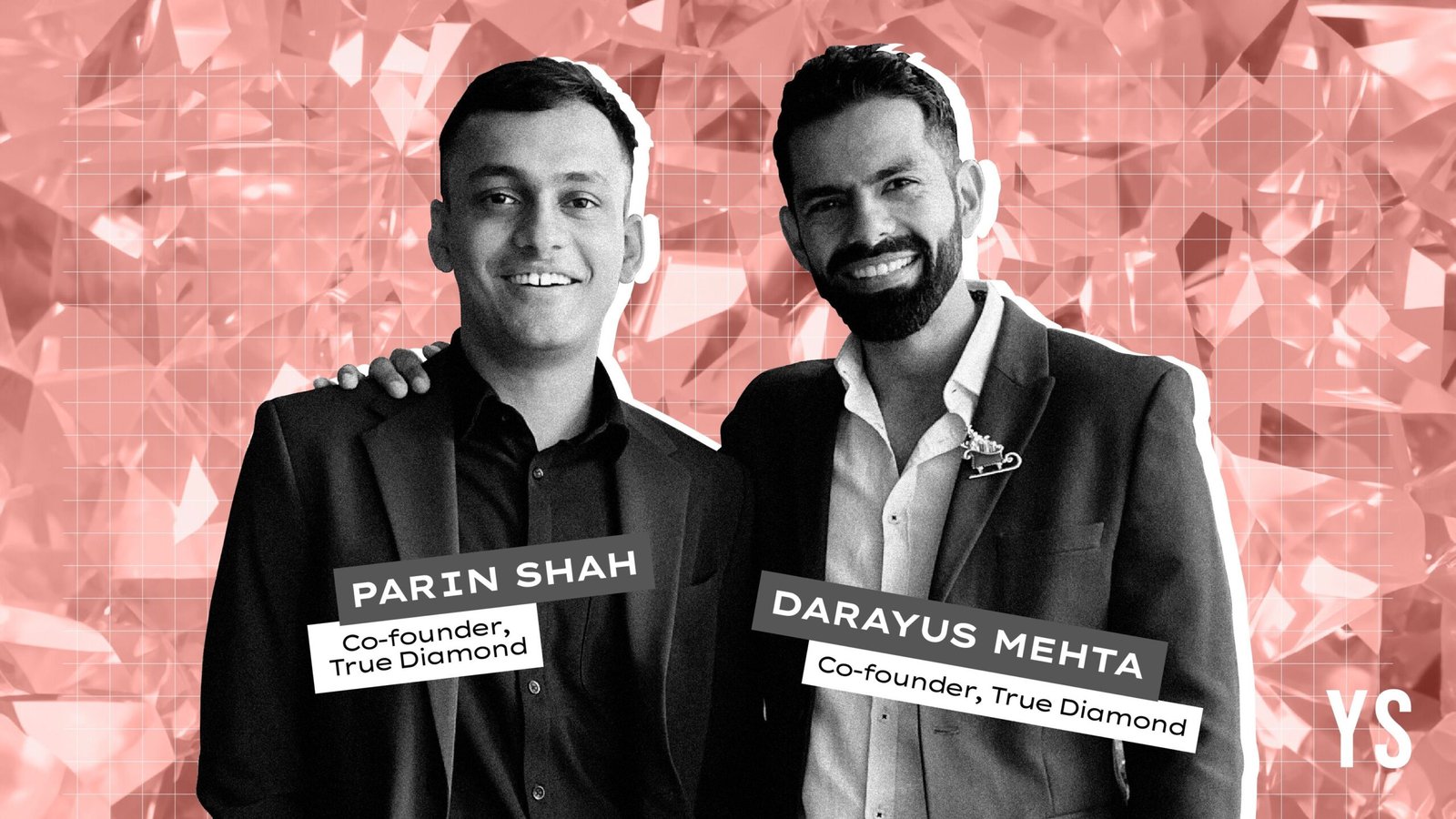
True Diamond, a Mumbai-based lab-grown diamond startup founded in 2024 by Darayus Mehta and Parin Shah, is cashing in on the phenomenon.
The startup began as a bootstrapped venture with the founders investing Rs 1 crore at its inception. In June 2025, the brand raised Rs 26 crore in a pre-Series A funding round led by India Quotient, with participation from existing investors, Titan Capital Winners Fund and Huddle Ventures. It is channelling these funds directly into marketing and expansion plans.
Bold, custom jewellery
“True Diamond creates fine jewellery with fun, contemporary designs for the modern woman—young, bold, and edgy,” True Diamond co-founder Darayus Mehta tells YourStory. Within its first year, the Mumbai-based brand launched over 5,000 designs, having achieved a 1.7x repeat customer rate, with many buyers returning for a second purchase. True Diamond’s pieces have also been donned by celebrities including Tara Sutaria, Pooja Hegde, Ahsaas Channa, and Trinetra Haldar, among other notable personalities.
It offers unique collections like the Lana Del Rey series, blending vintage glamour with nostalgia, along with black diamonds, experimenting with rare white-and-black combinations in India.
“Young buyers preferred modern finishes that align with their personal identity,” Mehta explains. He notes that yellow gold was seen as “old-fashioned,” so the brand introduced champagne gold, a mix of white and yellow gold, which is popular globally and suits Indian skin tones well.
True Diamond sells through its website and via its three physical stores in Mumbai, Hyderabad, and Noida. The brand also offers customisation with respect to diamond size, shape, clarity, settings, gold types, and finishes. “We’ve created black gold pieces, and even crafted jewellery in 9-karat gold when requested, instead of the standard 18K or 14K,” Mehta says.
The brand recently introduced “floating diamond” rings, an in-house concept where stones appear suspended in the air.
True Diamond procures all its lab-grown diamonds from Surat, using only high-quality CVD diamonds (grown in a laboratory using the Chemical Vapour Deposition method) and avoiding imports from China. Once the design is finalised, a 10-14-day process helps create a detailed CAD (online 3D model) of the piece. After approval, production begins, and the diamonds are sent to manufacturing partners for final production. The 40-member team then manages quality, customer feedback, and delivery.
.thumbnailWrapper{
width:6.62rem !important;
}
.alsoReadTitleImage{
min-width: 81px !important;
min-height: 81px !important;
}
.alsoReadMainTitleText{
font-size: 14px !important;
line-height: 20px !important;
}
.alsoReadHeadText{
font-size: 24px !important;
line-height: 20px !important;
}
}

Redefining rings in the Indian market
True Diamond functions with an exclusive focus on rings, catering to a niche segment within the broader jewellery market. Mehta points out that rings are India’s largest jewellery category and one of the most emotional purchases a person can make. “No legacy brand truly owns this space, so instead of trying to be a jack of all trades, we’ve chosen to be a master of one: rings,” he says.
The company offers a wide range of designs, from delicate, dainty pieces to bold statement styles. It has also introduced the Portuguese cut diamond to the Indian market, most often seen in antique and vintage jewellery from the early 20th century. Its speciality lies in having 160 or more facets, nearly three times that of a traditional 57-facet diamond, which results in an unusually rich sparkle, the founder explains.
“Our ability to bring novelty and personality to the rings category ensures that anyone thinking of buying a ring will consider visiting us at least once before making a decision,” Mehta says.
.thumbnailWrapper{
width:6.62rem !important;
}
.alsoReadTitleImage{
min-width: 81px !important;
min-height: 81px !important;
}
.alsoReadMainTitleText{
font-size: 14px !important;
line-height: 20px !important;
}
.alsoReadHeadText{
font-size: 24px !important;
line-height: 20px !important;
}
}

Scaling through an omnichannel strategy
The company moved from an online-only presence to opening its three experience stores within its first year. Its sales are now evenly split between online and offline channels. Mehta says an omnichannel strategy was essential to accelerating growth, an approach that has proven successful for competitors like CaratLane and BlueStone. “Jewellery is a highly tactile category, and most customers prefer to see and feel products before buying,” he adds.
The online-first, omnichannel approach allows True Diamond to experiment with IPs quickly and cost-effectively. When an IP gains traction online, the collection is scaled up and introduced offline. “We start small, test the response, and if it works, we go big. This constant innovation keeps the brand fresh, intriguing, and relevant to customers,” he says.
Innovating through challenges
The Mumbai-based startup attributes its growth to its innovation-first approach, “Not every experiment works, but all we need is one or two successes to make a big impact,” Mehta says.
However, on entering the relatively new lab-grown diamond industry in India, the company faced challenges around the perceived resale value of such diamonds and in building trust in a premium category long dominated by legacy players. The brand has attempted to resolve these issues through rapid innovation and a strong marketing strategy.
True Diamond has continued to prioritise sustainable, steady growth, reaching break-even within about six months of inception. “Jewellery has the power to spark joy in the smallest moments—like catching a glimpse of your ring while typing. That’s the feeling we strive to create,” Mehta says.
Looking ahead, it plans to launch 50 stores across India over the next 2-3 years. The brand expects offline sales to grow as it scales, using a test-and-scale approach.
Edited by Kanishk Singh
