

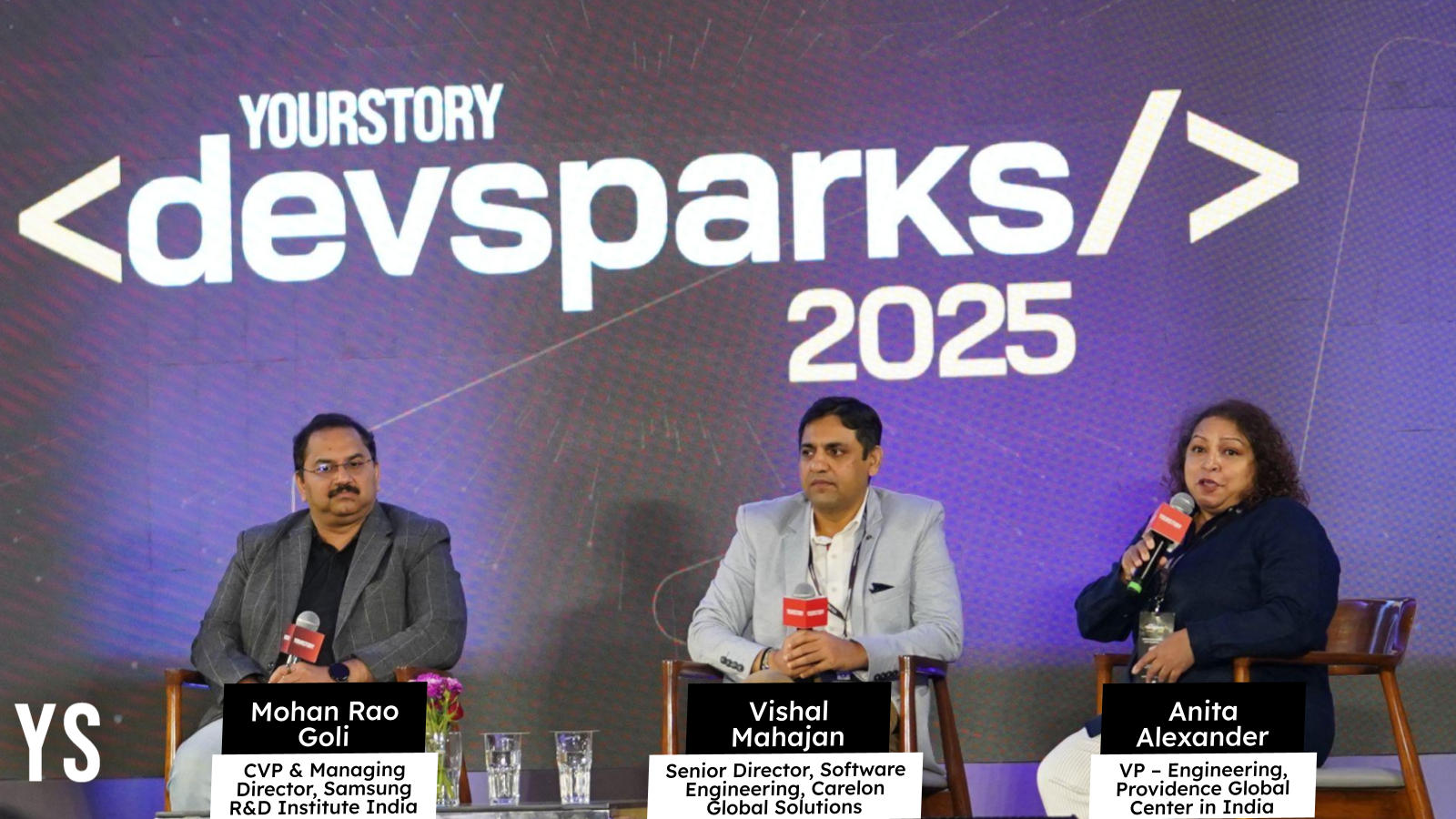
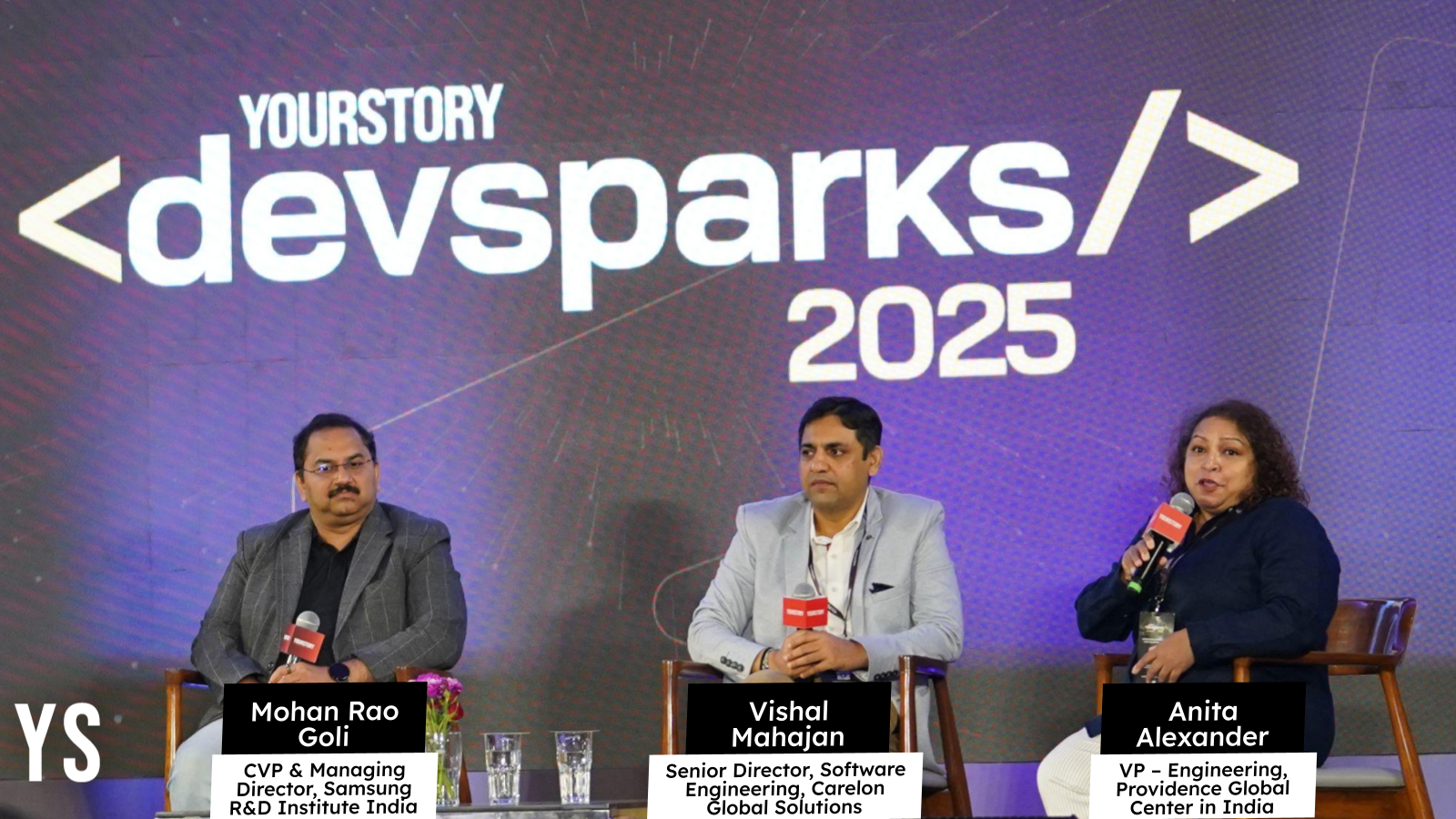
Data ethics and security are the foundation of innovation, not an afterthought. This was the common refrain from senior technology leaders during a recent panel discussion at DevSparks Hyderabad 2025, YourStory’s event focused on the developer ecosystem.
The big takeaway from the event was this: Generative AI and predictive analytics can scale only if ethics and security are embedded from the start.
Anita Alexander, VP – Engineering (Healthcare Intelligence), Providence Global Center in India, said, “The true breakthrough is using data responsibly so we can make healthcare simpler, safer, and more personal.”
The panellists from Samsung’s R&D Institute in Bengaluru, Elevance Health’s Carelon Global Solutions, and Providence India also talked about AI moving from experimentation to everyday operations.
Mohan Rao Goli, CVP & Managing Director, Samsung R&D Institute India, Bangalore (SRIB), underlined the scale of the company’s AI work, “Almost 60 to 70% of the AI technology engines are developed in Bangalore itself.”
Goli pointed to tools such as a camera SDK and a neural SDK that enable developers to harness device-level computer vision and efficient on-device acceleration.
From the healthcare side, Vishal Mahajan, Senior Director of Software Engineering at Carelon Global Solutions (part of Elevance Health), stressed upon commercial scale and urgency. “Data is a new oil that runs the company… because the amount of data that we produce on a daily basis, it’s humongous.”
Mahajan urged firms to focus on converting vast datasets into personalised, scalable insights for members, patients, and providers.
Device-edge vs cloud
Not every workload belongs in the cloud, the experts concurred.
Samsung’s Goli emphasised the importance of on-device models and performance balancing. The company’s neural SDK, for instance, is designed for cases where latency, privacy, or power efficiency make local execution preferable.
He explained that many AI models are purpose-built for small devices. “On any Galaxy phone, there are more than 150 AI models running on-device, each serving a different purpose for the user,” he noted.
Providence’s Alexander highlighted how serverless architecture and generative AI can deliver timely clinical insights. She described the marriage of domain expertise and cloud-native tooling as an enabler for both predictive analytics “to see if a patient will make up for their appointment” and for combining genetic sequencing with clinical insights to support proactive, precision medicine.
The speakers at the panel likened data to raw material, with platforms and governance being the refinery.
Alexander said Providence invests in “scalable data platforms” that combine the flexibility of data lakes with the structure of warehouses, while ensuring role-based access, so that clinicians and operations teams can act quickly and safely.
Samsung’s Goli echoed the importance of governance. He described practices to acquire and abstract training data with consent and in line with GDPR (General Data Protection Regulation) and licensing rules, including collaborations with universities to create high-quality, engineered datasets for model training.
Goli minced no words while referring to models without proper inputs. “The models without having the training data are absolutely nonsense.”
Hiring and skills
The panellists agreed that while hiring would continue, the skill-sets required are changing.
For Samsung, the emphasis is not just on coding but on problem-solving. Goli explained that new hires are assessed through a software certification test designed to evaluate their “algorithmic thinking, design thinking, and how they structure problems,” rather than looking at pure coding ability.
He said Samsung has spent the last five years upskilling its workforce in AI so that engineers who are already strong in their domains can become “AI-ready.”
Mahajan of Carelon struck a more optimistic tone about continuity in the skills market. “Java, .NET, Python, name the skillset, it is still going to remain,” he said.
At the same time, he urged developers to adapt. “We need to start utilising co-pilots as we move forward in our day-to-day life… AI is just an enabler to your job, the way we once adopted the internet… This is the time each one of us needs to start adopting AI at scale.”
For Alexander, the hiring challenge revolves around purpose and preparation. She explained that Providence runs dozens of curated programmes to help employees—whom the organisation calls “caregivers”—develop not only technical skills but also behavioural and domain expertise.
This, she reiterated, ensures the workforce remains future-ready regardless of job titles. “Regardless of what we call the title, our people are still going to be relevant as we move forward.”
Cybersecurity
A major concern for today’s enterprises is security.
Alexander insisted that cyber security is “everybody’s job, not just the department that’s working on it.”
She explained how Providence has built a global cyber defence structure with round-the-clock threat monitoring, sandbox environments for safe experimentation, and a guardrail council, bringing together the chief information security officer, chief data officer, and chief ethics officer, to set clear rules for the use of AI.
Internal, controlled LLM (large language model) deployments are now a key risk-mitigation strategy in organisations.
Goli explained Samsung’s approach: Developers are provided with an internal AI model trained on Samsung-generated code, while enterprise teams also have access to in-house versions of popular tools.
He added that Samsung continues to rely on Knox, its ‘military-grade’ security framework, and is fine-tuning LLMs with security-specific data to better detect and counter threats.
Mahajan of Elevance echoed the need for proactive defence, stressing that threat monitoring at scale has to be done in real time and machine learning models should be able to automatically detect and act on risks. Elevance, he said, deploys internal versions of LLMs with added security layers to ensure data does not leave the premise.
The overarching lesson from Devsparks was this: technology alone will not deliver better outcomes; the systems of governance and security surrounding it will.
As Alexander summed up, “We prioritise data and AI governance so that security, compliance, and ethical use of AI are absolute non-negotiables.”
Edited by Swetha Kannan
