

How do we help developers navigate both the challenges and opportunities of AI? How do we make sense of its potential? And how do we reduce the complexity and confusion as AI becomes deeply embedded in the software development lifecycle?
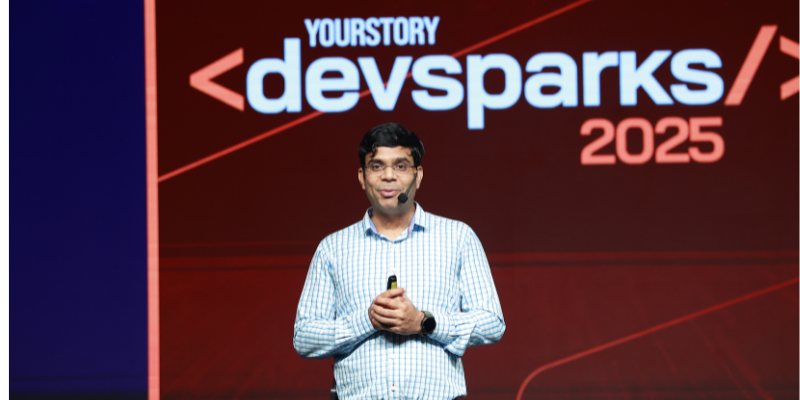
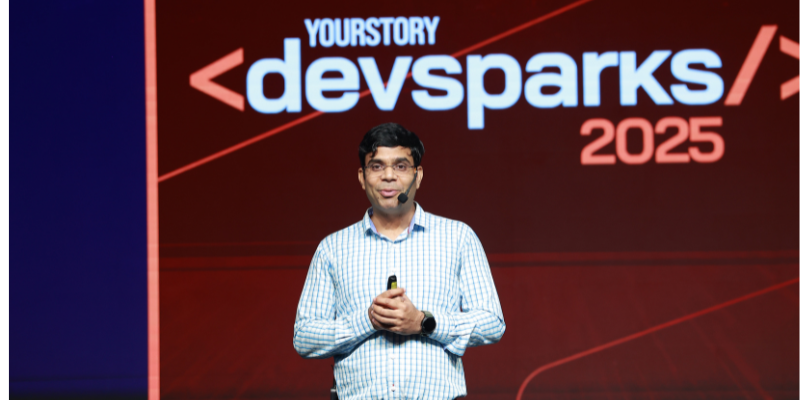
These were the questions explored by Anupam Mishra, Director, Developer Programs at AWS India and South Asia, in his lightning talk titled ‘A View from the Top: Introducing Devs to the Future of Software’ at DevSparks Bangalore 2025.
Tracing AI’s evolution in software development
Mishra began by charting how AI has reshaped software development in recent years. He recalled an earlier phase where developers were creating chatbot after chatbot until autonomous agents began taking over routine tasks.
“Today, a swarm of agents can work together to complete manual processes,” he observed. “Many companies now build autonomous systems that can categorize and resolve support tickets without any human intervention.” This shift, he noted, poses an important question for developers: “Have you ever thought—a big change is coming to my industry, and I don’t know how to be prepared?”
Urging continuous learning, Mishra said that developers are starting to question their roles, what parts of the process they truly control, and what the future of development might look like.
AI-managed vs AI-assisted development
Mishra then delved into the two main approaches developers are currently using with Generative AI: AI-managed and AI-assisted development.
To illustrate, he asked the audience, “How many of you use GenAI for coding?” About 80% of the room raised their hands.
In the AI-managed approach, developers simply describe a problem and expect GenAI to generate a complete solution. “This works up to a point,” said Mishra. For example, GenAI can quickly generate a simple to-do app or even a Tetris game. “My daughter and I built one in under five minutes,” he shared. But GenAI struggles with more complex applications. “You can’t build a shopping app like Amazon this way. It won’t work. You can’t ask it to build a system that handles 20 tasks. AI just isn’t there yet. This approach works for toy projects or proof-of-concepts.”
Even when GenAI produces complex code, it requires constant iteration. “You cannot take ownership of the code using this approach,” Mishra emphasized.
The AI-assisted approach, where developers guide AI by providing designs, tasks, and logic, also has limitations. While it can help engineers generate functions, create test cases from a BRD, or help product managers with wireframes, it only improves productivity by 10–15%. Mishra explained that the limited productivity gains are because most developers spend only about 30% of their time actually coding. “Most developers spend just 30% of their time actually coding,” Mishra said. “You’re not leveraging AI across the entire software development lifecycle (SDLC), so whatever time you save in coding is lost in outdated manual processes from the pre-AI era.”
Rethinking development in an AI-first world
To address this gap, AWS has been asking bold questions: “How do we bring about a paradigm shift where organisations can release features 2x, 3x, or even 5x faster, without compromising on quality or developer engagement?”
Over the past year, AWS has launched a dedicated initiative focused on developers, working closely with customers to tackle real-world problems. Out of this effort, a new AI-first model of development is emerging – one that rethinks the very structure of product creation. “We stopped thinking in terms of agility, sprint planning, retros, or daily scrums – all constructs from a pre-AI era. We asked ourselves: What does development look like in an AI-native world?” Mishra said.
Mob elaboration and mob construction: A new approach
One of the most impactful concepts AWS has adopted is mob elaboration. In this approach, engineers and product managers sit together and use AI to define a product, create the BRD, list acceptance criteria, and outline all roles involved. “What usually takes weeks with a single PM working in isolation now gets done in 2–3 hours with greater clarity,” Mishra said.
Another concept, mob construction, involves breaking a project into smaller, manageable units using AI, then assigning each to a cross-functional team. “The lines between roles are blurring,” he said. “A product manager, engineer, DevOps lead, and infrastructure member come together to build the product. We’ve seen teams complete in three days what would otherwise take three months.”
Building the future, together
Mishra concluded with a call to action for developers: to embrace change and support one another in discovering new possibilities. “There’s a lot of work to be done,” he said. “But I believe the developer community will shape the future together.”
