

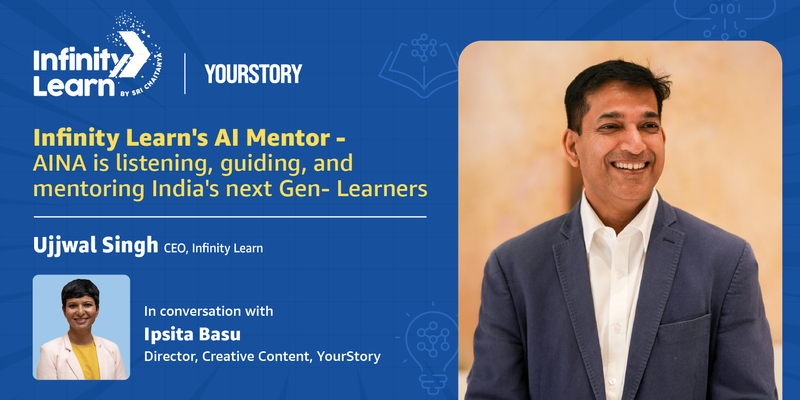
Over the past decade, India’s edtech sector has gone from an emerging curiosity to a multi-billion-dollar force shaping the future of education. From blackboards to smartboards and from physical classrooms to AI-driven learning platforms, the shift has been swift and significant. The market, currently valued at $7.5 billion is likely to cross $29 billion by 2030, according to a report by the Internet and Mobile Association of India (IAMAI) and Grant Thornton Bharat.
But for Ujjwal Singh, Founding CEO, Infinity Learn by Sri Chaitanya, the real opportunity in edtech lies not in expanding access but in delivering measurable outcomes. “Whether you’re teaching offline or online, the responsibility remains the same — to change a learner’s life. And that change should be measurable,” says Singh.
Breaking through the noise
Backed by the rich 40-year legacy of Sri Chaitanya that boasts over 1000 schools and junior colleges, Infinity Learn was launched in 2021 as the group’s digital learning arm. It entered a crowded market of over 8,000 edtech players, including giants like BYJU’S, Vedantu, and Unacademy.
But instead of competing on flashy app features, Infinity Learn took a different approach. “We built on three pillars: credibility, technology, and results,” Singh explains. “We aren’t here to be just another platform. We’re here to improve academic outcomes, especially for K-12 and competitive exam learners.”
That focus is already showing results. Infinity Learn’s success is driven by a paid learner base of approximately close to a million students. The platform has a hybrid model spanning online subscriptions and more than 50 offline centers spread across over 20 Indian cities of which 60% of its learners come from metro cities, Tier 2 and Tier 3 towns account for 40%; and they’re growing at a significantly faster rate.
The platform primarily serves students from Grades 6 to 12 and those preparing for competitive exams like JEE and NEET. And it’s not trying to be everything to everyone. Instead, it is laser-focused on academic performance and tangible improvement.
“Today’s learners are digital natives. They don’t just use technology, they expect it. But using tech for delivery is just one piece. The bigger challenge is personalization,” Singh explains.
The “why” behind Infinity Learn
For Singh, the motivation to build Infinity Learn has always been deeply personal, rooted in frustration with how traditional metrics in edtech often miss the real point.
“The edtech market celebrated Daily Active Users and video minutes. But the question that haunted me was, did it move the needle? If a student watched 100 videos but still failed Physics, had we truly served them? Baccha sikha ki nahi?” he says.
He recalls an incident from a parent-teacher meeting that left a lasting impression.
“A student had scored 78 out of 100 in Math. The teacher’s only feedback was: ‘Study more. Do better.’ No guidance on what to focus on, which concepts to revisit, or how to improve. It struck me that if this were healthcare and you went to the doctor with a fever, would they just say, ‘Be healthier’? Of course not. You’d get a diagnosis, a prescription, and a recovery path,” Singh remarks.
That analogy shaped his vision. “In learning, the equivalent is assessment, followed by actionable feedback and a personalized improvement plan. That’s what great mentors and teachers provide: not just evaluation, but direction. That moment became a turning point for me,” he says. “It made me realize that access to learning isn’t enough. We owe every learner precise next steps, a step-by-step improvement plan, and close monitoring. That’s why we built AINA, not just to deliver content but also to offer insight, empathy, and a path forward.”
Meet AINA, the AI mentor changing the game
With its foundation laid, Infinity Learn is now focused on scaling its next big innovation: AINA by Infinity Learn, a generative AI mentor designed to provide context-aware, emotionally intelligent, and data-driven academic support.
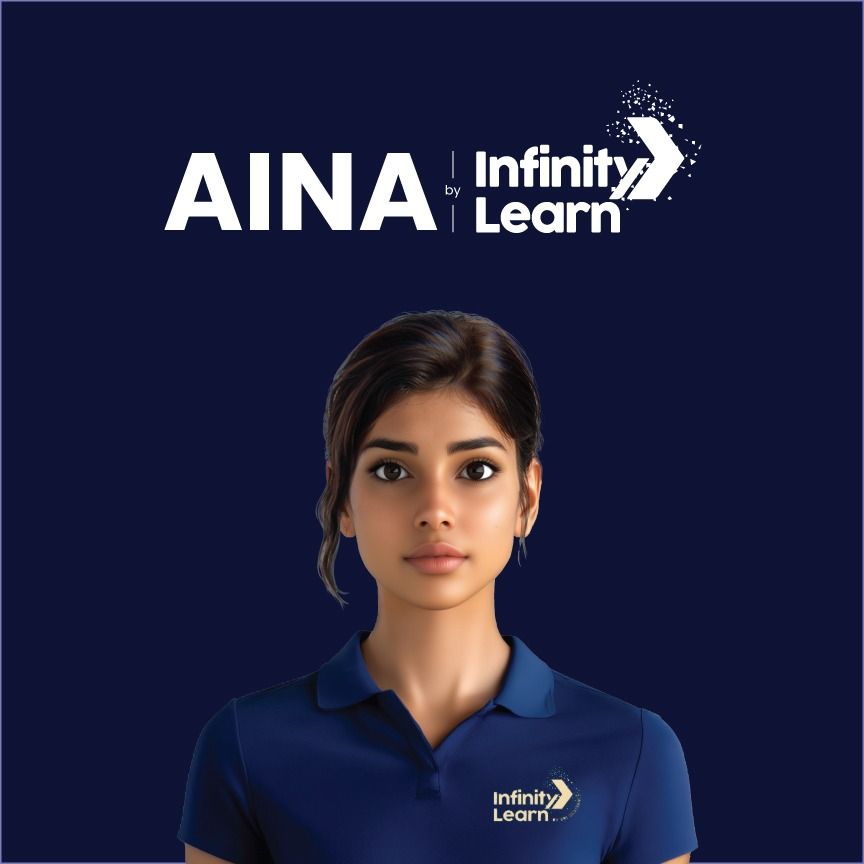
But AINA isn’t just a chatbot with a syllabus. She’s modeled as a mentor friend or an elder sister-like figure who guides with compassion but doesn’t hesitate to push you when needed. Built in collaboration with Google Cloud (as technology partner) and the International Institute of Information Technology (IIIT) for pedagogy research, AINA is trained on over 18 years of academic performance data and curriculum intelligence.
“She can detect learning gaps, analyze test performance, and even identify if a student is falling behind because they skipped a concept video,” says Singh.
Unlike open-ended chatbots, AINA operates in a closed-loop system, tightly integrated with the Infinity Learn platform. This ensures content alignment, student safety, and zero distractions. If a student tries to deviate, she gently nudges them back to their academic path.
Scaling AINA to 10,000+ schools
We are proud that AINA is voice enabled and now accessible to both paid and non- paid subscribers. Infinity Learn has even bigger plans for AINA, as it is in active conversations with state education departments to bring AINA into government-run schools in underserved regions.
“Our goal is to democratize mentorship. Every learner deserves a guide, and AI allows us to scale that human-like support to millions,” Singh says.
Augmenting, not replacing, teachers
One of the most common fears in the AI-in-education debate is whether it will replace teachers. Singh is firm in his rebuttal.
“AI is a co-pilot. It doesn’t replace teachers, it amplifies them. Think of it as extending the reach of a great educator to every student, regardless of geography.”
This philosophy echoes India’s National Education Policy (NEP) 2020, which encourages AI-based tools for adaptive learning, diagnostics, and personalized remediation. Singh says nearly 30% of educators on the Infinity Learn platform already use AINA for lesson planning, student tracking, and feedback loops.
Broader vision: Impact with soul
For Singh, AINA is only the beginning. Infinity Learn’s larger mission is to reimagine education at the intersection of “access, affordability, and outcomes,” ensuring that every learner has not just access to content, but a mentor.
That philosophy also drives the team’s work at the grassroots level, where they are prototyping models of holistic learning in underserved communities.
“True impact isn’t just about scale, it’s about soul,” Singh reflects. “It’s about building a future where learning is not only smart, but deeply human.”
As he puts it, “Technology should not just facilitate learning, it should strengthen it.”
