

The world of software engineering is undergoing its biggest shake-up in decades. For years, methods like waterfall and agile defined how developers built applications. These frameworks lasted long enough for teams to adapt, refine, and deliver. But with the arrival of generative AI, the ground beneath software development is shifting at a pace never seen before. Estimation methods no longer hold, sequential tasking appears outdated, and even the definition of mandatory skills is evolving.
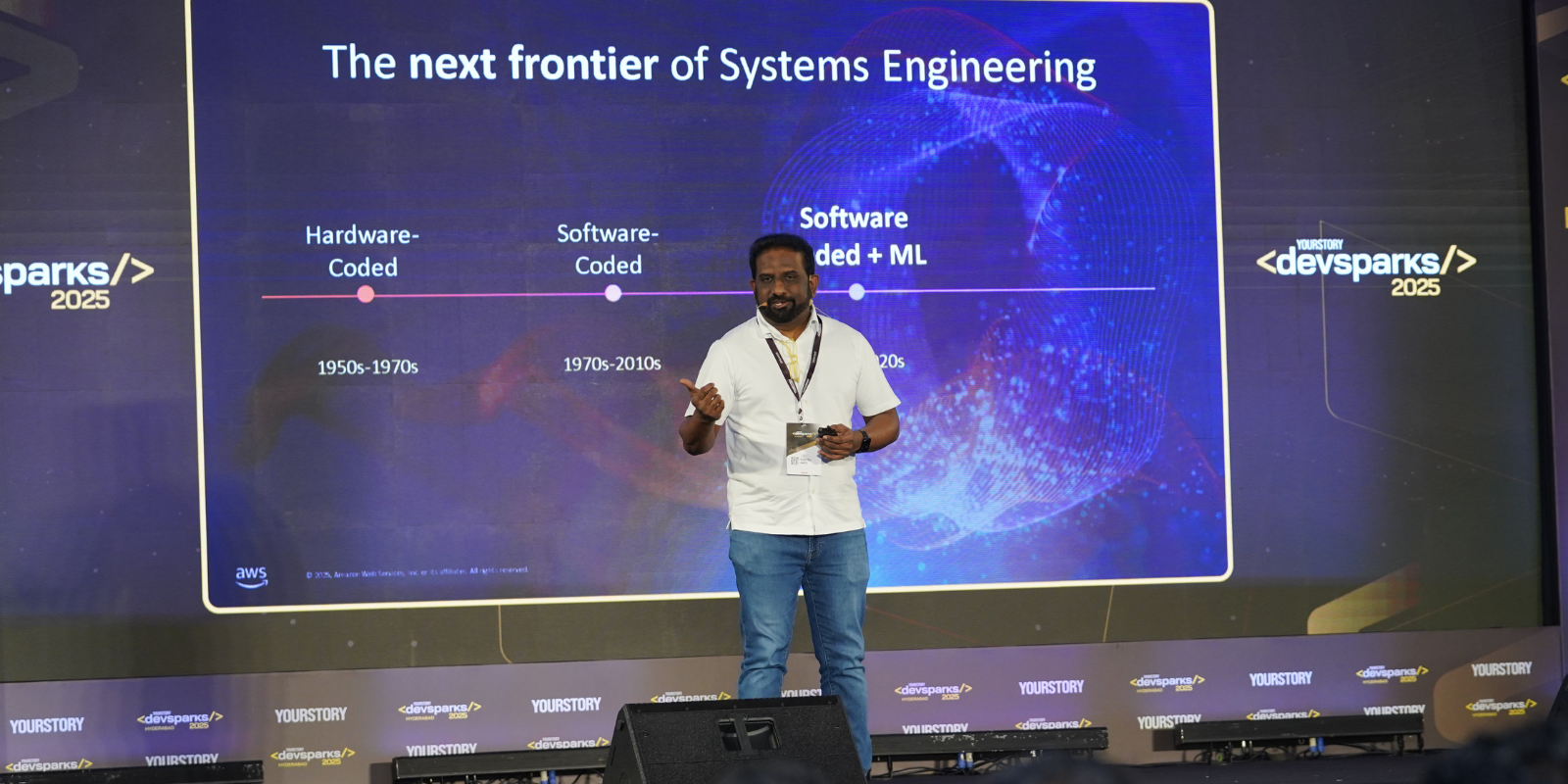
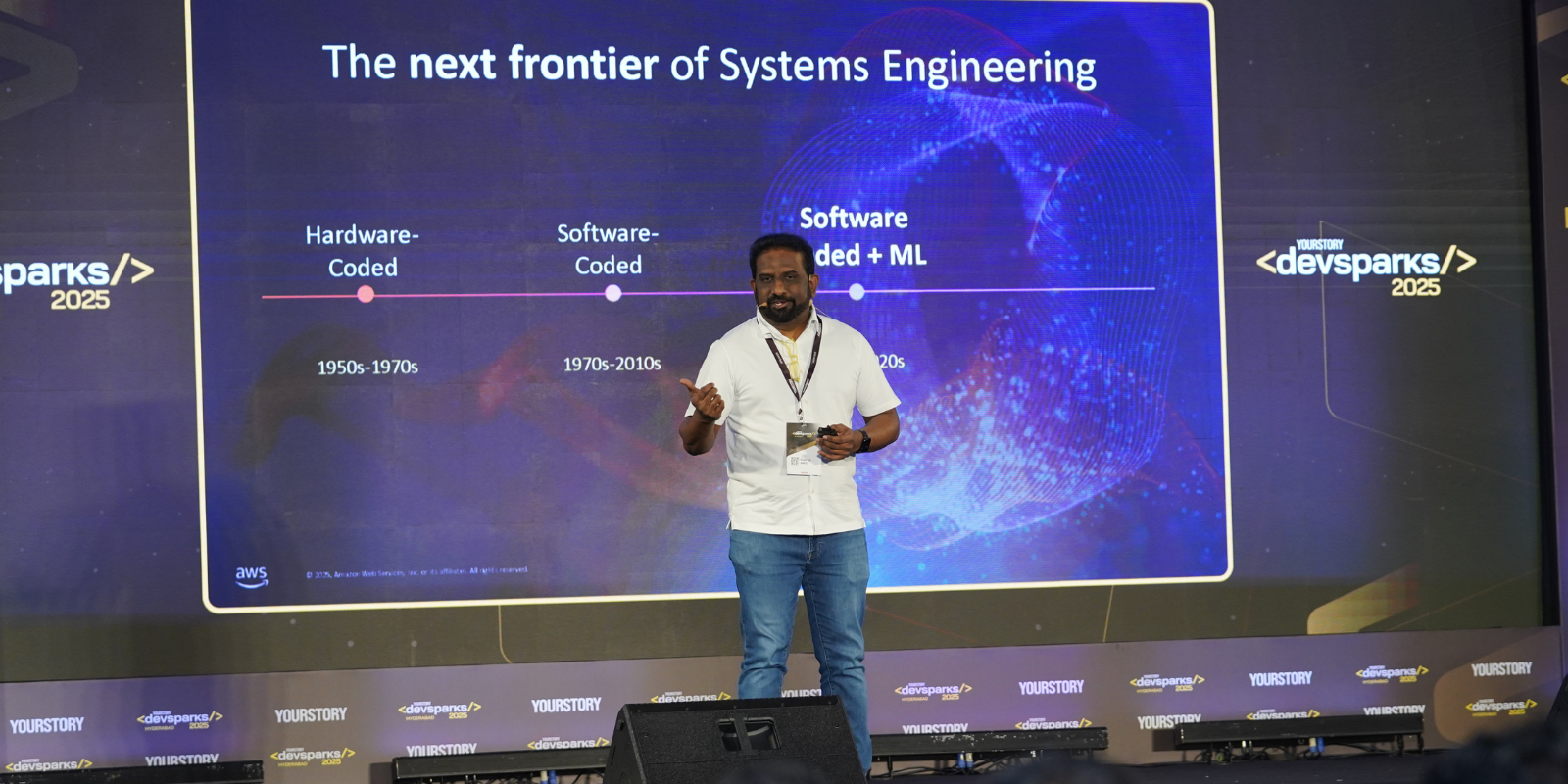
Amidst this wave of change and rapid evolution of technology, the recently concluded Hyderabad edition of DevSparks 2025, a nationwide movement aimed at empowering one million Indian developers with next-gen innovations and resources, featured a Lightning Tech Talk by Raja SP, Head of Developer Acceleration at AWS. In his keynote on Shaping the future of development: AI-driven dev lifecycle (AI-DLC), Raja challenged developers to fundamentally rethink the software development lifecycle.
From AI-managed to AI-native
Raja began by questioning the very foundation of software engineering. “At its core, software engineering is about embedding human intelligence into machines so they can perform tasks on our behalf and free us to maximize our potential,” he explained.
Tracing the evolution of the field, he noted how intelligence shifted from hardware to software and later evolved into classical machine learning. But despite these shifts, the way teams built software remained relatively constant for decades. That status quo, Raja argued, has been completely disrupted by generative AI.
“Developers today are asking: what skills matter now, how large will teams be, and how do I become an AI-native engineer, and what does that even mean?” he said.
Raja highlighted two patterns that dominated early AI adoption. The first, which he termed the AI-managed pattern, involved teams providing vague specifications to AI and treating it like a black box. “It might work for prototypes, but I have not seen production-grade workloads built this way,” he cautioned.
The second, the AI-assisted pattern, saw senior engineers orchestrating the solution themselves and using AI narrowly to fill gaps. While this worked better, Raja pointed out that it only resulted in modest productivity gains of 10–15%, which were based on early pilots with enterprise teams.
These observations echoed themes discussed earlier this year at DevSparks Bangalore, where Anupam Mishra, Director, Developer Programs at AWS, highlighted how most developers spend just 30% of their time actually coding, and why AI’s true value will only be unlocked when applied across the entire software development lifecycle. He introduced new practices like mob elaboration and mob construction, showing how cross-functional teams can compress months of work into days.
[Read the full Bangalore session recap here]
Neither approach, he argued, was enough to unlock the full potential of AI. “If we want consistent 5x to 20x gains, we need more than tools and best practices; we need an overarching methodology,” he emphasized.
Introducing AI-DLC, the AI-driven Development Lifecycle
This is where AI-driven Development Lifecycle (AI-DLC), AWS’s openly available methodology comes in. The central shift: instead of dumping problems on AI, start by asking it to produce a plan, verify it, refine it with human judgment, and then let AI execute. AI-DLC introduces new AI-native practices. Raja explained, “In the AI world, your sprints are supposed to be days or even hours. Nothing should be sequential anymore.”
He outlined two phases in particular:
- Mob Elaboration: Product managers, developers, and QA collaborate with AI from the start, refining ambiguous requirements into detailed user stories and plans. What once took months now takes hours.
- Mob Construction: Teams work in parallel, but only after rigorous domain modeling, through component models, sequence diagrams, and functional flows. This prevents hallucinations and poor design, producing production-grade outcomes.
Another critical feature is workflow tracking and audit trails. AI-DLC has been embedded into Amazon Kiro, AWS’s AI-powered IDE for spec-driven development, which turns prompts into detailed specs, then into working code, documentation, and tests. “Kiro tracks every step-plans, AI suggestions, human validations, final decisions, creating transparency and shared context across teams,” Raja said.
Real-world outcomes
To demonstrate, Raja shared how his team used AI-DLC with Kiro to build a learning app. The app generates sequenced learning paths for subjects like PyTorch or Python, complete with resources, labs, and progress tracking. Within just two and a half hours, the team delivered a production-grade, scalable application built with strong design patterns and AWS Well-Architected principles.
“The affinity developers feel for AI-generated code changes completely when they’ve seen the story, the model, and the rationale. They finally trust the code,” he remarked.
Looking ahead
Raja closed by stressing that AI-DLC is tool-agnostic and built for enterprise-scale collaboration. Large organizations, including Wipro, S&P Global, Persistent Systems, NASDAQ etc, are already experimenting with it. Developers can download the whitepapers, sign up for AWS Builder ID, and begin applying AI-DLC in their organizations.
“This is not about selling tools, it’s a developer-to-developer methodology for the AI era,” he concluded. To explore further on the AI-DLC Methodology, click here for the blog and the attached whitepaper.
