

“The story of Bharat is neither written in one language nor told through a single tradition. It lives in the weaves of our textiles, the lustre of our metals, and the rhythm of our crafts.”
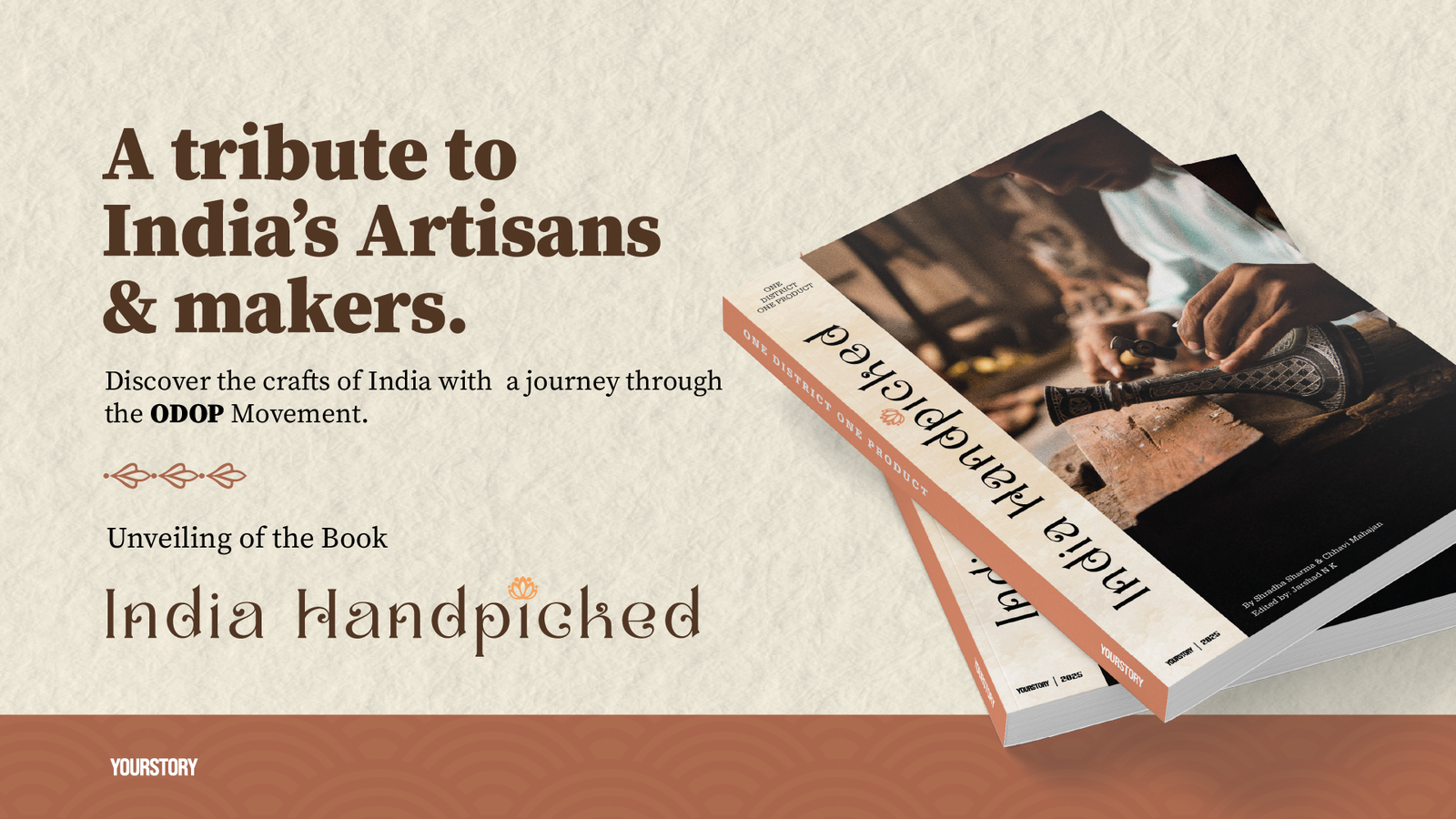
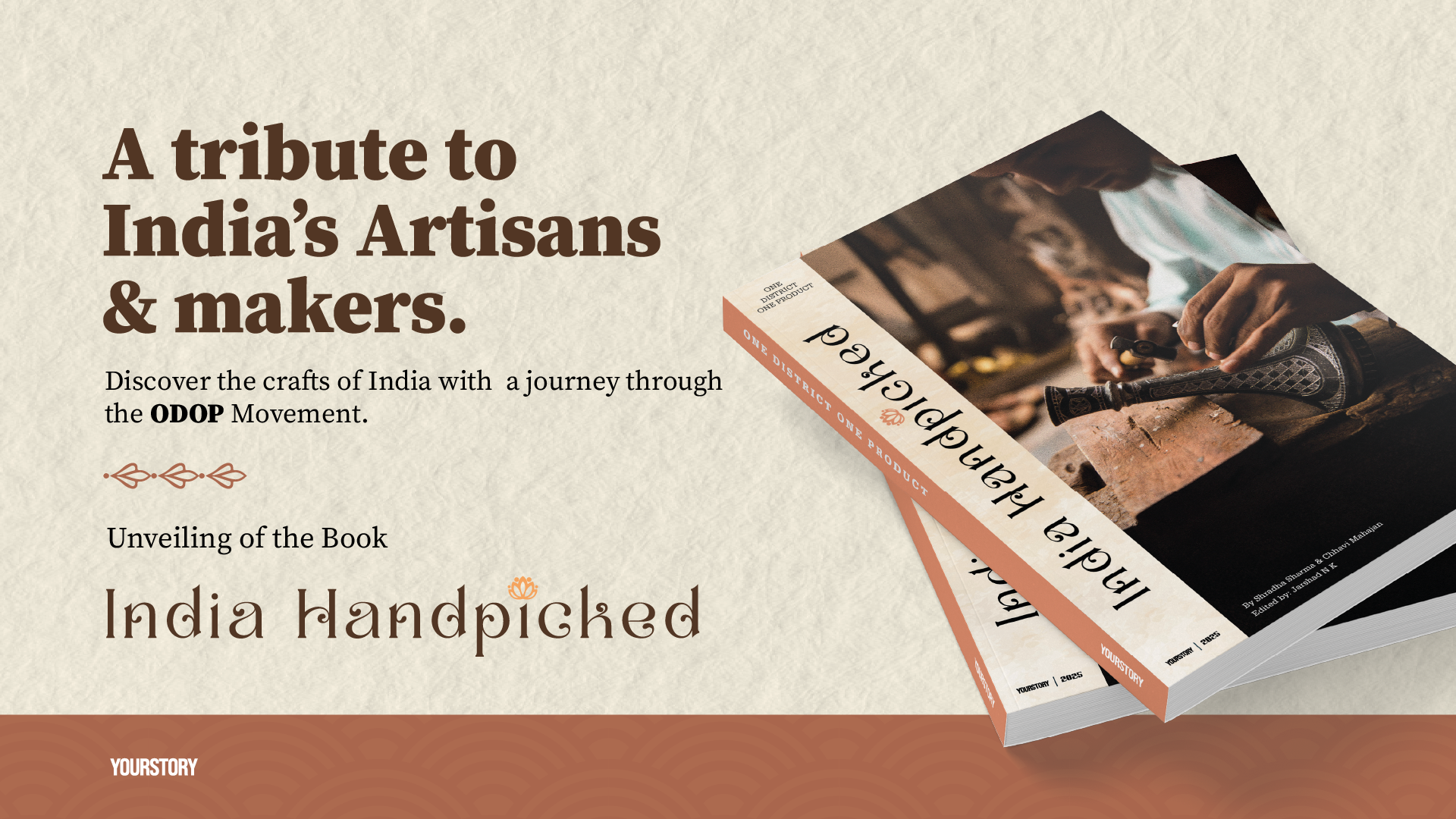
These words by Piyush Goyal, Union Minister of Commerce and Industry of India, in his foreword to India Handpicked, co-authored by Shradha Sharma, Founder and CEO of YourStory and The Bharat Project, and Chhavi Mahajan, highlight the very essence of the book.
India Handpicked, which spotlights the crafts of India, is a walk down the lanes of several districts of the country—including Anand, Azamgarh, Puri, and Navsari—reinforcing the truth that India’s crafts are not confined to the museums but are living, breathing traditions rooted in everyday reality. They live and breathe in the very hands and hearts of artisans, who continue the legacy of centuries-old practices.
Our country is home to diverse crafts, with every region boasting a distinct style, shaped not just by geography and history, but also by its cultural ethos. From the miniature paintings of Kangra in Himachal Pradesh that speak of the royal pulse of Pahari art, to the timeless Kashmiri silk carpets, and Khurja pottery of Bulandshahr in Uttar Pradesh, these crafts reflect the cultural identity of the region and form the economic backbone for millions of artisans.
“At YourStory and The Bharat Project, our work has always been about bringing such voices to the forefront. The voices we don’t often hear, but which carry the essence of India. These crafts are not just heritage pieces from the past. They are living, breathing examples of our entrepreneurial spirit, dignity in work, and identity rooted in tradition,” says Shradha Sharma, in her author’s note.
Released in collaboration with One District One Product (ODOP), an initiative by the Government of India to foster development of regional crafts, India Handpicked brings to life the stories of India’s crafts and its artisans and highlights how ODOP is transforming Indian crafts.
During the book launch, Goyal said India Handpicked captures Prime Minister Narendra Modi’s vision through ODOP.
“Our Prime Minister has given many gifts to the leaders of the world; they are India’s ODOP products. India Handpicked compiles their stories—where they started and what’s their history—in a non-boring way,” said Sharma, during the book launch.
.thumbnailWrapper{
width:6.62rem !important;
}
.alsoReadTitleImage{
min-width: 81px !important;
min-height: 81px !important;
}
.alsoReadMainTitleText{
font-size: 14px !important;
line-height: 20px !important;
}
.alsoReadHeadText{
font-size: 24px !important;
line-height: 20px !important;
}
}
Impact of ODOP
ODOP is an endeavour by the Government of India to enable holistic socio-economic development across the country. The initiative aims to promote craft products from every district across India, linking them to both domestic and international markets.
“When we launched ODOP under the visionary leadership of Hon’ble Prime Minister Shri Narendra Modi, our goal was simple yet transformative: to connect the unique heritage of every district with the opportunities of national and global markets. Today, ODOP stands as a key pillar of Aatmanirbhar Bharat, supporting livelihoods, empowering artisans, and taking ‘local’ to ‘global’,” says Goyal, in his foreword.
The ODOP initiative has identified a total of 1102 products from 761 districts across India so far. Under the initiative, all products are selected by the states or union territories of the country by taking into consideration the existing ecosystem on the ground, the products identified under Districts as Export Hubs, and those that are GI-tagged.
The activities undertaken by the ODOP initiative include a Mango Festival of India in Japan in 2022, in collaboration with the Embassy of India in Tokyo; Sui Dhaaga, the India-Russia buyer-seller meet for textile products in 2021; an exhibition of ODOP products in museums of Croatia and Canada; and the display of ODOP products at World Economic Forum 2023 at the Indian Pavillion, at Davos in Switzerland.
The initiative has led to on-ground impact at the grassroots level and market visibility. For instance, the centuries-old craft of Pochampally Ikkat, from Telangana’s Bhoodan Pochampally, in Yadadri Bhuvanagiri district, has received renewed attention in terms of market access and infrastructure, and has been spotlighted in the global crafts market.
Similarly, Varanasi’s lacquerware, once a fading craft, now records an annual turnover of over Rs 40 crore, employing thousands of artisans, especially women. The craft has also made its way into homes across the world, from Japan to Canada.
Take the case of handcrafted durries from Sitapur in Uttar Pradesh. The woven mats with intricate patterns are now seen in storefronts in Paris and at summits where global leaders exchange stories. In fact, inspired by their craftsmanship and versatility, global brands like IKEA have sourced durries from Sitapur.
Surat’s Sadeli woodwork, once confined to collectors, is now being reimagined by young artisans after ODOP introduced product diversification workshops and training programmes.
Diplomacy through craft
India’s cultural mosaic is a living archive of art, tradition and enterprise. Every district in every state holds a story that is not told in words but through the strokes of a brush, the weaves of threads, or the sculpting of metals.
What makes ODOP distinct is how it seamlessly integrates cultural pride with soft diplomacy. Many ODOP products have travelled outside the country via the corridors of power, as state gifts.
For instance, at the G20 Summit in 2022, when Prime Minister Modi gifted Ahmedabad’s Mata Ni Pachedi textile to Rishi Sunak, former PM of UK, it symbolised stories of migrant journeys and resilience. Similarly, in 2022 when PM Modi presented Kannauj attar (perfume) to French President Emmanuel Macron at the G7 Summit, it was a poetic gesture, a conversation between two fragrance capitals.
In 2024, as PM Modi prepared to address the UN General Assembly, he presented a Kashmiri Pashmina shawl to the then US First Lady Jill Biden, signifying a quiet message of sovereignty, heritage, and the enduring artistry of the region.
More recently, in 2025, during the G7 Summit, a Dokra horse sculpture from India was gifted to Cyril Ramaphosa, President of South Africa. It stood as a metaphor for the ties that bind both India and South Africa—enduring, intuitive, and shaped by resilience.
In 2025, the Indian prime minister gifted Croatia’s President Zoran Milanović a Pattachitra painting, symbolising folklore traditions connecting India and Croatia.
These gestures thus transformed heritage into storytelling tools, reminding the world of India’s timeless and contemporary craftsmanship.
“ODOP is not just about products, it is about people. Each district of India tells its own story, through the hands of artisans who are, in every sense, our cultural ambassadors. When these crafts are presented as state gifts to the world leaders they embody more than beauty and craftsmanship; they carry the spirit of India to the global stage, and build an identity and demand for these quality products,” says Amardeep Singh Bhatia, Secretary, Department for Promotion of Industry and Internal Trade, Government of India.
More than a policy
ODOP is more than just a policy. It combines history, storytelling, economies, and identity. By spotlighting the individual strengths of India’s districts, ODOP ensures development is not confined to the metros but also flows into the villages and small towns—the heart of Bharat.
As Sharma says in the author’s note of India Handpicked, “The ODOP initiative is not just about crafts or commodities. It is about people. It is about resilience, legacy, and the quiet pride that lives in every artisan’s hand. Behind every weave of a textile, every carved stone, every drop of attar, there is a story. A story of patience, inheritance, and love for one’s craft.”
Edited by Swetha Kannan
