

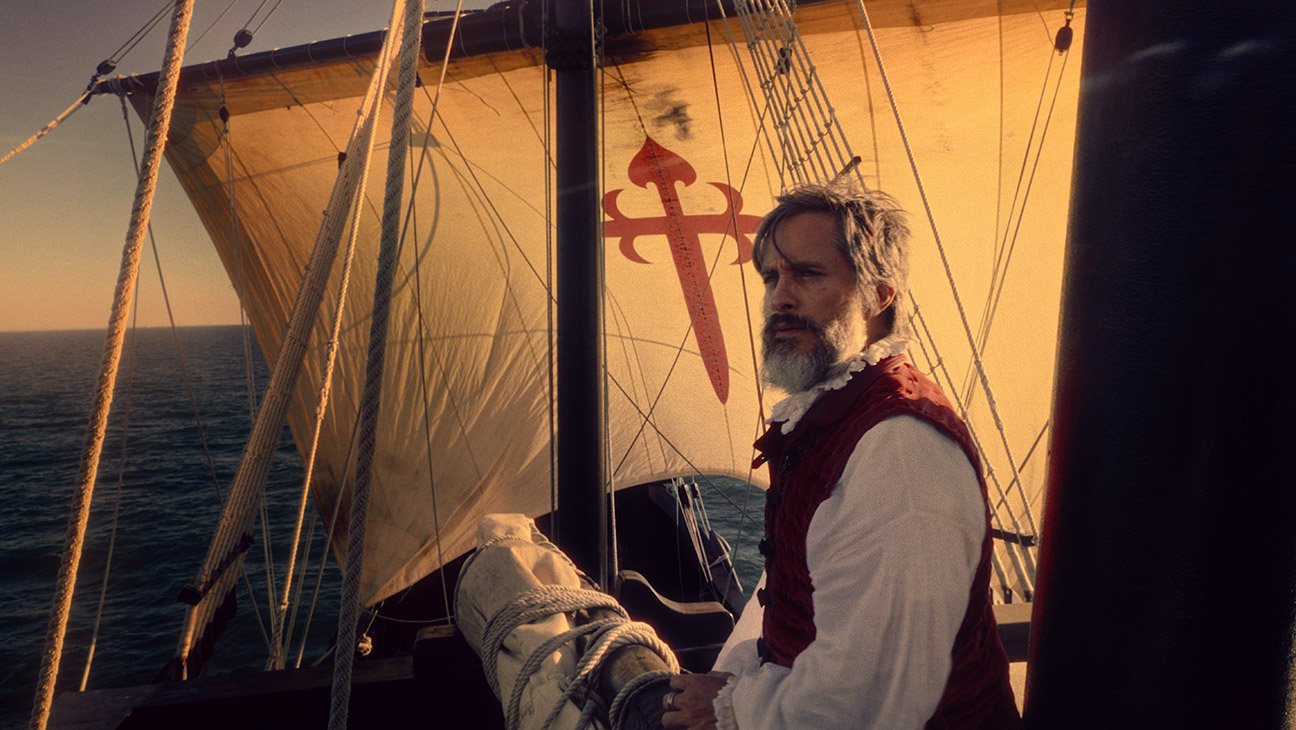
If “Gael Garcia Bernal as Magellan” sounds to you like a pretty cool Netflix series, you have never seen a film by Filipino auteur and slow-cinema master Lav Diaz. Known on the international festival circuit for his epically minimalist features with bladder-busting running times, his movies are challenging, high-art dramas made for a very select few — the opposite of the flashy, ADHD-friendly content found on streamers.
Premiering in Cannes, where Diaz’s most awarded film, Norte, the End of History, played in Un Certain Regard back in 2013, Magellan (Magalhães) is not for the impatient viewer who likes their explorer stories action-packed and easy to digest.
Magellan
The Bottom Line
A stunning time capsule that’s easier to admire than watch.
Venue: Cannes Film Festival (Cannes Premiere)
Cast: Gael García Bernal, Ângela Azevedo, Amado Arjay Babon, Ronnie Lazaro
Director, screenwriter: Lav Diaz
2 hours 40 minutes
And yet this exquisitely crafted feature may be one of the director’s most accessible works to date. It clocks in at only 160 minutes (Diaz’s films often run twice that long, if not more), but, more importantly, provides an honest glimpse at a figure who famously opened the world up for exploration, while furthering the mass destruction wreaked by colonialism.
“I saw a white man!” an indigenous woman screams in the movie’s opening scene, which shows her working calmly by a river in a picturesque rain forest. Like the snake appearing in the Garden of Eden — a Biblical reference that will soon be forced upon tribes with their own religious culture — the arrival of Europeans on the shores of unexplored lands will carry evil into an innocent place, changing it for the worse.
That first sequence takes place during the Conquest of Malacca in 1511, which saw Magellan fighting under Portuguese conquistador Afonso de Albuquerque. If you’re not familiar with this dark period, Diaz doesn’t necessarily make things clear enough to grasp. He’s less interested in historical facts and figures than in visually capturing what the start of colonial decimation looked like on both sides. Magellan never appears in his movie as a hero or antihero, but as a bold profiteer reaping what he can out of a global race to secure land through war and plunder. Guns, germs and steel indeed.
The narrative, which stretches from the bloody clashes on Malacca to Magellan’s death at the Battle of Mactan (Philippines) ten years later, portrays this decade of conquest and ruination with elegantly composed tableaux shot from a fixed position. Diaz is known for using black-and-white, but here he teams with Artur Tort (credited as both co-cinematographer and co-editor) to shoot with a rich color palette of green, brown and blue, finding beautifully detailed textures in locations on both sea and land. The villages recreated by production designers Isabel Garcia and Allen Alzola seem so authentic that you would think they had always been there, nestled in the jungle.
Certain images look like they were torn right out of 16th-century paintings, which is why Magellan is a movie you tend to gaze at rather than watch with full attention. Diaz often shows us the aftermath of battles, where dozens of bodies are artfully splayed on the ground, instead of the battles themselves. Lots of other drama happens off-screen, even if we do witness certain key moments from Magellan’s last years — whether it’s his decision to work under the Spanish crown after the Portuguese refused to back his last voyage, or his discovery of a passage to the South Pacific that became known as the Magellan Strait.
But the drama can be very stolid, borderline dull at times. Not that Garcia Bernal isn’t perfect for the part: Costumed in lots of fluffy shirts, he plays a fearless man with an immense ego who suffered for his success, making the whole profession of being a conquistador look less like a valiant enterprise than a major drag. But Diaz’s observant style (he never cuts within a scene; there’s no music to induce emotion) can keep us at arm’s length from events. Perhaps the most dramatic part of the film is the one that’s the most painfully stretched out, depicting Magellan’s long, relentless voyage (1519-1521) from Spain to the Spice Islands, which saw many crew members die along the way.
But whatever the Spaniards or Portuguese went through pales in comparison to all the tribespeople whom we see imprisoned, converted, enslaved or just plain murdered by Magellan and his men. The other main character in the film is Enrique (Amado Arjay Babon), an indigenous man whom Magellan captures on Malacca and takes with him on all his subsequent journeys. He gradually becomes “civilized” (to use a colonialist term) as the narrative progresses, until the tides turn in the Philippines and we see him returning back to his initial state, freed from the shackles of European domination.
As much as Magellan is a film that will play to a highly select audience, it makes a subtle but loud political statement about the colonial mindset both then and now. When the conquistadors claim they are fighting so that “Islam shall finally disappear,” hoping to beat the Moors in securing more territory, it sounds a lot like speeches you hear from far-right pundits and politicians in Europe today. Diaz’s movie may resemble a magnificent time capsule — and one that we watch with a certain distance — but there are moments when its stark realism reminds us how easily history can repeat itself.
