

The history of Warner Bros. is a history of mergers and sales, dating back to a sneaky transaction Jack Warner pulled off in the 1950s to become the studio’s largest shareholder.
Following that, there was the brief Warner Bros.-Seven Arts era in the 1960s, the studio’s subsequent acquisition by Kinney National Services — which brought long-time CEO Steve Ross into the company — and renaming as Warner Communications, and the 1989 merger with Time Inc. to create Time Warner (which several years later scooped up Turner Broadcasting).
The 21st century, though, has been an especially frenetic time for the company, with two — and soon to be three, after Warner Bros. Discovery announced a split of the company on Monday — mergers and subsequent breakups as the studio changed hands. Here’s a look at the transactional roller coaster of the past 25 years.
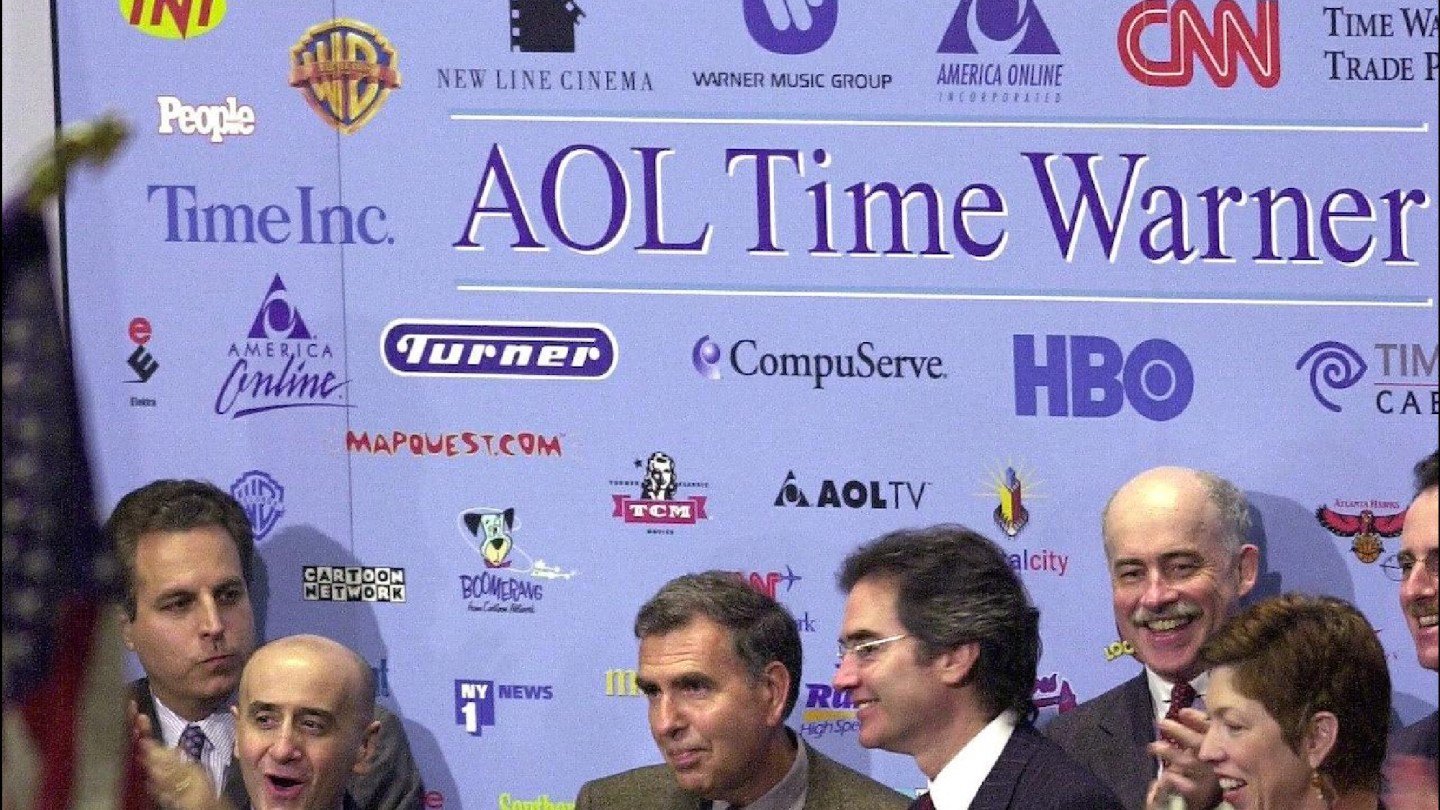
AOL Time Warner
2001-09
Why it happened: On Jan. 10, 2000, AOL — then the biggest internet service provider in the United States — and Time Warner announced their intent to combine in what was the largest corporate merger in U.S. history at the time. AOL envisioned Time Warner’s cable systems (which were still under their namesake parent’s control at the time) as helping to speed the push into the still fairly new broadband internet market, while Time Warner saw a radical new way to help distribute its movies, TV shows and publications. “This is a defining event for Time Warner and America Online as well as a pivotal moment in the unfolding of the internet age,” Time Warner president Richerd Parsons said in a press release at the time.
Why it fell apart: Oh, so many reasons. For starters, in the year between the announcement and when the merger was finalized, the dot-com bubble popped, sending shares of internet companies (even those that, like AOL, were making money) tumbling. Eighteen months after the combined company started trading, its share price had fallen by 80 percent, leading to several lawsuits by Time Warner shareholders who claimed AOL executives had fraudulently inflated the value of the company pre-merger. Wildly divergent corporate cultures didn’t help either. The hoped-for synergies also never really materialized, as AOL lost its dominant place in the market for internet service.
In 2003, AOL Time Warner quietly dropped the “AOL” part of its name, and in 2009 it spun AOL off into its own company, which was subsequently bought by Verizon in 2015. AOL is now part of the private equity-owned Yahoo.
“It was a good idea, but the execution of it wasn’t what it needed to be, and I accept responsibility for that,” AOL co-founder Steve Case, one of the architects of the merger, told The New York Times in 2010.
AT&T and WarnerMedia
2018-21
Why it happened: After letting go of AOL, Time Warner then spun off the “Time” part of its business in 2014 by creating a new company for its publishing assets (though it kept the Time Warner name). Two years later, AT&T expressed interest in buying Time Warner — following the lead of fellow cable and broadband provider Comcast, which had purchased NBCUniversal several years earlier. The deal, which renamed the company WarnerMedia, finally went through in 2018 after several challenges from the federal government in the first Trump administration.
Why it fell apart: Market reaction to the deal was never especially positive, partly because a lot of analysts deemed AT&T’s $85.4 billion acquisition an overpay and partly because of a heavy assumption of debt in the combined company. As WarnerMedia entered the streaming fray with the launch of the once-and-future HBO Max, losses on that side of the business piled up. The COVID-19 pandemic further depressed business. Several corporate restructurings led to big rounds of layoffs. And, as was the case with the AOL merger, the two companies had very different cultures that never really meshed. In 2021, AT&T threw in the towel. Which led to …
Warner Bros. Discovery
2022-26(?)
Why it happened: With AT&T washing its hands of WarnerMedia, Discovery Inc. CEO Daid Zaslav reached out to his counterpart at AT&T, John Stankey, about a possible deal. After several months of behind-the-scenes negotiations, the two companies made it official in May 2021, announcing plans to merge. The deal was completed in April 2022, combining the WB film and TV studio assets, HBO, the Turner cable networks and HBO Max with Discovery’s cable portfolio and its own streaming service, Discovery+ — plus a number of localized outlets in countries across the world. The deal was done through an all-stock transaction called a Reverse Morris Trust, and the combined company took on the name Warner Bros. Discovery.
Why it’s falling apart: Oh hey, culture clash! Zaslav, a long-time cable TV hand who had been Discovery’s CEO since 2006, built that company on a wide array of unscripted programming, which it produced at scale and relatively inexpensively. That, to say the least, is not how the likes of HBO and Warner Bros. Pictures were accustomed to operating, and that clash led to things like the scrapping of a completed Batgirl movie as a tax writeoff, the un-branding of HBO Max as Max (and then re-branding as HBO Max later this year), and the decision to walk away from a long-time relationship with the NBA (despite suing the league and claiming it wasn’t allowed to exercise its right to match the offers of Disney, NBCUniversal and Amazon).
There were other reasons, of course, among them a massive amount of debt (currently about $37 billion) and a slow path to profitability for Max. Hundreds more layoffs resulted — the most recent round coming just a few days before Monday’s announcement that the company is splitting back up. Zaslav will lead the streaming and studios business, including HBO and HBO Max, after the break, and current WBD CFO Gunnar Wiedenfels will become CEO of the global networks company (which, incidentally, will take on the bulk of that $37 billion in debt).
