



Who are you feeding?
In a world glorifying hustle, mythologist and writer Devdutt Pattanaik asks this simple question to startup founders.
“A person who is ambitious thinks about their own hunger. And the people around them, they don’t just see them as beings—they see them only in terms of consumption,” he says.
In a candid conversation with Shradha Sharma, Founder and CEO of YourStory, Pattanaik talks about endless hunger—a trait often celebrated in corporate boardrooms, MBA schools, and at startup pitch fests, but one which depletes one of purpose, joy and sanity.
Pattanaik’s latest book, Escape the Bakasur Trap, talks about this unending ambition and how, when unchecked, success can come at the cost of happiness and balance.
He compares the relentless pursuit of success to Bakasur—a demon from Indian mythology who was not known for being evil, but for his unending appetite. Pattanaik explains that in today’s times, Bakasur is not a person, but a mindset—of an unending quest to achieve success.
“The most successful people I met, whom I thought were very, very successful…did not look very happy. I mean, people who have private jet-level wealth, and I would see them being anxious, angry, always irritable,” he says. After decades of experience working with corporate leaders and entrepreneurs, Pattanaik turned to mythology for answers.
He believes many leaders overlook the differences between Swarg or heaven, and Vaikunth, the home of Lord Vishnu. Swarg, he explains, “is where there is wealth, money, and possession, but no happiness.” But Vaikunth is where one can achieve contentment. He adds that a lot of successful leaders, in their quest for materialistic pleasures, often overlook emotional and spiritual fulfilment.
Then how does one grow, if not by chasing success? Pattanaik answers through his book and this conversation.
<div class="externalHtml embed active" contenteditable="false" data-val="” align=”center”>
Rethinking one’s purpose
Pattanaik recalls attending a startup conference and asking entrepreneurs about their customers: “They all gave me the same dialogue: ‘The poor man who needs this…’, I said, ‘Don’t lie. You are running the startup because you want to sell—you’re selling your product to the investor who will give you money’. And the room just went quiet.”
In this hunger to please investors, founders often lose sight of who they are really building for. “If people don’t know who they’re feeding, their business or job will never be successful.”
Pattanaik compares this to Bakasur’s endless hunger. “You should decide whom you’re serving. And for that, you need to reflect. Just doing the work won’t cut it,” he advises startup founders.
In the startup world where valuation trumps value created, contentment is often seen as the enemy of growth, and Pattanaik wants to challenge that. “…I am challenging this whole idea that growth can only happen through dissatisfaction.”
He emphasises considering santosh or contentment as a core pillar of any business. “India is one of the few cultures in the world where santosh is central. In fact, it’s said that Lakshmi (Goddess of wealth) will only come to you when you have santosh…because when you’re content, your investment practices are fantastic—you’ll know how to invest. You won’t approach the world out of anxiety, you’ll approach life in a simple way, knowing: ‘I can pay my bills.’”
A new outlook
Speaking from his own experience, Pattanaik says that one should figure out how much money they need to run their house and take care of the basic expenses. Once they achieve that number, they should focus on enabling others.
<figure class="image embed" contenteditable="false" data-id="579177" data-url="https://images.yourstory.com/cs/2/11718bd02d6d11e9aa979329348d4c3e/Imagee5ti-1755523533646.jpg" data-alt="Devdutt-Patnaik" data-caption="
Author Devdutt Patnaik
” align=”center”> Author Devdutt Patnaik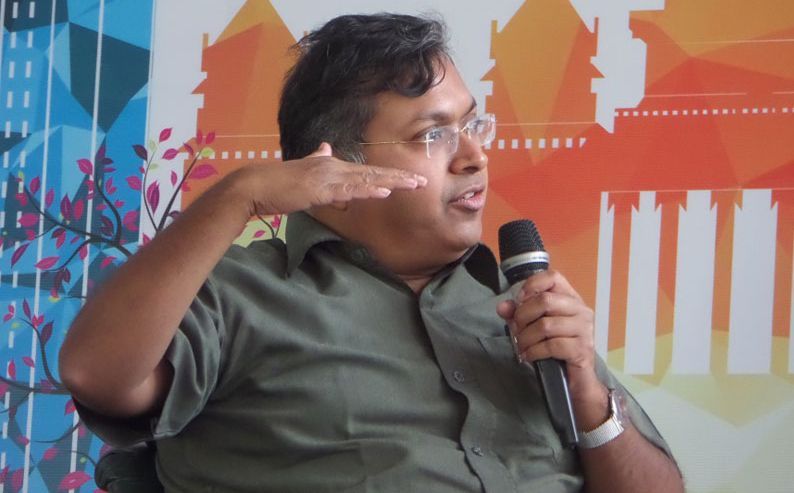
In another metaphorical comparison, Pattanaik mentions that founders must serve, and not just scale. Emphasising the concept of punya or karmic credit, he says everyone has to repay, and everyone owes something to the world.
“There is no shortage of money in this world…there is a shortage of happiness and contentment,” he says. In order to escape the Bakasur trap, Pattanaik offers startup founders a new way to approach their pitch—to build for purpose, peace and people.
Edited by Jyoti Narayan
