



The inaugural edition of Prosus Luminate, held at the Leela Palace in Bangalore, brought together over 750 of India’s most influential tech founders, investors, and innovators for a day-long exploration of India’s digital future. With a sharp focus on how technology is reshaping the country’s economic landscape, the event featured thought-provoking sessions that delved into fintech, AI, ecommerce, funding, hypergrowth, and the dynamics of India’s on-demand economy.
Ashutosh Sharma, Head of the India Ecosystem at Prosus, opened the event by emphasizing India’s global innovation influence: “By anchoring Luminate here, we’re celebrating the ambition and global relevance of Indian innovation, and helping catalyse the conversations that will define the next decade of growth.”
Across keynote speeches, high-stakes panels, and deep-dive conversations, Prosus Luminate reflected India’s multifaceted tech journey – from the role of Artificial Intelligence in driving e-commerce and fintech inclusion to the future of one-tap services. Adding a macro perspective, global AI expert Nina Schick explored how AI is reshaping geopolitics, global power structures, innovation, and influence.
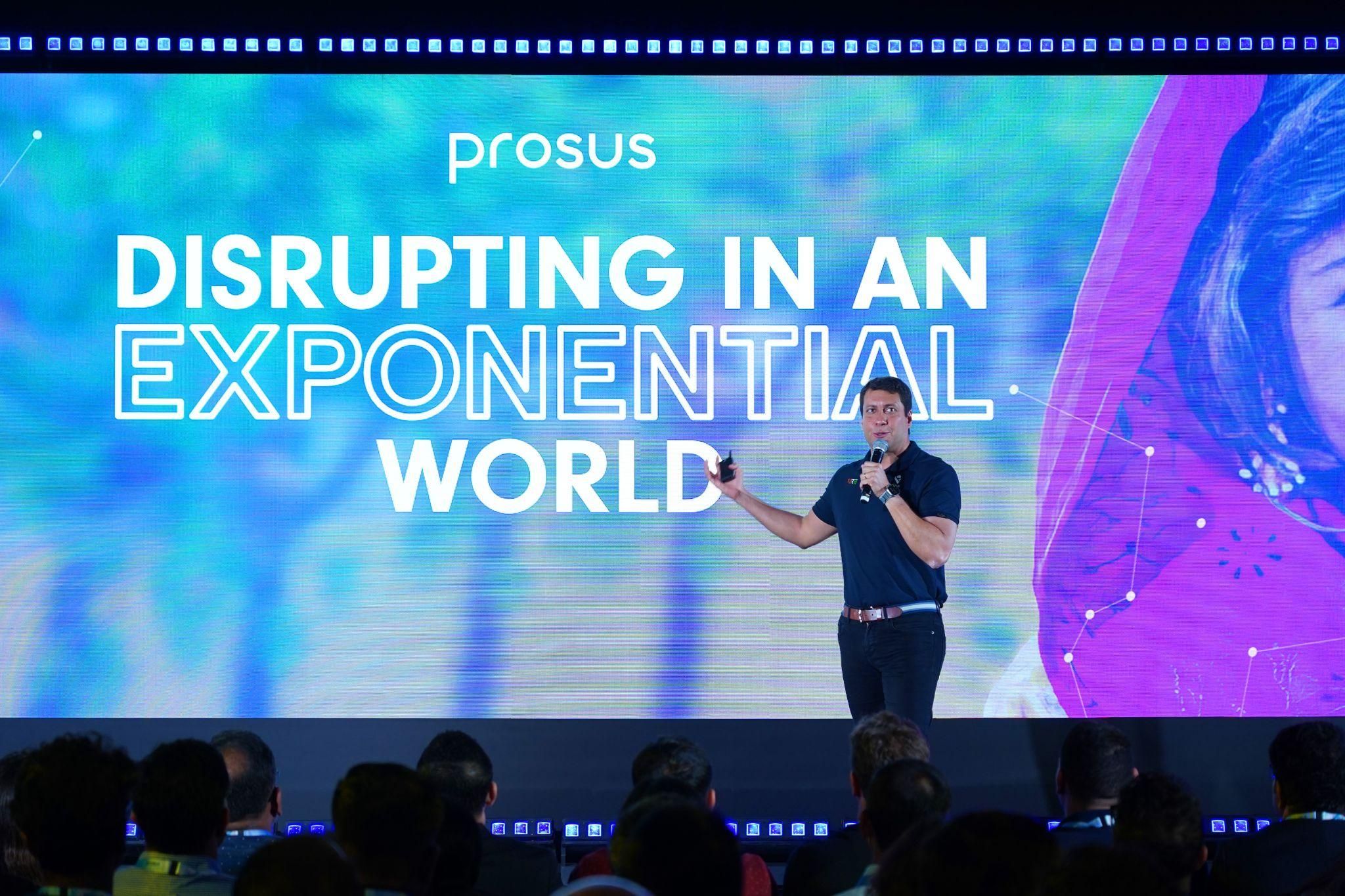
Prosus CEO Fabricio Bloisi and Sharma reflected on the company’s investment of nearly $9 billion in more than 30 Indian startups, reaffirming India’s central role in Prosus’s global strategy. As Bloisi noted, “We’re not just an investor. We believe we’re building the biggest big-tech company outside the US and China, and India can help lead that story. This is a market with 1.5 billion people. If you look to the future — not just the next three years, but the next 30–40 years — everyone bets it’s going to keep growing a lot. I saw this story before. We talked about China in 2005 … and now, the future has arrived. It will also arrive in India.”
The event hosted conversations with the who’s who of global venture capital and India’s startup stalwarts, sharing their insights on scale, impact, and clarity. The consensus was unanimous – India isn’t just a growth market; it is a proving ground for the world.
Fintech as India’s growth catalyst
In the panel ‘Lumen Lounge: India’s Raw Material’, fintech pioneers Mahendra Nerurkar (Amazon Pay), Sharath Bulusu (Google Pay), and Shashank Kumar (Razorpay) discussed the sector’s role in India’s economic evolution. The conversation explored how UPI is evolving beyond simple transactions, now enabling digital storefronts, banking services, and broader value-added tools for merchants.
“Consumers adopted UPI, and merchants saw the benefit… Credit will bring the next set of people into the fold,” Shashank highlighted the momentum created by UPI and the opportunity that lies ahead.
The moderator of the panel, Anirban Mukherjee, CEO of PayU – a Prosus Group company, emphasized the role of AI and digital rails in democratizing credit and enhancing GDP per capita. He concluded with an optimistic outlook: “We are just at the beginning of another exponential phase. If we solve for every micro segment, and GenAI helps us do that in a cost-efficient way, fintech can significantly contribute to India’s GDP.”
Capital meets conviction: The investor lens
The ‘Scaling Heights’ panel featured an insightful dialogue between Stephanie Hui (Goldman Sachs), Sumir Chadha (WestBridge Capital), and moderator Ashutosh Sharma.
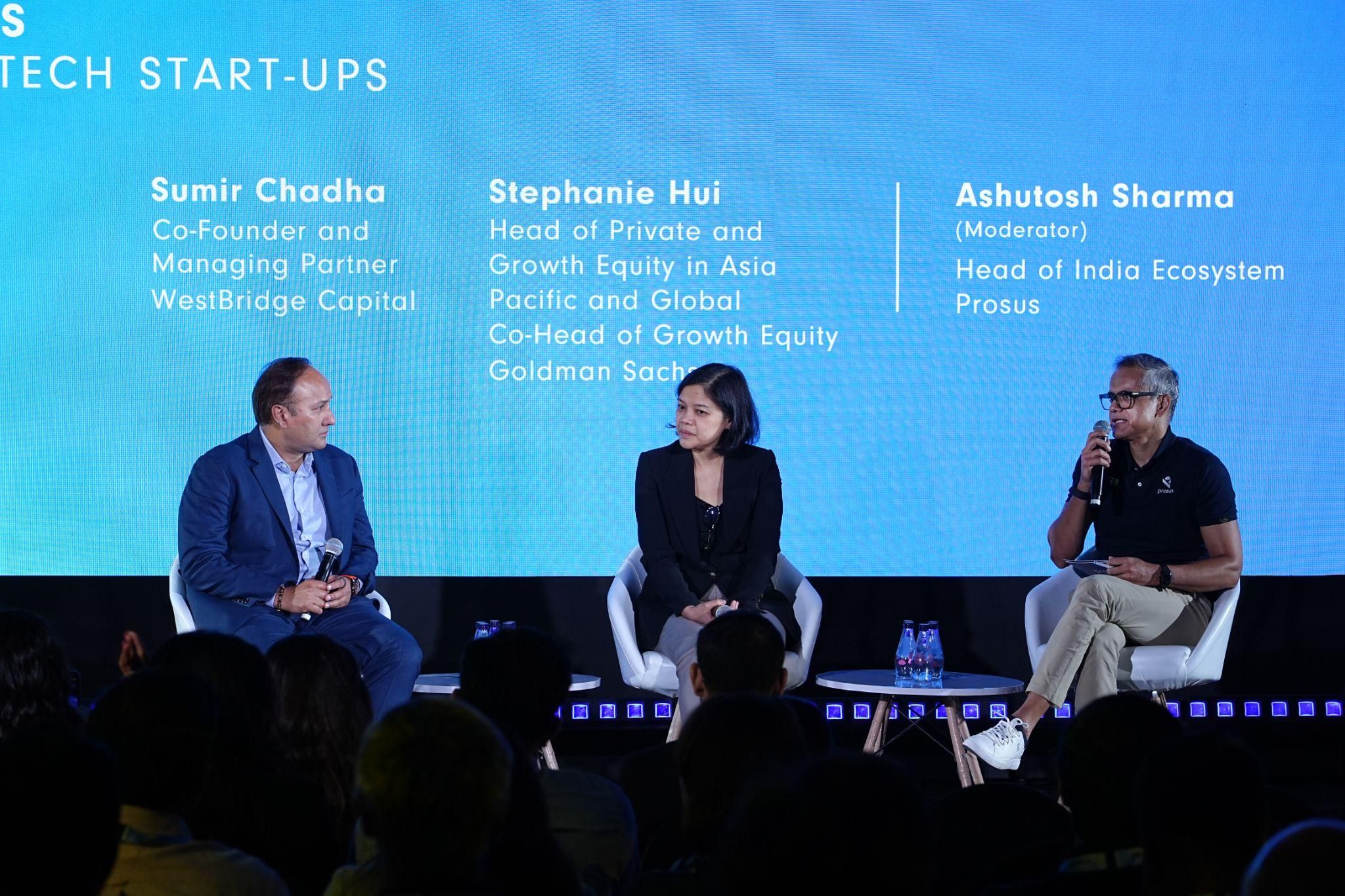
Sharma set the tone for a thought-provoking conversation, setting the context for a candid discussion on what makes Indian startups investable, stressing founder obsession, long-term vision, and operational discipline.
“We don’t back people who want to win. We back people who need to win,” said Chadha, emphasising founder obsession as a non-negotiable trait. He clarified that while IPOs bring liquidity and visibility, they also bring relentless focus on “profits, profits, profits” from public investors. Stephanie cautioned that not every founder is suited to running a public company: “Being a listed company CEO is like having a camera follow you around all day. Some people like that. Some hate it.”
Blitzscaling in Bharat
Sriharsha Majety (Swiggy) and Vidit Aatrey (Meesho) discussed the high-stakes world of hypergrowth in ‘Blitzscaling Bharat’, a panel moderated by former journalist CNBC-TV18’s Sonia Shenoy. They agreed that product-market fit is an evolving journey, and in Bharat, affordability often trumps convenience.
“There is no category in which 100% of loyal users are loyal users. Most users are promiscuous. You win by staying useful.” Majety underscored affordability as the ultimate differentiator in India.
Both founders acknowledged that competition is a constant in India’s consumer landscape. Majety noted that Swiggy was “born in a war” and has never known peace in the market. Aatrey emphasized the importance of staying focused on the company’s core mission rather than being distracted by market share battles.
They also observed notable behavioral shifts among Gen Z consumers driven by aspiration and social media influence, yet tempered by tight budgets.
The founders agreed that in a price-sensitive, multi-lingual, trust-deficient market, clarity of purpose remains the only constant.
Crafting one-tap India
The ‘On-Demand India’ panel featuring Abhiraj Bhal (Urban Company) and Aravind Sanka (Rapido) was moderated by Apoorve Goyal (Prosus). The founders discussed how on-demand platforms are evolving from enabling convenience to powering livelihoods.
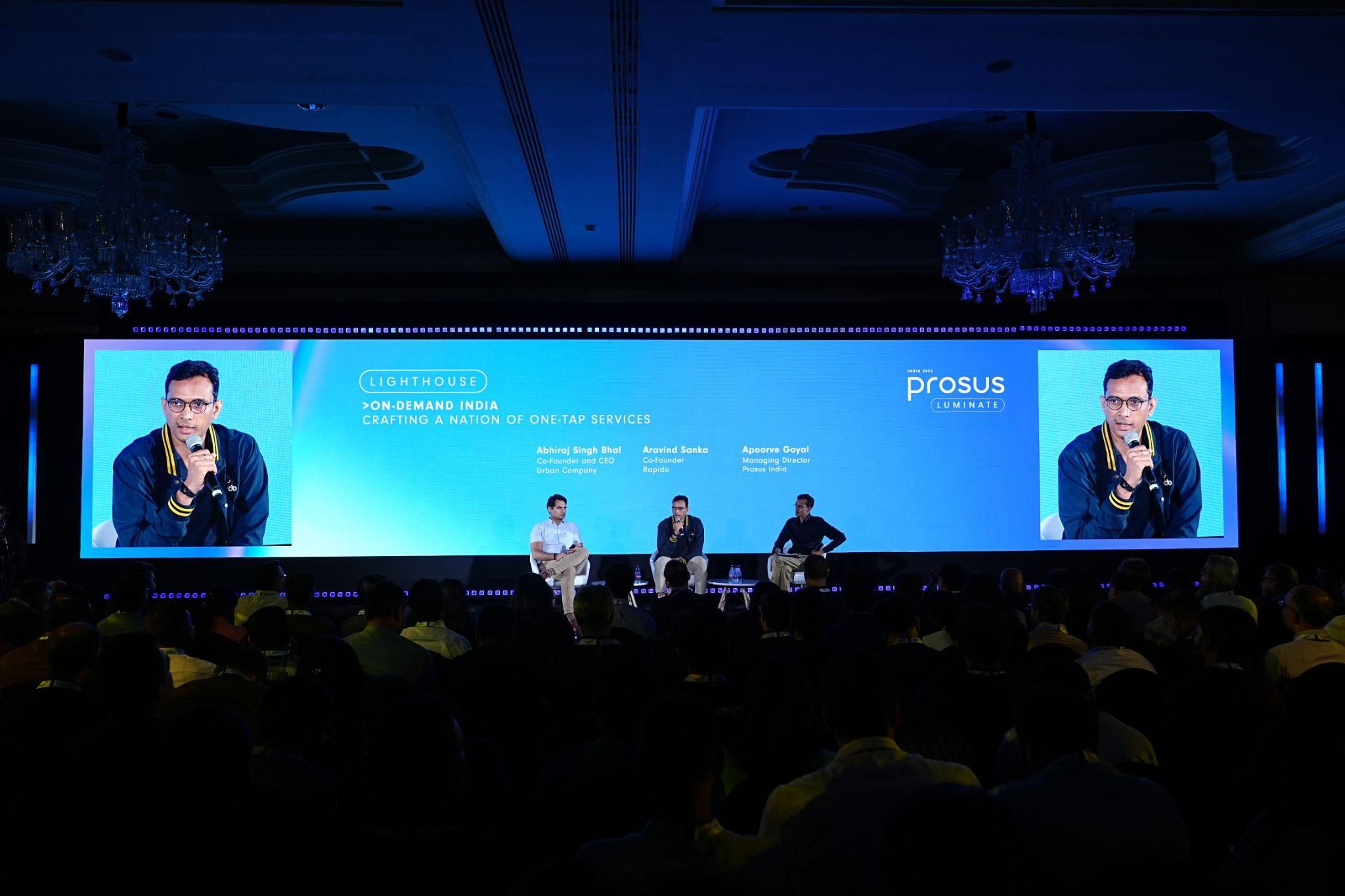
“Most companies stop at your doorstep,” said Bhal. “We’re building an operating system for your home, and that trust is something we take very seriously.”
Sanka explained Rapido’s hyperlocal approach: “India is the only country where transportation happens on two-wheelers, three-wheelers, and four-wheelers. Every city is different. We don’t give one solution to 200 cities.”
Both founders addressed the realities and promise of the gig economy, with Sanka adding, “Gig work is a gateway to aspirations, for people who need flexibility, or just need to eat tomorrow.”
Bhal also shared compelling data underscoring the income potential for gig workers on Urban Company: “The average Urban Company service professional, net of all costs, makes close to Rs 27,000 a month. If they work 100 hours, that goes up to nearly Rs 34,000. This is not possible for a plumber, carpenter, or cleaner to earn (this consistently) outside the platform.”
In a market where trust must be rebuilt daily, their message was clear: platforms can’t just deliver, they must empower.
Zero-friction commerce
In a futuristic session, moderated by Euro Beinat, Global Head of AI and Data Science at Prosus, the participants explored how AI is not just reshaping backend processes; it’s becoming the interface, infrastructure, and intelligence behind modern commerce.
At the start of this session, a brand new A.I. startup Codekarma came out of stealth mode and was unveiled at Luminate.
Debdoot Mukherjee (Meesho) shared that their recommendation engines process 45 trillion features. “Personalization isn’t a feature. It’s the product.” Madhusudhan Rao (Swiggy) illustrated the seamless integration of AI with a simple use case: “If I open Swiggy at work during lunch, I can order in three clicks. That’s AI at work.”
From conversational commerce to logistics prediction, the panel revealed how voice, vision, and adaptive UX are laying the foundation for frictionless buying. As moderator Beinat from Prosus aptly concluded, “If we turned off all AI systems today, these companies would still run, but at a fraction of their scale.”
Mind over machine
In the closing session, spiritual guru Sri Sri Ravi Shankar reminded the audience that innovation without introspection leads to burnout.
“You must stop the car to refuel. The mind also needs rest,” he said. “Meditation is not concentration. It’s conscious relaxation.”
Speaking to a room full of entrepreneurs and investors, he made a case for integrating well-being into the entrepreneurial journey. Attention span, decision fatigue, and inner alignment were discussed not as spiritual ideas, but operational imperatives. “In the age of Artificial Intelligence, connect to the Absolute Intelligence within,” he added.
India in focus — and in front
Prosus Luminate wasn’t just a one-day event; it was a pulse check on where India stands and where it’s headed. Across every session, one truth echoed: India’s digital economy is no longer catching up; it’s setting the pace. With fintech inclusion, AI-powered e-commerce, hyperlocal innovation, and mental well-being all on the same stage, the narrative was clear: ambition must be matched by depth.
As Bloisi shared, “Prosus Luminate is where we bring together the brightest ideas and the boldest builders, not just to talk about the future, but to shape it.” His words captured the essence of the day as a commitment to what comes next.
On the sidelines of the event, Bliosi shared his belief and conviction in the Indian story with local media. He talked about India being one of the 3 key focus geographies or “ecosystems” for Prosus, and how multi-billion-dollar Indian companies would be the norm, not the exception.
Prosus Luminate served as a timely reminder: the conversations we have today will shape the technologies, companies, and cultures of tomorrow.
