

What does it take to dream of becoming a doctor, an IAS officer, or a startup founder when you come from a small village in India? For many children in rural Uttar Pradesh, the answer today is: education and a school that believes in change.
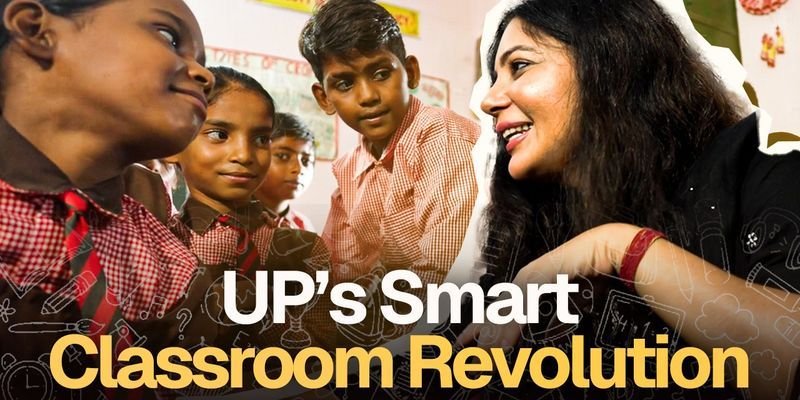
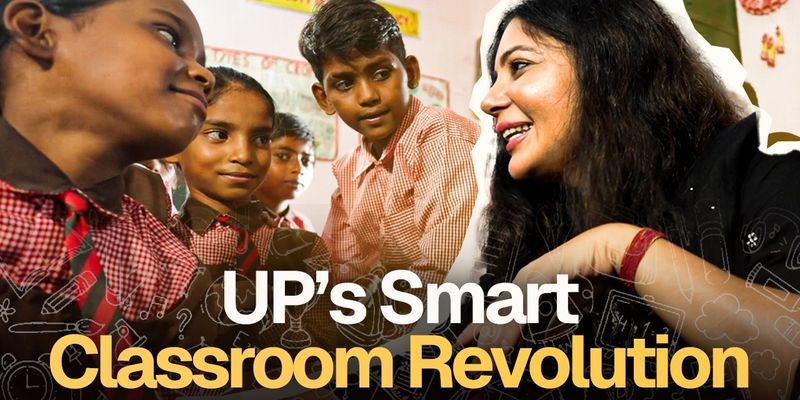
Shradha Sharma, Founder and CEO of YourStory, recently visited a government primary school in Ram Chaura village to understand how transformation at the grassroots is shaping the future of India’s children. Her visit was more than symbolic; it was a deep dive into a system too often dismissed for its shortcomings, yet now showing signs of remarkable progress.
“Who Will Be the Next Doctor or IAS Officer?”
In a cheerful classroom where the blackboard had turned bright yellow and smart TVs were replacing chalk, Shradha asked the students what they wanted to be when they grew up. Their answers echoed with ambition: “doctor,” “teacher,” “army officer,” “IAS.”
<div class="externalHtml embed active" contenteditable="false" data-val="” align=”center”>
Children from under-resourced families now confidently talk about careers once seen as out of reach. And why not? The school is equipped with smart classrooms, live video lessons, digital worksheets, and story-based learning. Teachers use interactive content to keep the students engaged and make complex topics fun and accessible.
“When I ask who wants to become a doctor or IAS officer, so many hands go up,” Shradha said. “These dreams aren’t just for rich kids in big cities anymore. That’s the real change.”
Transformation Rooted in Infrastructure and Intent
Satyapal, the headmaster of the primary school in Ram Chaura, shared the journey of the school’s revival. “When I joined, none of the 19 government-mandated parameters were in place. Attendance was poor, and even basic facilities were missing,” he said.
Over time, with government support and dedicated efforts, the school saw:
- Separate toilets for boys and girls
- Safe drinking water via tap connections
- Electrification of the campus
- Introduction of smart classrooms
The result? 100% student attendance. “Children come to school every single day because they enjoy it,” he added. “The smart classes spark their interest, they’re excited to learn.”
A Parent’s Perspective: Hope and Trust Restored
Seema, a mother whose children study in the same school, was candid in her praise. “The food is good, the facilities are excellent, and my daughter loves coming here,” she said. “Even my son passed from this school with good marks. Everything a child needs is provided.”
Government schemes are ensuring not just free meals and uniforms, but also dignity and opportunity. “If you want to find hope, purpose, and future in this country,” Shradha said, “come to schools like this and meet these kids.”
Scaling the Model: School Pairing for Better Learning
At another stop in Hariyapur village, Shradha explored the concept of school pairing merging low-enrollment schools with nearby higher-enrollment ones to optimize resources. The benefits were visible immediately.
- More students meant better social learning and discipline
- Dedicated teachers for every subject
- Shared infrastructure and learning materials
- A more engaging and energetic school environment
“Earlier, only a few children used to eat lunch together. Now they all sit together, learn together, and grow together,” said one teacher.
A Vision Worth Scaling
Shradha’s visit sheds light on a powerful narrative: when education meets empathy and infrastructure, dreams begin to bloom regardless of zip code.
This model of transformation, smart classes, community involvement, infrastructure development, and school pairing can be replicated across the country. It holds the promise of bridging the urban-rural education gap and building a future where every child, no matter where they come from, gets an equal chance to succeed.
