

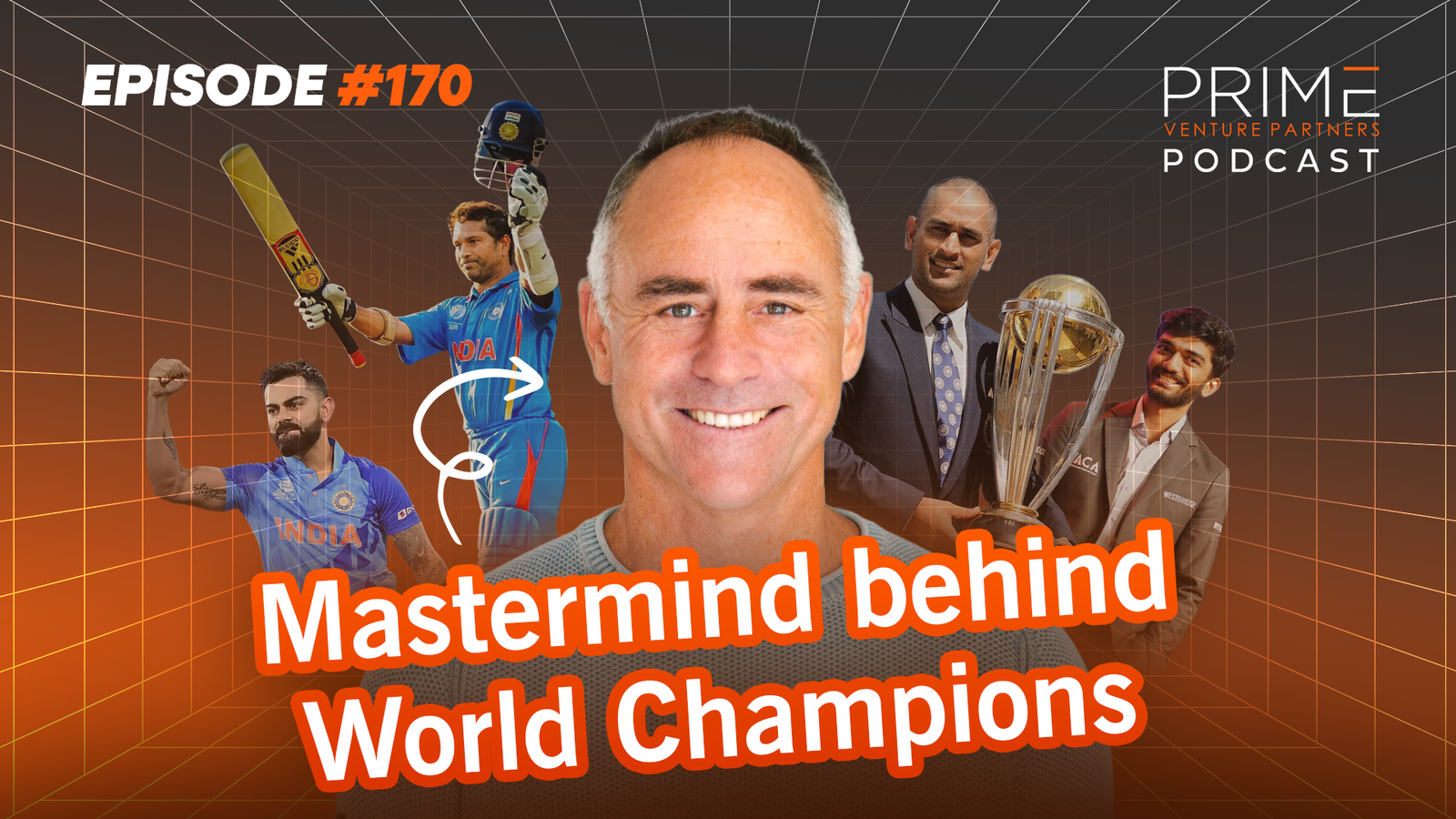
“Virat Kohli is the best preparer in the cricket world,” says mental coach Paddy Upton, who has worked with India’s 2011 World Cup-winning cricket team, the bronze medal winning Indian hockey team at the 2024 Olympics, World Chess Champion D Gukesh, and many more.
He also reminds startup leaders of their most important lesson: “Who I am and the results of what I do are different.”
The podcast with Paddy Upton has it all!
High performance: Same rules, different game
While elite athletes and startup founders might operate in vastly different arenas, the fundamental principles of high performance remain the same. Both need resilience, relentless preparation, and the ability to deliver under pressure.
But their environments differ sharply. “In sport, it’s 11 vs 11, the rules are the same, there’s a referee, and a scoreboard,” Paddy notes. “In startups, it’s often David vs Goliath, no clear rulebook, and no referee watching every move. The scoreboard is fuzzy. The complexity is far greater.”
Yet, both worlds share a brutal truth: perform or perish. Whether it’s promotion or funding, the challenges are real and rapid.
From player to captain to coach
One of the core transitions in a founder’s journey mirrors that of a sports professional moving from player to captain to coach.
“Early-stage founders are like individual athletes,” Paddy explains. “They must be at the frontier of innovation, fully prepared mentally, physically, and emotionally.” That’s the foundation of personal mastery.
But as companies scale, founders need to evolve. “You start as the player. Then you need to become the captain—coordinating, aligning, leading. Eventually, you must become the coach, enabling others who are more skilled in their domain than you. That shift requires a complete change in mindset.”
It’s a progression few founders consciously prepare for, and one that demands both awareness and intention.
Leadership is trainable as a skill
A common pitfall in both sport and business? Confusing individual excellence with leadership potential. “The best player doesn’t always make the best captain,” Paddy points out. “Likewise, promoting the top salesperson to sales manager often means you lose a great seller and gain an average manager.”
True leadership requires balancing self-orientation with other-orientations such empathy, collaboration, and emotional intelligence. “You can spot leadership potential, but it must also be nurtured. In sports, we often fail by not offering captaincy training. In business at least we have coaching. Leadership is a skill, and it’s trainable.”
.thumbnailWrapper{
width:6.62rem !important;
}
.alsoReadTitleImage{
min-width: 81px !important;
min-height: 81px !important;
}
.alsoReadMainTitleText{
font-size: 14px !important;
line-height: 20px !important;
}
.alsoReadHeadText{
font-size: 24px !important;
line-height: 20px !important;
}
}

Mental fitness is built on boring basics
Paddy’s most urgent message to founders? Don’t overlook the basics. “Mental wellness starts with sleep, nutrition, and exercise. These are unsexy fundamentals, but without them, everything else falls apart.”
He draws a stark analogy: just as poor sleep can quickly unravel an athlete’s performance, startup leaders running on adrenaline and junk food are undermining their decision-making, resilience, and team morale.
Another foundational habit? Separating self-worth from outcomes. “When people collapse who they are with what they do, success makes them euphoric, but failure destroys their identity. That rollercoaster is exhausting. Founders must learn to say: ‘This didn’t work, but I’m still okay.’ That equanimity is the foundation of long-term performance.”
Interrogate wins, not just losses
One of the most striking ideas Paddy shares is the flawed belief that failure teaches us more than success. “That’s rubbish,” he says bluntly. “We don’t learn from failure; we learn from interrogation.”
In both sport and startups, the tendency is to deeply analyse mistakes and quickly celebrate wins. But true high performers apply the same scrutiny to success. “Ask two questions: What did we do well? What would we do better next time? And do this when emotions have cooled down and not in the heat of victory or defeat.”
It’s not about fault-finding, it’s about designing better decisions for the future. That subtle mindset shift can separate average teams from exceptional ones, says Paddy.
Lessons from legends
Paddy’s reflections are rooted in lived experience. He’s learned as much from listening as from leading. From Virat Kohli, he learned the power of preparation. “He may not be the best batsman, but no one prepares better. That’s what made him the best for over a decade.”
From MS Dhoni, he received one of his most humbling lessons. “After a few team meetings, Dhoni came to me, put his arm around my shoulder, and gently said, ‘Paddy, you don’t have to talk every time.’”
It was a powerful reminder: speak less, listen more, and serve your audience, not your ego.
Even the missteps of others have shaped his philosophy. “I’ve seen self-centred athletes who burned bridges and lost relevance. I’ve also seen average performers who were exceptional humans but they were remembered far more fondly. Sponsors and society remember character,” says Paddy.
In closing, Paddy offers a warning against the flood of quick-fix advice in today’s digital world. “Just like junk food causes obesity, junk content on social media is making us mentally obese. We’ve lost our ability to discern.”
The antidote? Go back to the universal principles that have stood the test of time: preparation, presence, discipline, humility, and values. “They were true 5,000 years ago. They’re still true today.”
Timestamps:
00:00 – Introduction
01:46 – What startups & sports have in common
03:46 – Leadership evolution: Player → captain → coach
05:46 – Mental fitness: Sleep, nutrition & exercise
08:16 – Separating identity from outcomes
12:00 – How to review wins & losses
15:20 – The danger of chasing shiny objects
17:35 – Lessons from Virat Kohli & MS Dhoni
Edited by Swetha Kannan
