

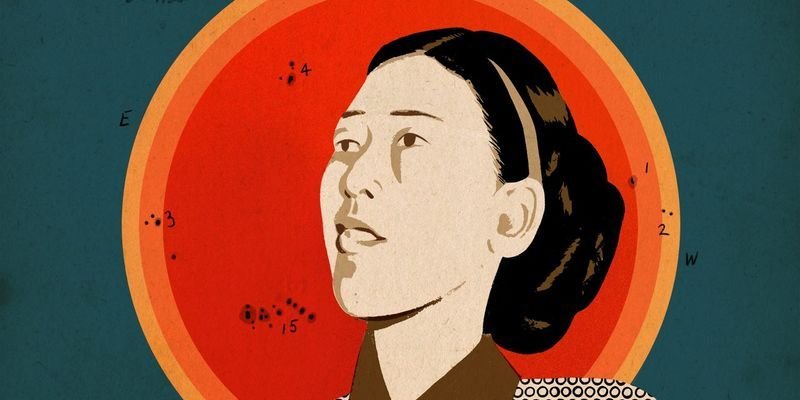
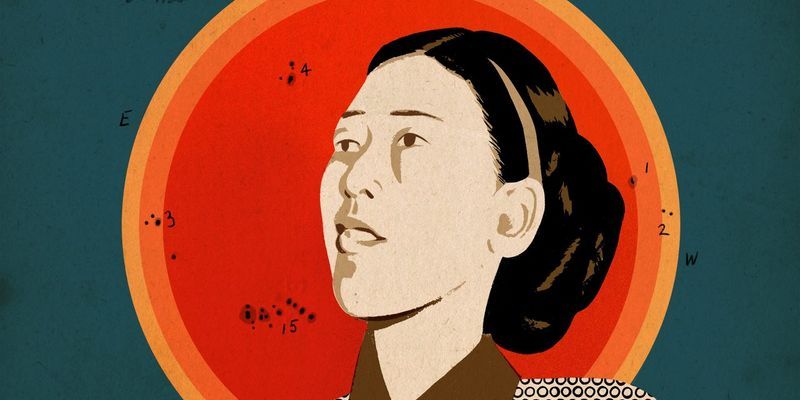
On a chilly spring evening in 1944, the air above Tokyo was pierced with the sound of sirens. Allied bombers were descending on the city, and residents scrambled into shelters as blackouts swept across the skyline. In the chaos, one young woman pulled a futon over her head—not to shield herself from firestorms, but from the cold night air as she crept outside to do something unusual.
Her name was Hisako Koyama, and while her neighbours prayed for safety, she turned her eyes toward the heavens. Beneath the blackout-darkened skies, she found clarity. With no city lights to drown them out, the stars burned brilliantly. Koyama would often sketch what she saw—meteors, constellations, and shifting patterns in the sky. But in the daylight, her gaze turned toward something far more dangerous, far more luminous: the Sun.
A Telescope, Some Paper, and Fierce Determination
Koyama wasn’t a scientist. She wasn’t even formally trained in astronomy. What she had was a modest refractor telescope gifted by her father, a deep curiosity, and the kind of patience that most professionals struggle to maintain.
Her method was deceptively simple. She would angle her telescope at the sun, project its image onto paper, and trace what she saw. What emerged were clusters of dark blotches, constantly shifting, splitting, and reforming sunspots.
At the time, these were no trivial doodles. Sunspots are the visible scars of the Sun’s magnetic turbulence, regions where charged plasma twists magnetic fields so violently that the temperature dips and light dims. To scientists, sunspots weren’t just blemishes. They were clues to the Sun’s 11-year solar cycle, its eruptions, and even the magnetic storms that could travel across space to disrupt power grids, telegraphs, satellites, and astronauts.
But there was a catch. Sunspots were notoriously difficult to track. They moved, multiplied, and faded rapidly. And they depended on the keen judgment of the observer. What one person dismissed as noise, another might record as a spot. In this realm of uncertainty, Koyama’s contribution became extraordinary.
From Hobbyist to Hidden Figure
When she sent her first sketches to the Oriental Astronomical Association, she expected nothing. Instead, she received a letter of commendation. Her sketches were unusually accurate, her consistency remarkable. Encouraged, she carried on—and soon gained access to a more powerful telescope at the Tokyo Science Museum (now the National Museum of Nature and Science).
By 1946, Koyama joined the museum staff as a professional observer. What began as a wartime pastime blossomed into a four-decade career. Nearly every clear day for 40 years, she sketched the sun’s surface more than 10,000 drawings in total, covering over 8,000 individual sunspot groups.
Imagine that: while the world rebuilt from war, split atoms, and landed on the Moon, Koyama sat patiently, day after day, pencil in hand, recording the fiery heartbeat of our nearest star.
The Butterfly Effect—Drawn by Hand
Scientists already knew that sunspots followed a strange migration. They appear first near the Sun’s poles, then drift toward the equator as years pass, tracing an elegant, wing-like pattern over time. It was called the butterfly diagram of the solar cycle.
But here’s the rub: documenting even one cycle required 11 years of daily data. Few could commit to that kind of patience. Koyama, however, didn’t just capture one cycle. By the end of her career, she had drawn three and a half solar cycles—one of the most complete, consistent, and human-made portraits of the Sun ever compiled.
Her work wasn’t flashy. It didn’t grab headlines. But it became a backbone of solar science, offering researchers a baseline to reconstruct four centuries of solar activity, linking back to Galileo’s time. Even satellite-based solar observatories today rely on her hand-drawn archive for calibration.
When Pencil Outshines Satellites
One of her most remarkable moments came in November 1960, when she sketched a rare white-light solar flare—visible in her projection setup. Few people on Earth have ever seen such an event directly, let alone recorded it.
And yet, for Koyama, it was just another entry in her endless pursuit of consistency. In a 1964 interview, she lamented that 17 years of work had only captured one solar cycle. By the time she retired in 1981, she had far surpassed that, unknowingly securing a permanent place in astronomy’s hall of quiet heroes.
Recognition
In 1985, Koyama compiled her life’s work into a book: Observations of Sunspots 1947–1984. A year later, she received the Oriental Astronomical Association’s Prize of Encouragement of Academic Research. Decades later, in 2012, asteroid 3383 Koyama was named in her honour.
Today, her sketches live in the archives of the National Museum of Nature and Science in Tokyo. Digitized and standardized, they form part of international solar databases used to predict space weather—crucial in an age where geomagnetic storms can threaten satellites, space stations, and even global internet systems.
The Bigger Picture
Why does Hisako Koyama’s story matter now?
- Citizen science is booming. In an era of AI and automation, Koyama’s work reminds us of the unmatched power of human patience and perception.
- Space weather is a global risk. As we rely on satellites for communication, navigation, and finance, the archives she built decades ago help us model and prepare for solar storms.
- Her ordinariness is her genius. She wasn’t a scientist. She wasn’t wealthy or privileged. She was, as some researchers call her, “an ordinary woman whose extraordinary patience changed science.”
In a world chasing instant results, her legacy feels radical: slow science, built one sketch at a time.
A Legacy That Shines Brighter Than the Sun
Hisako Koyama didn’t discover a new planet. She didn’t coin a law of physics. She did something harder. She showed up, every day, for 40 years, to watch and draw the same star we all take for granted.
In doing so, she revealed a truth most scientists couldn’t: that science isn’t always about grand theories or eureka moments. Sometimes, it’s about showing up with a pencil and a steady hand, every day, for a lifetime.
And so, the woman who once sheltered under a futon during air raids became a quiet guardian of solar history. Her work continues to ripple outward, shaping how we understand the Sun—and how we prepare for its storms.
