

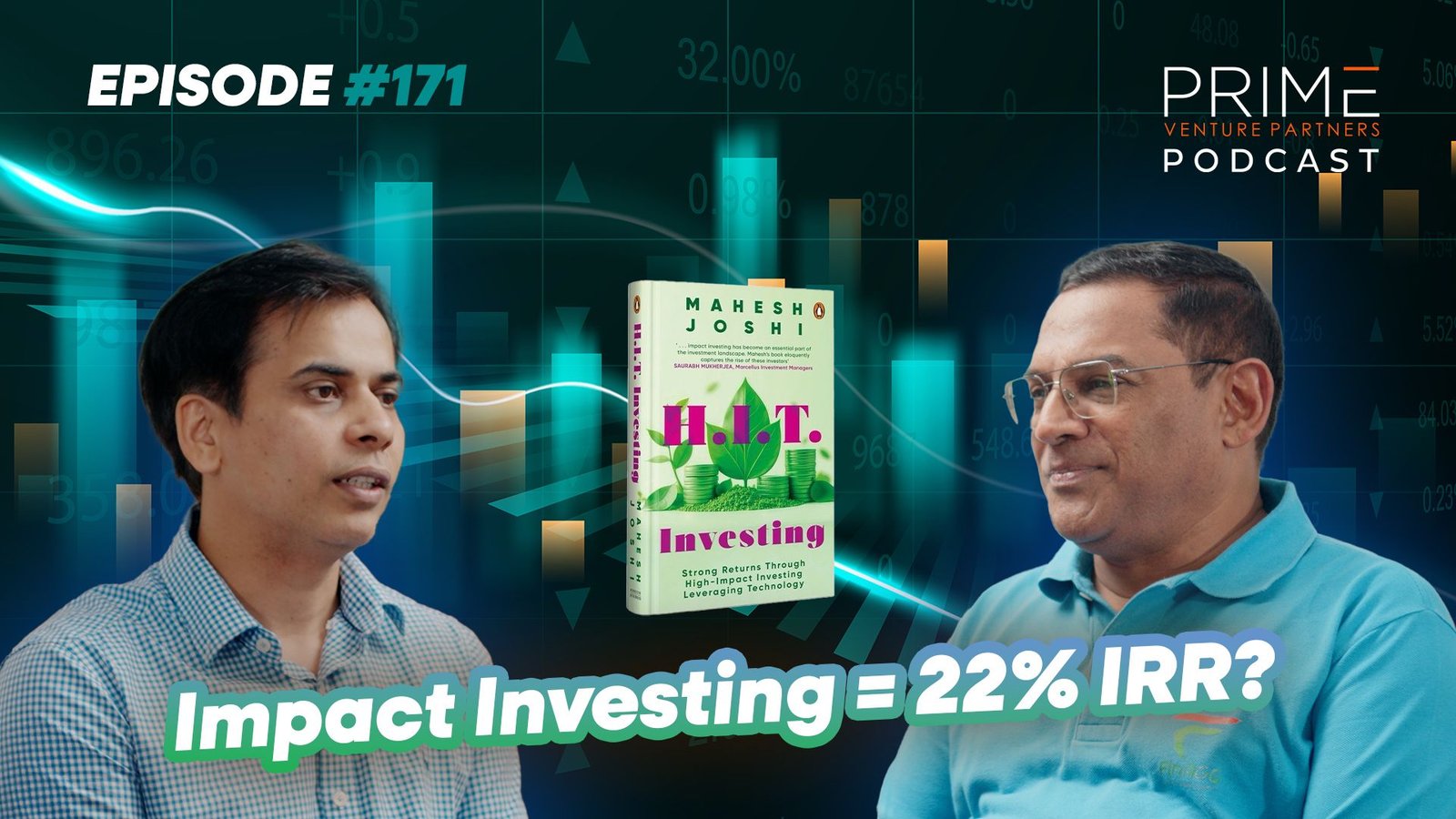
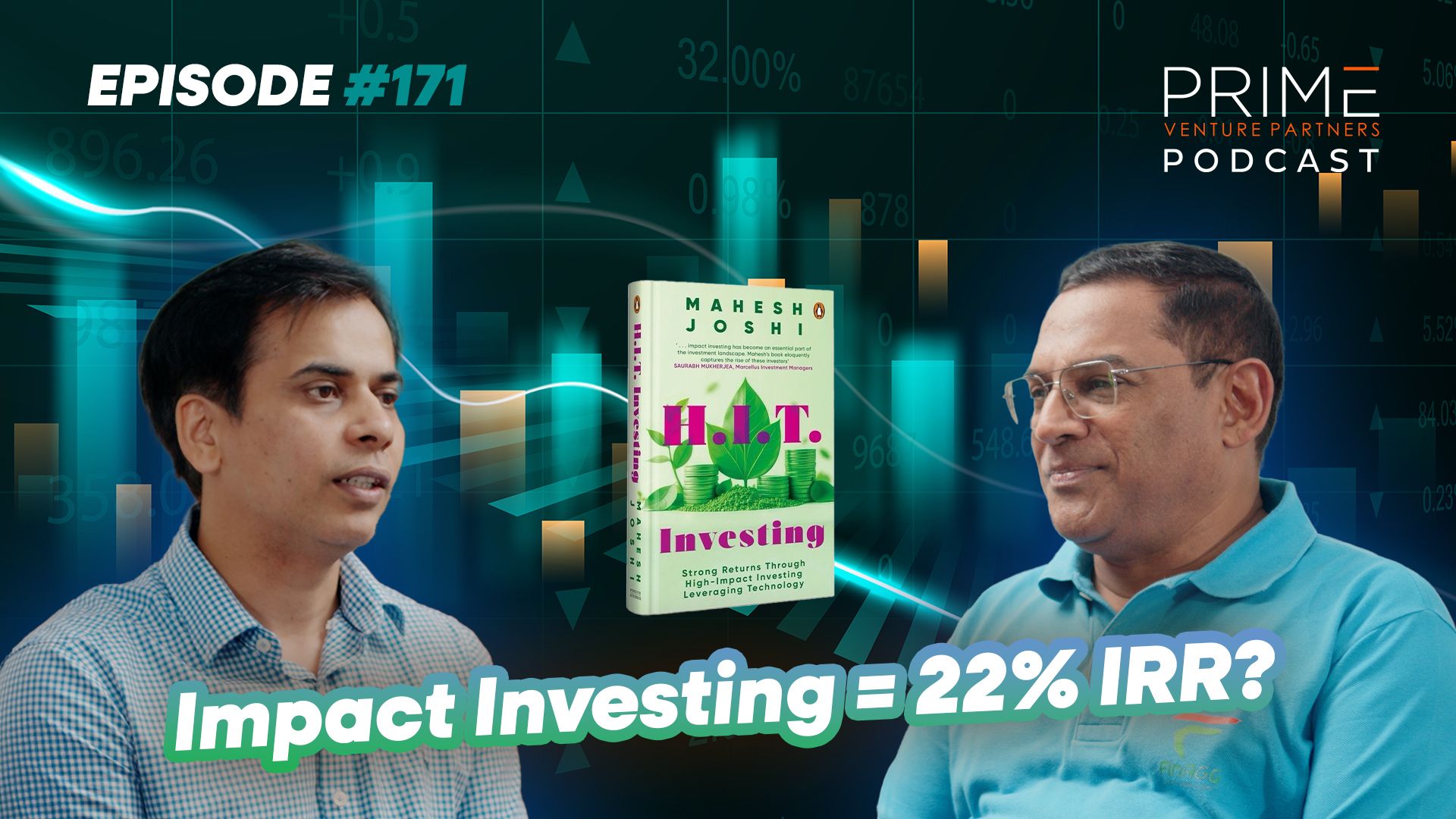
In this Prime Venture Partners Podcast episode, Mahesh Joshi, Head of Asia Private Equity at BlueOrchard Finance Ltd, and author of H.I.T. Investing explores how technology-led startups can create large-scale impact and still deliver strong financial returns
Mahesh Joshi, a seasoned private equity investor, talks about HIT investing (High Impact through Technology). It’s not just a clever acronym; it’s a philosophy rooted in the belief that technology can simultaneously unlock strong financial returns and life-changing social impact.
“Impact investors are trying to generate commercial returns and they’re going after these sectors because there’s an opportunity to generate huge returns,” says Joshi. “If you don’t generate returns, you’ll be out of business very soon.”
In conversation with Prime Venture Partners’ Sanjay Swamy, Joshi shares the thinking behind his book HIT Investing, the misconceptions about impact investing, and why technology is the essential multiplier.
Impact investing: Beyond philanthropy
For many, impact investing still sits in the shadow of charity. Joshi challenges this misconception.
“People outside often equate impact investing to philanthropy, but that’s wrong. It covers the entire spectrum from philanthropy all the way to commercial capital, with blended finance in between.”
He points to IFC’s three-part definition that crystallised in 2018: Intent, Contribution, and Measurement.
- Intent: Identify the problem be it healthcare affordability, financial inclusion, or climate resilience
- Contribution: Actively help portfolio companies achieve that intent
- Measurement: Track whether the intended outcomes are actually achieved
“You have to fulfil all three to be called an impact investor,” Joshi emphasises.
Why technology is the enabler
From micro-loans to climate insurance, Joshi sees technology as the great equaliser.
“Some of the businesses we invest in would not even exist without technology. It drives affordability and accessibility, the two most critical parameters in impact investing.”
India’s UPI infrastructure is a standout example. “We take for granted the growth it’s unlocked here. Compared to other emerging markets, India has done a lot right to deliver consistent growth year after year.”
He cites Finagg, a company providing working capital loans to kirana stores many run by women at 18–20% interest. These customers wouldn’t qualify for loans even at 25% with collateral.
“It’s leveraging technology to work on thinner margins, reduce loss ratios, and lower collection costs yet still be highly profitable.”
The founder profile that sustains impact
In Joshi’s experience, impact founders tend to be older, deeply experienced operators.
“Most of our founders are mid to late-40s, with years in the industry. They understand the problem, have the networks to solve it, and know how to build sustainable businesses. There’s no impact in having to shut down and fire 100 people. For impact to sustain, the business has to sustain.”
He recalls how founder intent is central to success. Citing microfinance veteran Vishal’s approach: “Seventy percent of their work is promoter referencing and understanding the founder’s purpose. If you solve for the customer, you won’t make the mistakes that sink the business.”
Sectors with maximum opportunity
While Joshi’s book covers multiple sectors, he sees some clear front-runners.
- Financial services: Market capitalisation has grown 50X in 20 years. There’s still massive underserved demand.
- Healthcare: Models that address affordability and accessibility at scale, from telemedicine to insurance-linked healthcare financing.
- Climate: It’s the biggest crisis we face. Every business should be thinking about solutions here. Climate resilience, especially in agriculture and infrastructure, is a rising investment theme.
- Agriculture: Opportunities in improving supply chain efficiency, farmer incomes, and climate-proofing crops.
These are not just large markets, they are deeply consequential to national growth.
The exit advantage
One of India’s strengths, Joshi notes, is its robust IPO market.
“Many LPs are seeing exits only from India. The IPO market here creates a pull effect, more investors are attracted, valuations improve, and it benefits companies all the way down the chain.”
Impact-aligned businesses, with their ESG readiness and governance practices, often see premium valuations because they appeal to both traditional investors and those with explicit impact mandates.
“More investor interest in our world usually equates to higher valuations. ESG isn’t a nice-to-have anymore, it’s become fundamental to how businesses are assessed.”
AI: The next frontier
While still exploring the best AI use cases, Joshi sees it as non-negotiable.
“One thing is certain that it’s very important for everyone to incorporate AI into their solutions. Otherwise, you’ll be left behind.”
Portfolio companies are experimenting with AI in two main ways: improving customer service (personalisation, instant support) and optimising operations (cost efficiency, predictive analytics).
BlueOrchard even brought together all its portfolio founders in London for a deep-dive on AI adoption.
“Everybody’s on a different journey, but the message is clear, if you stay still, you fall behind.”
The value conscious market
Sanjay Swamy pushes back on the cliché that India is “cost conscious”.
“We are a value-conscious market. If people see the value, they’ll pay sometimes disproportionately to their income.”
He recalls a telling example from mobile payments: white-collar respondents wouldn’t pay to pay bills by phone; blue-collar workers were happy to pay ₹10 to avoid losing half a day’s wages and travel costs.
“Time is literally money for them. If you save them time, they’ll pay for it.”
Why HIT matters now
For Joshi, HIT investing isn’t a niche, it’s the future of scalable, sustainable capitalism.
“India is such a great market for impact investing. You’re not squeezing every customer for margins; you’re playing on volumes. And with technology, you can deliver affordability and accessibility without compromising returns.”
The opportunity, he says, is as much about mindset as it is about market size. In a world grappling with climate change, income inequality, and rapid technological shifts, HIT investing offers a model where purpose and profit reinforce each other.
“We’ve seen that when impact is built into the DNA of a company, it not only survives, it thrives.”
In Joshi’s world, there’s no trade-off between doing good and doing well. HIT investing proves that when technology, intent, and execution align, businesses don’t just deliver returns, they transform lives, scale sustainably, and redefine what winning in the market truly means.
Timestamps:
00:00 – Introduction
00:56 – What is HIT investing?
04:32 – Understanding impact investing
10:24 – Financial services in India
13:45 – India as a hub for HIT startups
16:12 – Common misconceptions about impact investing
20:35 – Traits of founders who succeed in impact investing
28:40 – Global learnings applied to the Indian market
32:07 – Financial services growth & untapped opportunities
36:20 – Sectors primed for HIT innovation
42:12 – What Mahesh Joshi does for fun
43:55 – Closing thoughts
Edited by Swetha Kannan
