


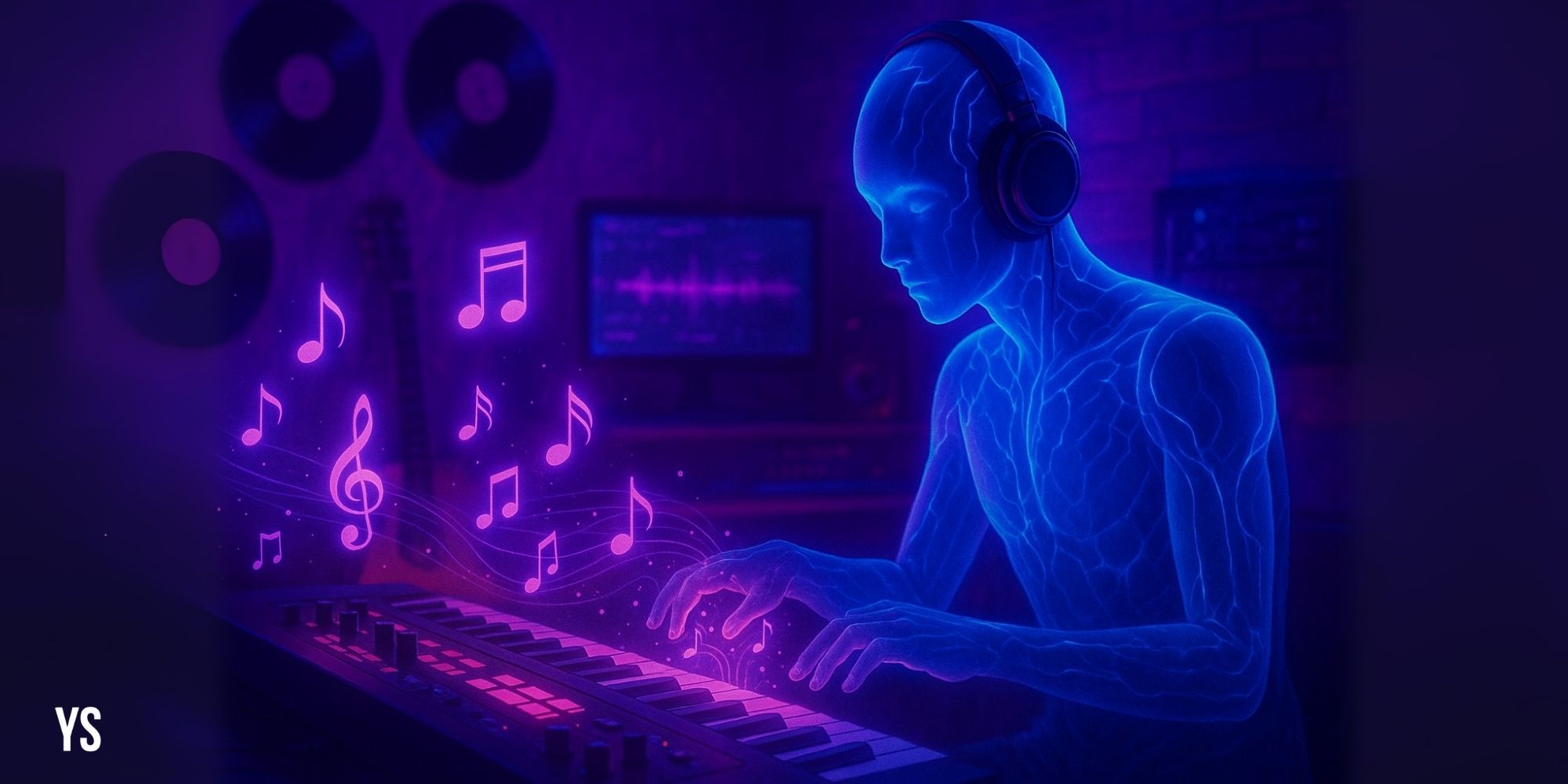
With artificial intelligence transforming industries from finance to healthcare, the music world is no exception. From creative composing partners to internet-famous AI bands, here’s how AI is reshaping the way music is made, distributed, and experienced.
Real-World Applications of AI in Music
Compositional tools & assistance
Platforms like OpenAI’s MuseNet and Jukebox use deep neural networks to generate compositions or vocal performances by learning patterns in large MIDI or audio datasets. Other systems, like Google’s NSynth, employ WaveNet autoencoders to synthesize entirely new sounds.
Mastering & production
Services such as LANDR analyze audio tracks and automatically apply mastering presets—compression, EQ, limiting—tailored for genre and style.
Voice cloning & synthesis
Tools like Vocaloid provide realistic singing voices by piecing together vocal samples and waveform concatenation with pitch and timbre manipulation, giving composers a virtual vocalist.
Creative workflow augmentation
AI-powered apps like Dubnote streamline idea capture through voice memo transcription, tempo detection, and section tagging—handling organizational tasks so artists can stay creative.
AI Bands: Velvet Sundown
Enter The Velvet Sundown—a wholly AI-generated psychedelic-folk band that shot to fame on Spotify. They released two full albums in early June and quickly amassed over 1 million monthly listeners
Highlights:
- The band’s biography later disclosed that all music, lyrics, vocals, artwork, and even backstories were created using AI tools such as ChatGPT and Suno, guided by human direction.
- Their viral hit, “Dust on the Wind,” topped markets like Sweden’s Viral 50 chart, though critics voiced concerns over their “generic” or “soulless” sound palette.
- The creators describe Velvet Sundown as an “artistic provocation” designed to challenge current norms in authorship, artistry, and music ethics.
How AI Works in Music: Technical Breakdown
<div class="externalHtml embed" contenteditable="false" data-val="
| AI Process | Underlying Technology | Creative Application |
|---|---|---|
| Composition generation | Generative deep learning models (e.g. LSTM, Transformer, GAN) | Models predict musical sequences (notes, chords, rhythms) to create new compositions in various styles. |
| Sound synthesis | Neural audio models like WaveNet autoencoders, NSynth | Produce novel timbres by learning latent audio embeddings. |
| Voice synthesis | Concatenative sampling methods and EpR models (e.g. Vocaloid) | Create expressive vocals with controllable pitch and timbre. |
| Production pipelines | Automated mastering via machine learning (e.g. LANDR) | Automates mixing and mastering processes based on learned presets, tailored per genre. |
| Text-to-music | Multimodal generative AI (e.g. Suno) | Generates songs from textual prompts including style, mood, genre, and lyrics. |
“>
| AI Process | Underlying Technology | Creative Application |
|---|---|---|
| Composition generation | Generative deep learning models (e.g. LSTM, Transformer, GAN) | Models predict musical sequences (notes, chords, rhythms) to create new compositions in various styles. |
| Sound synthesis | Neural audio models like WaveNet autoencoders, NSynth | Produce novel timbres by learning latent audio embeddings. |
| Voice synthesis | Concatenative sampling methods and EpR models (e.g. Vocaloid) | Create expressive vocals with controllable pitch and timbre. |
| Production pipelines | Automated mastering via machine learning (e.g. LANDR) | Automates mixing and mastering processes based on learned presets, tailored per genre. |
| Text-to-music | Multimodal generative AI (e.g. Suno) | Generates songs from textual prompts including style, mood, genre, and lyrics. |
AI vs. Regular Software
- Rule-based software relies on explicit instructions (e.g., EQ filter at 200 Hz).
- AI-based music systems learn implicit rules and patterns by analyzing vast datasets, enabling them to compose or synthesize in nuanced, context-aware ways.
In contrast to deterministic software, AI tools exhibit flexibility: generate new content, imitate styles, deconstruct and reconstruct audio in creative, sometimes unpredictable ways. They’re statistical and data-driven—not rule-bound.
Implications & Ethical Considerations
- Creativity and accessibility: Artists like ABBA’s Björn Ulvaeus have adopted AI as a co-writer tool, finding it helpful for overcoming creative blocks.
- Legal and moral issues: Concerns around copyright—especially when models train on existing works—are rising. The Velvet Sundown’s emergence fueled a debate about authenticity, ownership, and transparency.
- Economics of music: AI may reduce production costs and enable scalable content. But it also risks displacing human artists, potentially lowering diversity and originality.
What Lies Ahead?
AI in music is here to stay—and growing. Expect further advancements:
- More natural-sounding AI vocalists and lyricists.
- Expanding roles for multimodal creation tools (text-to-music, image-to-music).
- Greater integration of AI into live performance and interactive experiences, including virtual or augmented reality concerts.
Yet human artists will remain central—AI tools, when used responsibly, can become powerful collaborators rather than replacements.
AI is not just reshaping how music is made—it’s redefining who (or what) can be an artist. From tools like MuseNet and Vocaloid to fully AI-generated phenoms like Velvet Sundown, these innovations stretch the boundaries of creativity and ethics. As listeners and creators, staying informed—and demanding transparency—will be key in navigating this evolving soundscape.
