

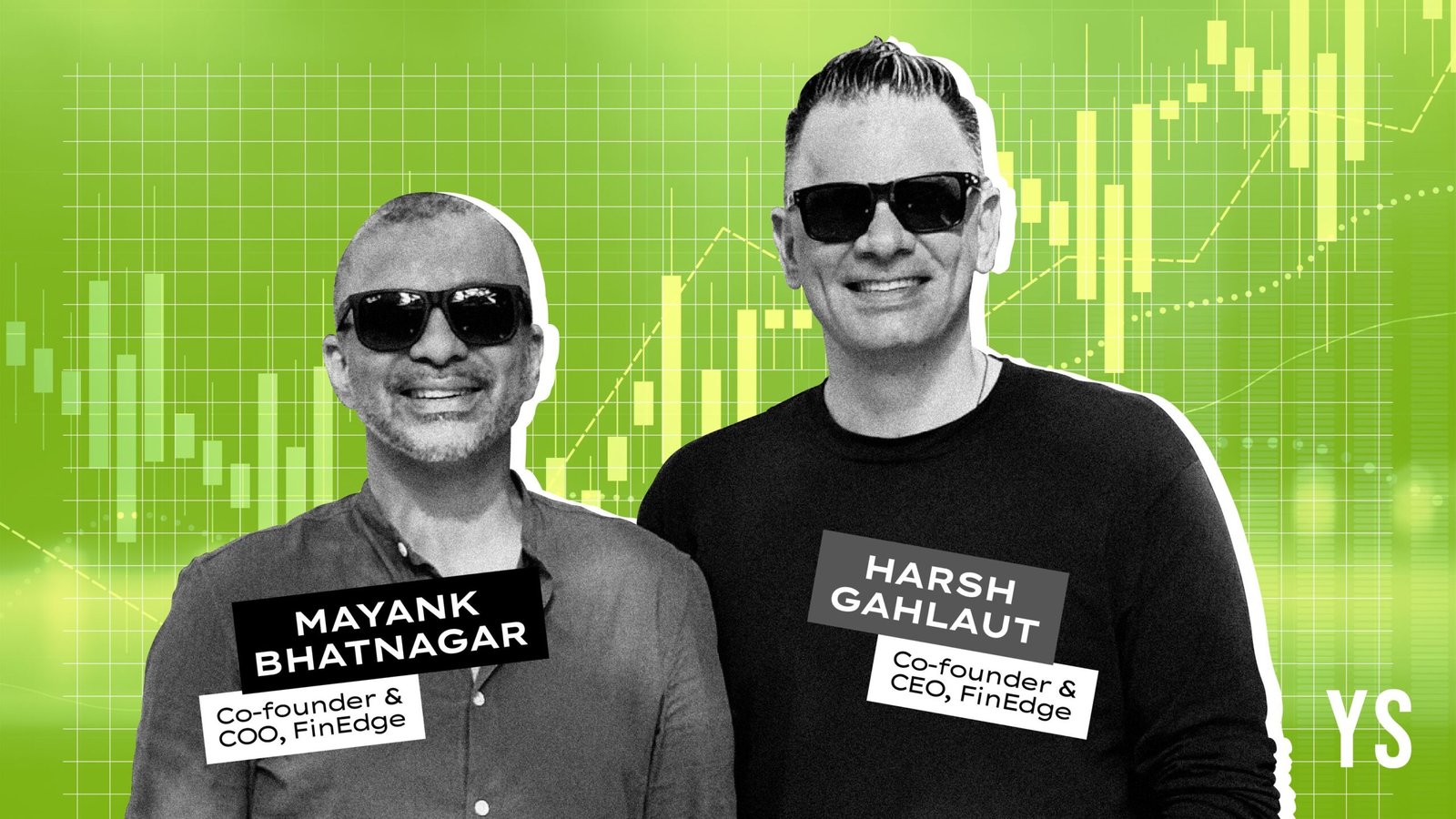
After about a decade of working in the banking industry, Harsh Gahlaut found what he describes as ‘glaring problems’ in it.
“Many just didn’t care about the user. Everyone was chasing the wealthiest people for the wallet share. Companies used to talk about the demographic and the large middle class but nobody would end up going to them,” Gahlaut says.
Gahlaut teamed up with Mayank Bhatnagar—a seasoned professional across retail and corporate banking—and in 2011, the duo co-founded FinEdge, a wealth management company that puts clients first.
“We wanted to take care of people. We didn’t want to disrupt anything or cause a lot of noise. We wanted to go after people who didn’t have money and help them achieve financial freedom,” he says.
Gahlaut is the CEO and Bhatnagar the COO of Gurugram-headquartered FinEdge, which employs 46 people.
A digital-first approach
As Gahlaut and Bhatnagar started from a virtual-first base, they realised that most of the software available back then was more transactional in nature. There was no such technology available back then that would help give better financial advice to clients and manage relationships over a period of years.
“We initially used third-party software to offer our virtual financial planning services, and then, due to lack of good options, we started building our entire digital ecosystem from 2016 onwards,” he says.
In 2020, the team started working on its moonshot product called Dreams into Action (DiA), a hybrid platform at the crossroads of human interaction and AI-enabled conversations. This platform was built in modules, which they started deploying from 2021 onwards. In 2023, all the modules were completed and rolled out.
“So let’s say you and I are having a virtual conversation. DiA absorbs all that information and dynamically starts making a plausible plan based on your expenses and other aspects of your financial situation,” explains Gahlaut.
.thumbnailWrapper{
width:6.62rem !important;
}
.alsoReadTitleImage{
min-width: 81px !important;
min-height: 81px !important;
}
.alsoReadMainTitleText{
font-size: 14px !important;
line-height: 20px !important;
}
.alsoReadHeadText{
font-size: 24px !important;
line-height: 20px !important;
}
}

DiA would also determine if certain goals were rational or not. “It wasn’t just user interface technology. It actually enabled the advisor and the client to have more meaningful conversations about a plan that is actually buildable,” he adds.
“Each client has one advisor but each advisor manages over 1000 clients. DiA helps the advisors stay up to date with every single aspect of a client’s financial portfolio. The client should feel they are the only client of that advisor,” he says.
The CEO says that even though a client may not be able to notice the impact of DiA, it nevertheless plays a major role in the operations. DiA focuses on behavioural investing, helping clients stay disciplined and avoid emotionally-driven financial decisions.
“In our industry, technology only solves about 10% of the problems with the other 90% requiring human efforts. But for those human interactions to be effective, you require a lot of technology deployment,” Gahlaut tells YourStory.
He adds that as GenAI grows and Agentic AI also comes into the picture, FinEdge will remain hybrid. The technology will be readily incorporated but no AI will interact with its clients.
The business side of things
The business-to-consumer (B2C) company has close to 2000 clients across 90 cities in India and in other countries such as the UAE, the UK, and Germany, among others. Around 70% of its clients come from West and South India. It boasts a retention rate of 80% with clients who have been with the company for more than two years.
“As an organisation, we don’t have sales targets, we don’t do product targets and we don’t do marketing. Our growth is pretty much from word of mouth. Our referral rate is very high. Almost every client we onboard refers us to five people who get onboarded within the next 24 months,” he says.
In its clientele, about 1,400 are NRIs. FinEdge doesn’t charge anything to its clients. Its platform—DiA—is free to use. It makes money through regular mutual funds and through commissions, which are built into the services.
“The cost of advice is bundled in the investment product. The investor typically pays approximately 0.5% per year as the cost for this bundled advice,” he says.
.thumbnailWrapper{
width:6.62rem !important;
}
.alsoReadTitleImage{
min-width: 81px !important;
min-height: 81px !important;
}
.alsoReadMainTitleText{
font-size: 14px !important;
line-height: 20px !important;
}
.alsoReadHeadText{
font-size: 24px !important;
line-height: 20px !important;
}
}

When a client gets on board, they are assigned with an investment manager. Then both the parties set up a call on DiA and that is when the software kicks into action and starts devising the financial plan for the client. All of this is based on the conversation between the parties.
FinEdge manages Assets Under Management (AUM) of about Rs 1500 crore. By steadily improving its tech, the company believes it will acquire one lakh clients by 2031 and manage one lakh crores of AUM by 2035.
“This growth must come without compromising our core value of being client centric and staying away from any sales or revenue targets,” he says.
Funding
With an initial investment of Rs 16 crore by the founders, the company broke even in 2016. With a yearly turnover of Rs 15 crore, FinEdge hopes to cross the Rs 100 crore mark by 2029.
Competing with companies like the Bengaluru-based Scripbox and the Gurugram-based INDmoney, Gahlaut believes FinEdge ‘edges’ them out due to its more dynamic software.
“I think we are at the beginning of the tech wave in the financial sector and most companies are taking the low-hanging fruit. I have not seen any other company build tech or AI enhancements within a software on the behavioural side. To get people to remain invested for a long time.”
Edited by Affirunisa Kankudti
