

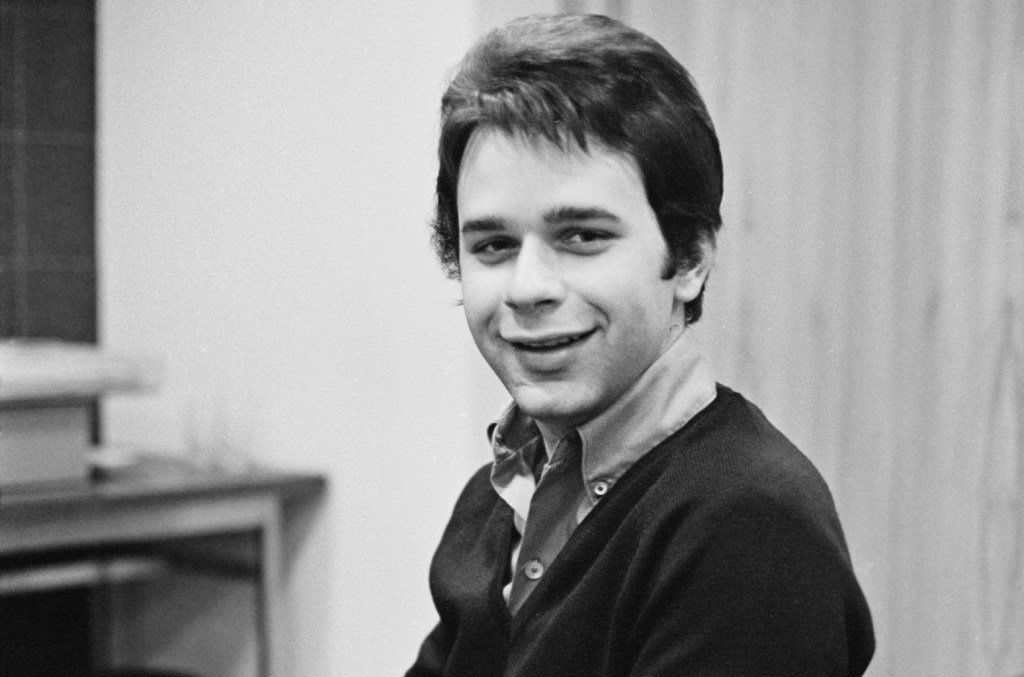
Forever No. 1 is a Billboard series that pays special tribute to the recently deceased artists who achieved the highest honor our charts have to offer — a Billboard Hot 100 No. 1 single — by taking an extended look back at the chart-topping songs that made them part of this exclusive club. Here, we honor Lou Christie, who died on Wednesday (June 18) at age 82, by looking at his lone Hot 100 No. 1: the lyrically questionable but musically undeniable “Lightnin’ Strikes.”
The year 1966 is often considered one of the greatest in the history of pop music, and scanning the list of artists who topped the Billboard Hot 100 will give you a pretty good idea why. It’s a list that includes British Invasion legends like The Beatles and The Rolling Stones, West Coast pop-rock standard-bearers like The Beach Boys, The Lovin’ Spoonful and The Mamas & The Papas, pace-setting Motown groups like the Supremes and the Four Tops and even a couple less-remembered garage-rock acts with one all-timer to their credit in The Troggs and ? and the Mysterians. The list of greats hardly ends there: Simon & Garfunkel, Donovan, Percy Sledge, both Frank Sinatra and his daughter Nancy…
Amidst that list of hall-of-famers, it’s pretty easy to miss Lou Christie’s name. Christie, born Lugee Sacco, was not the most phenomenal nor the most emblematic of 1966 chart-toppers; during a period of obvious transition in rock history, he felt and sounded a little more like the version of the pop world that was being left behind than the one being moved into. But he was representative of the impossibly rich depth of great top 40 music being produced in 1966 even a tier below the A-listers — while few would rate Christie’s “Lightnin’ Strikes” as the best No. 1 hit of a year that also included “Good Vibrations,” “Reach Out, I’ll Be There” and “The Sound of Silence,” fewer still would deny the pop confection’s considerable hook-driven, falsetto-laden charms.
Though “Lightnin’ Strikes” was the first (and only) No. 1 hit of Lou Christie’s career, in truth it was really something of a comeback single for the blue-eyed soul singer born just outside of Pittsburgh. He was still a teenager when he first reached the Hot 100 in early 1963 with breakout hit “The Gypsy Cried,” a song co-written with Twyla Herbert — a woman 15 years older than Christie who is mentioned in Fred Bronson’s Billboard Book of Number 1 Hits as “a clairvoyant who is said to have accurately predicted which of their songs would become hits.” Despite the unlikely pairing, Herbert and Christie would have fantastic success as writing partners, beginning with “Gypsy” (which peaked at No. 24 on the Hot 100 in March 1963) and the even bigger and better “Two Faces Have I” (No. 6 that June).
Both singles also benefited from the production of fellow Pennsylvanian Nick Cenci, who made the game-changing suggestions for Sacco to adopt Lou Christie as his artist name, and to really feature his falsetto range on the singles. Cenci had good reason to push Christie’s voice into that upper register — during the pre-Beatles ’60s, the biggest pop act in the world was vocal group The 4 Seasons, led by the piercing falsetto of the iconic Frankie Valli. Just two weeks before “Gypsy” peaked on the Hot 100, the Seasons had scored their third consecutive (non-holiday) No. 1 hit with “Walk Like a Man”; Cenci advised Christie to study of the first of those No. 1s (“Sherry”) and model his own vocal performance after it. The timing was ideal: While The 4 Seasons wouldn’t hit the top 10 again until “Candy Girl” that August, Christie took advantage of the group’s brief chart lull to establish himself as a rising top 40 star.
But that rise was quickly interrupted. After hitting the Hot 100 one more time in 1963 that August with “How Many Teardrops” (No. 46), Christie was called up for Army Reserve duty. He went from touring with (and possibly romancing) an ascendant Diana Ross on Dick Clark’s Caravan of Stars tour to serving duty at Fort Knox for six months, derailing his pop career until his 1965 discharge. From there, he was determined to get things back on track — and according to Number 1 Hits, he called Herbert the day he got out to start working on songs again.
One of the songs the pair came up with was “Lightnin’ Strikes.” The song glided by on an irresistible soul-pop thrum, with low sax, steady piano and backbeat-heavy bass and drum that all could have easily backed a Motown smash of the year or two prior. (The song’s B-side was called “Crying in the Streets” — appropriate, considering that “Strikes” most closely resembled a more emotive “Dancing in the Street.”) Extra musical punctuation was offered via backing vocals from New Jersey girl group The Delicates, who provide “stop!” echoes throughout the pre-chorus, and mark each verse lyric with an unintelligible-but-effectively harmonized “uhheeeyaaooo” that keeps things sweet-sounding throughout.
And those verses do need a little extra dose of sweetness, because the lyrics themselves could certainly be read as sour. A still-baby-faced Christie begins with a plea for understanding about The Way Men Are — “Listen to me, baby, you gotta understand/ You’re old enough to know the makings of a man” — but despite the implied philandering there, he’s asking his girl to stay patient: “It’s hard to settle down/ Am I asking too much for you to stick around?” The idea of settling down, for Christie, remains a vague and far-off proposition, and in the pre-chorus, he makes his lack of self-control (or willingness to try to temper it) very clear: “When I see lips beggin’ to be kissed/ I can’t stop.” The double-standard is obvious, but Christie shrugs it off as temporary: “All the girls are sayin’ that you’ll end up a fool/ For now, baby, live by my rules.”
Tough stuff, but delivered in an irresistible-enough musical package that you can essentially tune out the ickiness of the verse lyrics and just wail along with the uhheeeyaaooos until you get to the chorus. And the biggest reason the song works is still Christie himself: He’s solid enough as a crooner on the verses, but once he begins with the “I can’t stop (stop!)”s at the end of the pre-chorus — gradually working his vocals up the octave until he’s back in that recognizably signature range — he basically undergoes a Wolf Man transition, until he’s the lothario howling at the moon in soaring falsetto about liiiiiightniiiiiing striiiiikiiiiiing again and again and again and again. He’s not really any more or less monstrous than he was in the verses, but now his superpowers have been unleashed, and he truly is unstoppable.
There’s more to recommend “Lightnin’ Strikes”: the subtle melodic shift to a delicate piano riff and “Be My Baby”-like drum heartbeat in the pre-chorus, the final pre-chorus shift to a “chapel in the pines” that teases a climactic proposal (no such luck for Christie’s intended), and most unconventionally, a six-string bass solo, which guitarist Ralph Casale told Songfacts was improvised as a goof, but left in for how it approximated the sound of a rumbling thunderstorm. But “Strikes” is most charming for its simplicity, the effectiveness of its chorus and backing vocals, and a backing beat grooveable enough to distract you from the message you’re moving to.
“Strikes” debuted at No. 93 on the Hot 100 dated Christmas 1965, moving to the No. 1 spot on the chart eight weeks later, replacing Petula Clark’s “My Love” and lasting one week at pole position, before making way for Nancy Sinatra’s “These Boots Are Made for Walkin’” — a hit perhaps slightly more indicative of the time’s changing gender dynamics. He had one more major ’66 Hot 100 hit in the similarly winning “Rhapsody in the Rain,” which reached No. 16 that April — and might have gone much higher, if not for many radio stations at the time deeming it too controversial for its backseat-themed lyrics. Christie’s follow-up singles stiffed on the charts, and he would not visit the chart’s top 40 again until he switched labels in 1969 and had a second mini-comeback with the bubblegum-flavored, less-falsetto-driven “I’m Gonna Make You Mine,” a No. 10 hit that August.

Lou Christie
Billboard
In the next decade, Christie drew some attention and positive critical notices for the 1971 concept album Paint America Love, but the album missed the Billboard 200 entirely and produced no hit singles. Christie only reached the Hot 100 once more, with his No. 80-peaking cover of the pop standard “Beyond the Blue Horizon” in 1974, and otherwise mostly settled into a career performing on the oldies circuit. Sadly, his death from cancer at age 82 last week (June 18) comes just after two other 82-year-old icons from his era — Brian Wilson and Sly Stone — and thus seems unlikely to get the attention it deserves. But “Lightnin’ Strikes” shows how important even the less-remembered hitmakers of an age are in painting the full portrait of that moment in time — and 1966 simply would not be the year that it is in the public memory without that Christie falsetto and those uhheeeyaaooos.
