


Lofty climate goals often sound simple at their core: cut emissions, reach net zero, and report progress. But for enterprises with complex supply chains, just measuring emissions is a major hurdle. Mumbai-based Snowkap is using AI to turn that challenge into a starting point for real climate action.
“The biggest challenge in ESG (Environmental, Social, and Governance) and GHG (Greenhouse Gas Emission) today is data,” says Rajesh Patel, Co-founder and CEO of Snowkap. “What gets measured gets changed. But many companies don’t even know what to measure.”
Formally incorporated in 2021, Snowkap operates under Below2 Impact Solutions Pte, a Singapore-registered company where Snowkap is currently its sole brand focus. The name ‘Below2’ reflects a global goal, to limit warming to below two degrees Celsius. Snowkap is its flagship brand, designed to make sustainability measurable, actionable, and commercially viable.
.thumbnailWrapper{
width:6.62rem !important;
}
.alsoReadTitleImage{
min-width: 81px !important;
min-height: 81px !important;
}
.alsoReadMainTitleText{
font-size: 14px !important;
line-height: 20px !important;
}
.alsoReadHeadText{
font-size: 24px !important;
line-height: 20px !important;
}
}

The genesis of Snowkap
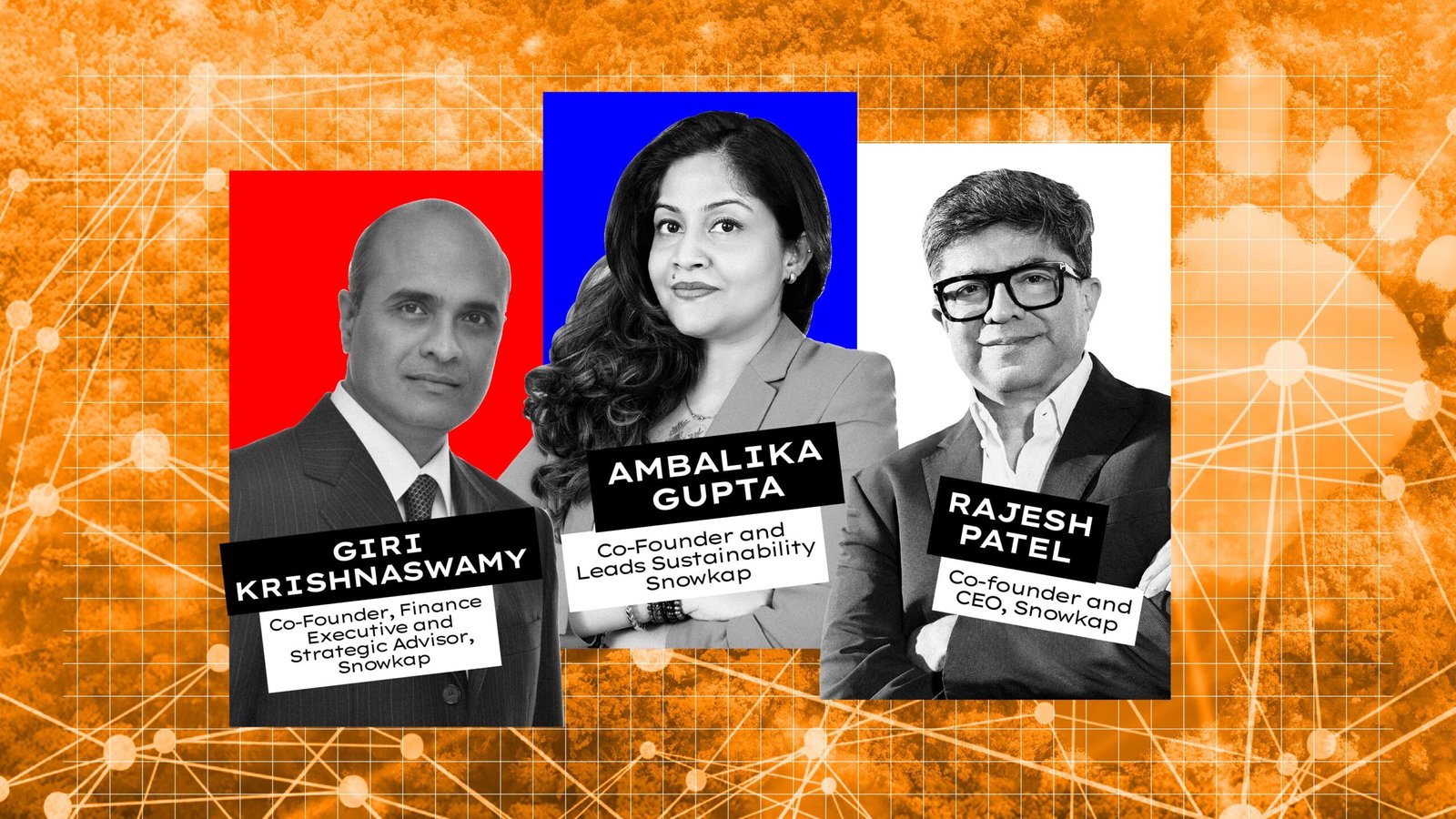
Snowkap was co-founded by Patel, a technology entrepreneur with over three decades of experience, Ambalika Gupta, and Giri Krishnaswamy. Patel is also Chairman and CEO of Powerweave Group, a global technology services and digital solutions company. Gupta, who leads sustainability at Snowkap, has worked in ESG at Mahindra and ESG tech firm Datamaran. Krishnaswamy, a seasoned finance executive and strategic advisor, has held leadership roles at Nestlé, Centrum Group, and Acorn Fund.
The idea for Snowkap emerged in late 2020 when clients of Powerweave began asking for ESG data on vendors. Patel says Scope 1 emissions, from a company’s direct operations, were generally well documented. Scope 2 emissions, which cover indirect emissions from purchased energy, were also being reported by most organisations. However, Scope 3, the indirect emissions from vendors and the broader value chain, remained a blind spot.
“Most companies struggled to measure Scope 3 emissions,” Patel says. “We saw an opportunity to simplify that process, and that became our starting point.”
.thumbnailWrapper{
width:6.62rem !important;
}
.alsoReadTitleImage{
min-width: 81px !important;
min-height: 81px !important;
}
.alsoReadMainTitleText{
font-size: 14px !important;
line-height: 20px !important;
}
.alsoReadHeadText{
font-size: 24px !important;
line-height: 20px !important;
}
}

From measurement to mitigation
Snowkap’s solution is built around a proprietary AI-powered platform. It supports businesses across four stages: capturing data, generating insights, planning actions, and measuring impact.
The platform consolidates ESG and GHG data from multiple sources, including PDFs, invoices, and procurement records, by using in-house developed AI and machine learning. Clients upload raw documents, and the system handles the rest.
“We’ve designed the AI to integrate data from internal systems, web sources, and global databases,” Patel says. He adds that the software can automatically generate compliance reports for frameworks like India’s BRSR (Business Responsibility and Sustainability Report), Europe’s CSRD (Corporate Sustainability Reporting Directive), and GRI (Global Reporting Initiative) standards.
Additionally, the platform helps companies act on their data by evaluating vendors, suggesting lower-emission alternatives, optimising processes, and reducing waste.
Patel gives an example: a company buying one tonne of PET (used in plastic bottles) might be unaware that the purchase also includes approximately 1.3 tonnes of carbon dioxide emissions. Snowkap helps quantify that, compare vendors, and assess the benefits of switching to recycled PET. “It’s about turning data into action,” he says.
Serving enterprises and enabling suppliers
Snowkap’s primary customers are large enterprises with significant ESG challenges. Its clients include Tata Global Beverages (Himalayan), Joy Personal Care, Malabar Gold & Diamonds, Senco Gold, and JSW Steel. The platform also indirectly serves thousands of smaller vendors connected to these firms, Patel says.
“Many vendors want to reduce their emissions but lack the tools. We equip them through our enterprise clients,” Patel explains.
The platform is hosted on cloud infrastructure via AWS and IBM, is ISO 27001 certified, and compliant with global data privacy standards, including GDPR (General Data Protection Regulation) and India’s DPDP (Digital Personal Data Protection Act).
Snowkap employs 50 people, of whom 30 are in technology roles, including AI engineers, full-stack developers, data analysts, and sustainability experts. The company uses generative AI and computational models to deliver insights, simulate emissions-reduction strategies, and automate compliance reporting.
It also uses retrieval-augmented generation (RAG) on top of large language models to interpret complex policy documents. Dashboards allow clients to track emissions, compare against peers, and monitor progress towards science-based targets.
“Our AI does much of the heavy lifting in the background, simplifying what was once a consultant-driven process,” Patel says.
One of the early challenges was getting large companies to trust a new startup. “We had to prove that we could deliver and be reliable,” Patel says. The company faced another challenge in hiring, especially for roles that needed a mix of AI skills and sustainability knowledge.
Headquartered in Mumbai, Snowkap also operates offices in Europe, Dubai, GCC, and the US (Baltimore and Los Angeles), serving clients globally. The company currently serves 25 clients across these markets.
Market outlook and competitive edge
Snowkap was bootstrapped with $300,000 from its two founding teams and later secured $1 million through a friends-and-family round.
The company operates on a SaaS-based model, offering enterprise licences that start at $50,000 per year. It also provides value-added services such as ESG education, beginning at around $8,000. These services include training programs to help internal teams understand ESG and GHG fundamentals, as well as hands-on guidance on regulatory frameworks, materiality assessments, and sustainability goal-setting.
In addition to licensing, Snowkap follows a partner-driven approach to implementation. It collaborates with global consulting and technology firms such as Bosch and Alvarez & Marsal, which play a key role in client onboarding, training, and solution rollout. These partners not only bring domain expertise and regional reach but also help Snowkap maintain a lean core team while delivering at scale.
Patel says the company aims to serve 10 million vendors and onboard 5,000 corporations worldwide in the next few years. “Globally, over $30 trillion in assets are managed under ESG mandates. Every mid-to-large enterprise will need a solution like Snowkap,” he says.
The company faces competition in several categories, including the Big Four consulting firms, software giants such as SAP and Salesforce, and ESG-focused companies like EcoVadis and Persefoni. “But our advantage lies in speed, cost, specialisation, and enterprise-grade capability,” Patel says.
Looking ahead, Snowkap plans to launch Snowkap.ai by October 2025. Currently in testing, the new platform will deepen its AI capabilities and expand its predictive and decision-making tools.
Edited by Jyoti Narayan
