

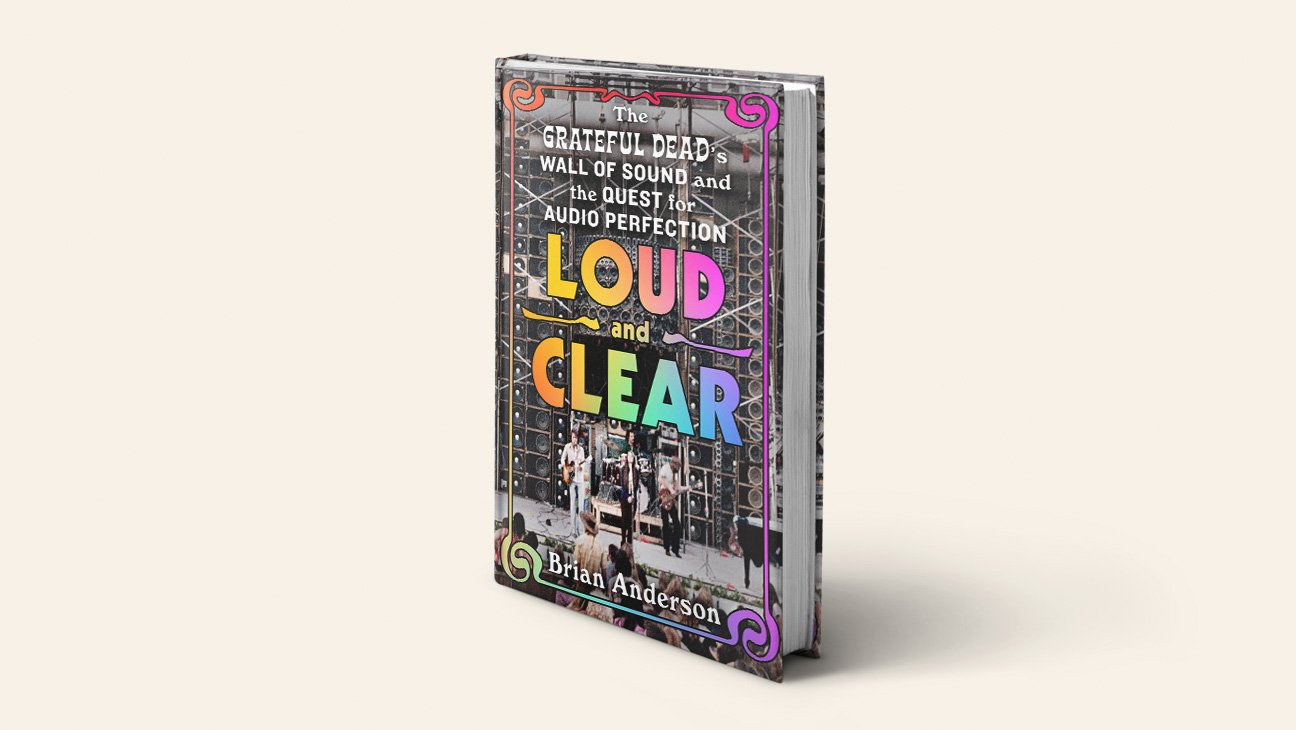
When journalist Brian Anderson acquired a crumbling speaker monitor from the Grateful Dead’s legendary 1974 Wall of Sound via a Sotheby’s auction, it wasn’t just memorabilia he was after. The former science editor at The Atlantic was seeking a portal, both physical and metaphorical, into Grateful Dead history. A way back to a moment when, as bassist Phil Lesh wrote in his 2005 memoir Searching for the Sound, “from the beginning every one of our moves was powered by deep waves in the group unconscious, these mighty currents were moving us in a singular direction toward a musical polar opposite.”
If that sounds a bit out there, that’s because it was. The Grateful Dead charted the musical and psychedelic terrain of the 1960s counterculture. By the early ’70s, they were searching for new ways to innovate and to forge a deeper communion with their audience.
The Wall of Sound was their most audacious attempt: a 60-foot-wide, 75-ton scaffold of nearly 600 speakers designed to deliver pristine, distortion-free sound to both the band and audience. Debuting in March 1974, it pushed the boundaries of live audio in such a way that marked a new generation in live-music audio, but was short-lived.
That legacy, Anderson argues in Loud and Clear (St. Martin’s Press, June 17), extends far beyond Dead lore. Today’s immersive venues like the $2.3 billion Sphere in Las Vegas, where Dead & Company now hold extended residencies, owe a direct spiritual and technological debt.
“The Wall of Sound walked so the Sphere could run,” Anderson told me. “The idea of making the venue an immersive sound space is baked into both. The Sphere just has the money and technology to actually make it happen without needing 75 tons of scaffolding.”
The Wall was so radical it placed the entire PA system behind the band — a move that defied sound design norms but fulfilled the Dead’s dream of unifying performer and listener.
“It was crucial that the band and the audience hear the same thing,” Anderson says. “The audience was just as much a part of the show as the band was.”
Now, with Loud and Clear, Anderson delivers the definitive chronicle of the Wall — a towering, short-lived PA system that revolutionized live music and remains a symbol of the Dead’s sonic and spiritual ambition. Combining oral history, memoir, and reporting, the book reconstructs how a band of misfits and audiophiles came to build and transport the monolithic Wall of Sound.
The Wall was not just equipment, it was architecture and ideological aspiration.
The book opens with Anderson unboxing the artifact, his slice of the Wall, at his parents’ suburban home. A battered vocal monitor made of Finnish birchwood, the speaker still bore a stamp: G. DEAD / JUL 17 1974. It had, he realized, “touched hundreds of thousands of people” and “clocked thousands of miles.” That discovery sets off a journey into one of the most ambitious live sound experiments ever attempted.
The Wall, Anderson shows, was not just an engineering marvel, the brain-child of Owsley “Bear” Stanley’s LSD-informed genius, it was a philosophical statement. The system rejected traditional front-of-house mixing. Instead, it gave each musician control over their sound, eliminating conventional monitors. The Wall was the monitor. “It was crucial that the band and the audience hear the same thing,” Anderson told me. “The audience was just as much a part of the show as the band was.”
In great detail, Anderson profiles the roadies, engineers, and builders, figures like Mark “Sparky” Raizene, Janet Furman, and Dan Healy, whose labor, he argues, was just as central as Garcia’s guitar. “These were people who lived this, who busted their asses and made something miraculous happen — and no one had ever asked them about it,” he said.
Stanley’s vision, engineered by Ron Wickersham, Dan Healy, Rick Turner, and others, was to create a PA system where every component had a sonic purpose. In the book, Anderson notes how “each string of Phil’s bass had its own dedicated speaker column,” and how the system delivered stereo separation in such clarity that “you could hear the space between the notes.” Now imagine that level of technical sophistication on LSD in the mid-70s.
Loud and Clear also acknowledges the Wall’s unsustainable nature. At its peak, the system required four semis, leapfrogging scaffolds, and $100,000 in monthly transport costs. “A good piece of every Grateful Dead dollar would go towards their sound reinforcement,” Anderson said. “That was all well and good until… the operation started getting so big… that message that the Wall of Sound was not sustainable got through to Garcia.”
The Wall ran from March to October, traveling from San Francisco to Jersey City and back, before being dismantled forever after a final five-night stand at Winterland.
The book doesn’t shy away from the darker edge of that era. By late 1974, the communal idealism had soured, undercut by cocaine, burnout, and turf wars among the crew. The Dead stopped touring at year’s end, and wouldn’t come back to touring consistently until almost two years later, and of course, the Wall was dismantled. But the legacy endured, in curved speaker arrays used in venues today, and as Anderson points out some of the tech is used in noise-canceling headphones, and even in the greater music industry business model of DIY artistic control.
“The Wall is a colossal character unto itself,” he notes, quoting Lesh calling it “the voice of God.” Yet it was also an albatross. “It was apocalyptic,” Lesh said. Weir called it “the monster with a thousand screaming eyes.”
Today, that monster lives on, not in steel and speakers, but in light. During Dead & Company’s residency at the Las Vegas Sphere, the silhouette of the Wall appears once more, towering above the crowd, a flickering memory made mythic. A dream made audible.
