


For many stroke survivors, regaining the use of their arms and hands is one of the toughest challenges on the road to recovery. It demands hundreds of precise repetitions each day- an exhausting task for patients and a time-intensive one to follow up for therapists.
Hyderabad-based BeAble Health is trying to change that with ArmAble, a smart rehab device that turns exercises into easy, familiar games to keep patients motivated and consistent. The device uses familiar, intuitive games like swatting mosquitoes to make repetitive arm and hand movements playful and engaging.
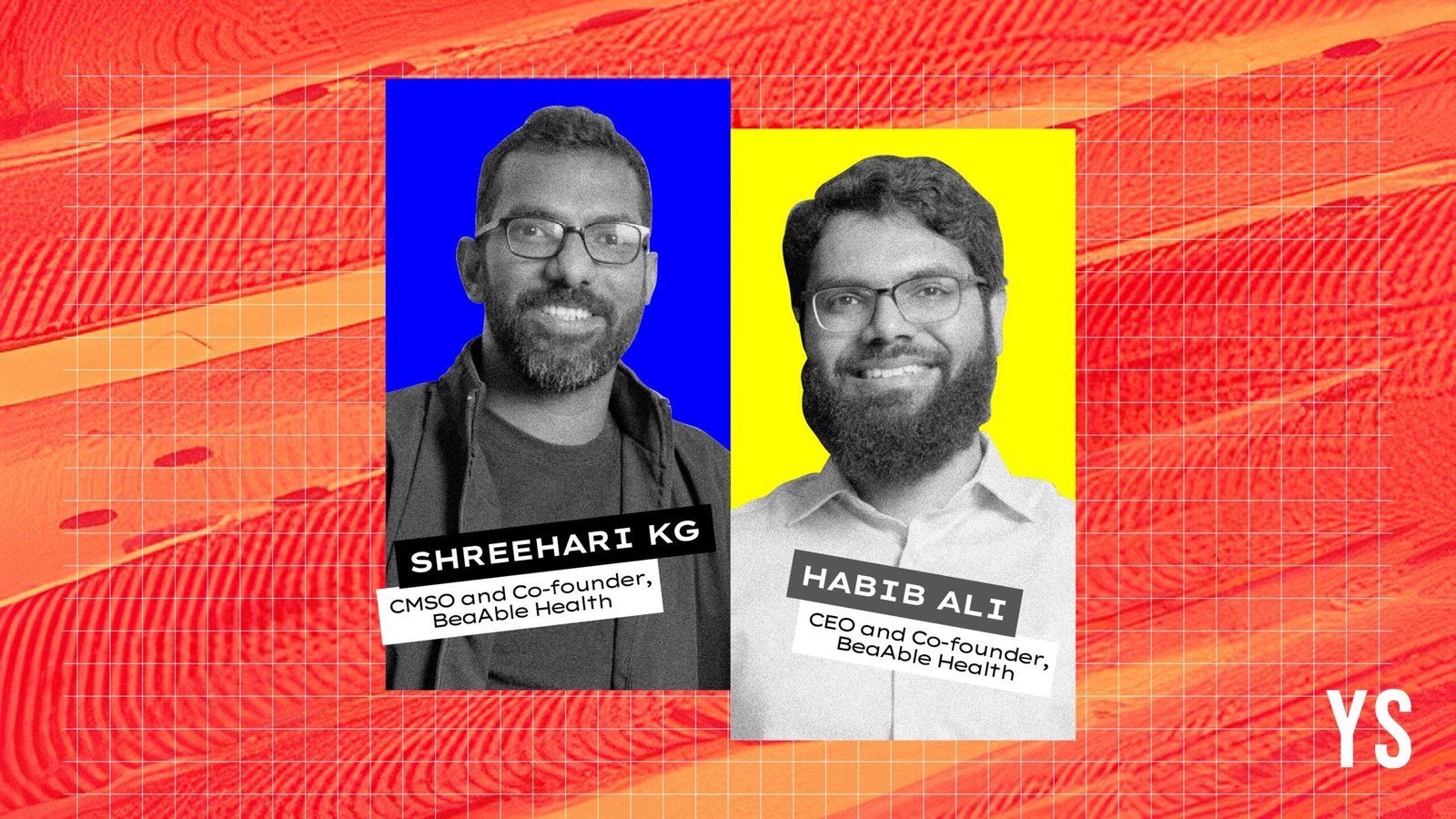
Founded in 2019, BeAble Health is led by Habib Ali, the CEO, and Shreehari KG, the CMSO, a former assistant professor at Christ University and Amrita University in design and film studies.
Ali, who completed his double master’s in biomedical engineering from Manipal University and IIT Hyderabad, spent much of his early career in hospitals, observing patient challenges and thinking about practical solutions. While at college, he started two biomedical ventures: a hands-free electrolarynx for people who had lost their voice box, and a device to aid jaw rehabilitation. Both gave him insight into product design, but also revealed the limits of scaling without a deeper understanding of entrepreneurship.
That realisation led him to IIT Hyderabad’s Fellowship in Healthcare Entrepreneurship, where he spent a year shadowing doctors, nurses, patients, and caregivers to identify unmet needs in medicine. Of over 300 documented problems, six or seven were linked to physiotherapy, especially upper limb recovery after stroke.
“We found that arm and hand movement recovery was much poorer than leg recovery,” Ali says. The reason, he explains, lies in the brain’s wiring: the areas controlling upper limb movement are more complex, and regaining function requires hundreds of repetitions to trigger neuroplasticity, the brain’s ability to form new connections.
But patients tire quickly, and therapists cannot manually help them to reach the 300-600 daily repetitions that research recommends. Robotics wasn’t the answer either; active recovery is limited if a machine moves the limb for the patient.
Ali then considered gamification, turning therapy into games that use culturally familiar actions like swatting mosquitoes.
“If you see a mosquito, you instinctively swat it. That’s the kind of natural movement we design for,” Ali says. The approach also uses bilateral training, where the healthy hand helps guide the weaker one, creating a connected movement that supports the recovery.
.thumbnailWrapper{
width:6.62rem !important;
}
.alsoReadTitleImage{
min-width: 81px !important;
min-height: 81px !important;
}
.alsoReadMainTitleText{
font-size: 14px !important;
line-height: 20px !important;
}
.alsoReadHeadText{
font-size: 24px !important;
line-height: 20px !important;
}
}

Products and technology
BeAble Health’s flagship product, ArmAble, is a gamified therapy device priced at about Rs 8 lakh. The company operates on a B2B model, selling primarily to healthcare institutions. The device is used in over 50 hospitals and rehab centres across India, including NIMS Institute of Medical Sciences in Hyderabad, Hamsa Rehab in Chennai, and Romania Hospital in Bengaluru.
ArmAble’s integrated software platform, BeOne, tracks movement data, analyses performance, and presents easy-to-understand insights for therapists.
BeOne currently operates directly on the device, but a standalone mobile application is on the anvil by the end of the year. This will be accompanied by a subscription model with different tiers tailored for rehab centres, individual patients, and independent therapists.
BeAble Health is also using an AI wrapper to process and interpret raw movement data, transforming it into actionable feedback for clinical use. The sensors capture how the patient moves, and this data is processed through the wrapper to detect movement patterns.
These patterns are then compared with the patient’s therapy goals, allowing the game to adjust in real time, making exercises harder or easier based on the patient’s performance, so that the patient’s recovery remains both effective and engaging.
.thumbnailWrapper{
width:6.62rem !important;
}
.alsoReadTitleImage{
min-width: 81px !important;
min-height: 81px !important;
}
.alsoReadMainTitleText{
font-size: 14px !important;
line-height: 20px !important;
}
.alsoReadHeadText{
font-size: 24px !important;
line-height: 20px !important;
}
}

Navigating challenges
The company’s clinical trials were planned for 2020, but were delayed by the COVID-19 pandemic. Post-COVID, BeAble Health localised its supply chain so that most components are sourced within 100 km of Hyderabad, reducing dependency on imports.
Ali points out that fundraising for medtech devices is challenging. “VCs often look for rapid growth models, but in medical devices, product development, clinical validation, and regulatory approvals can take five to six years,” he says.
BeAble Health’s initial investment was around Rs 25 Lakh, and it has relied heavily on government and foundation grants from organisations like BIRAC, Social Alpha, India Innovation Growth Foundation, and the Indo-US Endowment Fund, with typical grants ranging between Rs 25- 50 lakh.
So far, the company has raised a total of Rs 2.5 crore and is now looking to raise close to $1 million in its next funding round.
According to Ali, the company conducted India’s first multi-centre randomised clinical trial for such a product, showing 39% better recovery and a 9.1-point improvement on standard stroke scales, which means patients using ArmAble regained more movement and independence in daily life than with regular physiotherapy. The company also holds patents in India and the US, adding to its credibility.
Market and the competition
BeAble Health is currently focused on South India, but it plans to expand to North and East India. Internationally, BeAble Health has explored markets like the UK and Germany, sent its first prototype to a young stroke survivor in the UK, and showcased its work at physiotherapy conferences in Dubai and Saudi Arabia.
According to Data Intelo, the global market for medical rehabilitation smart devices was valued at about $3.8 billion in 2023 and is projected to grow to roughly $9.2 billion by 2032, at a compound annual growth rate (CAGR) of around 10.3%.
“We’ve generated roughly Rs 3.5 crore in revenue so far,” Ali says. “Out of 18,000-plus rehab centres in the country, around 5,000 focus on neuro rehab, which is our primary target.”
As for challenges, the company sees the biggest barrier not in rival products but in awareness. “A lot of people don’t even know about physiotherapy and therapists. They can also be hesitant to adopt new technology,” he says.
In terms of direct competition, the company points to global players like DIH and other European imports, which cost around Rs 50- 60 lakh. “It’s significantly higher than ArmAble, so there is no match in terms of calling them our competition,” Ali says.
The road ahead
BeAble Health’s small team of seven operates from Hyderabad, assembling devices in-house from outsourced components. The company runs on Zoho, which has been its business operating system for some time. Much of the manufacturing is outsourced to specialist vendors, with all components shipped to the Hyderabad facility, where the team assembles the devices, tests, and validates, and then ships the product out.
“We’re not a manufacturing industry company in the traditional sense,” Ali says. “Our job is to design and deploy the products.”
Two more products are in the pipeline: ArmAble Mini, a smaller, table-top version of the flagship device, designed for home-based rehabilitation at a price point of Rs 2- 3 lakh; and T-Able, a modular occupational therapy table adjustable for sitting, standing, or inclined use and suitable for both adults and children. Both are scheduled to be launched this year.
Beyond these, the company has eight more products in development, at stages from early concept to prototype testing. All are designed to integrate with the BeOne platform to form a connected rehab ecosystem.
For Ali, the mission is clear: “The problem we’re solving is not just device-specific or software-specific. We need to empower the rehab ecosystem with the right tools, and that’s what we’re building.”
Edited by Affirunisa Kankudti
