

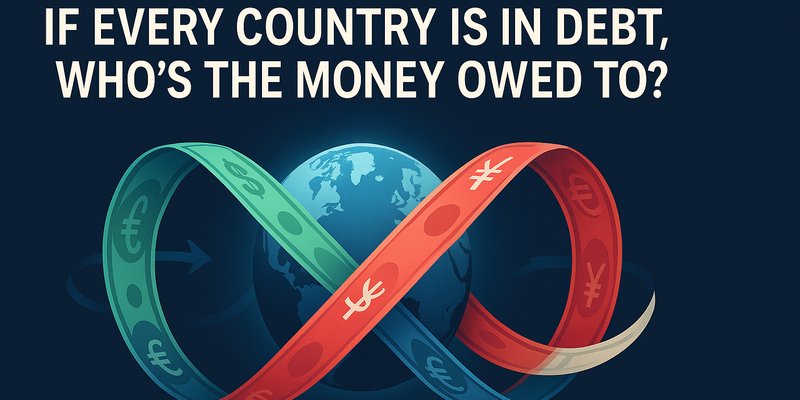
It’s a question so simple that it sounds like a riddle: If every country owes money, who exactly is getting paid? With the U.S. national debt topping $36 trillion, and global debt exceeding $300 trillion—more than three times the world’s GDP—you’d expect a clear answer. But the truth is far more complex, tangled in a web of circular lending, national savings, and institutional investing that underpins the entire modern economy.
A debt-shaped world
Debt isn’t just a number on a spreadsheet—it’s the fuel of our global economy. Governments borrow to build roads, fund schools, support crises, and stimulate growth. What was once a wartime tool has become standard operating procedure. From the 1980s onwards, countries realised debt could be used to grow economies, not just survive downturns.
But this has led us to a strange place: nearly every major country is a borrower. Yet they’re also lenders. China, for example, holds over $750 billion in U.S. debt, while simultaneously being $18 trillion in debt itself. American banks hold Chinese bonds. Chinese banks hold U.S. treasuries. Japan, Europe, Brazil—they all owe and own.
Who exactly holds the debt?
Take the United States as a case study. Of its $36 trillion debt:
- Around 20% is intragovernmental, owed to agencies like Social Security.
- The remaining 80% is held by the public—but not just foreign governments.
In fact, about 70% of that public debt is held by Americans themselves—banks, pension funds, insurance companies, mutual funds, and even individuals. The Federal Reserve alone holds nearly $6 trillion in U.S. Treasuries. When you deposit money in your bank, it doesn’t sit still. Banks invest that cash—often in bonds. So unknowingly, you might be lending money to your own government.
The rest—around 30% of U.S. debt—is owned by foreign entities. Japan is the largest foreign holder at over $1.1 trillion, followed by China, the UK, Luxembourg, and the Cayman Islands. But even these foreign nations are playing both sides—lending and borrowing simultaneously.
The circular economy of debt
Modern debt doesn’t move in straight lines—it flows in loops. Governments issue bonds to raise money. Investors—from banks to pension funds—buy those bonds and earn interest. That interest is often reinvested… into more bonds. The cycle continues.
This happens not just within countries, but between them. Japanese savings may fund Dutch infrastructure. Dutch savings may finance Brazilian bonds. Brazilian banks may invest in U.S. treasuries. Global debt, it turns out, is a closed-loop ecosystem, not a one-way street.
Governments are essentially borrowing from their own people, funnelling money from idle savings into active spending. When you hear that “America is in debt,” it might actually mean America owes Americans—with interest.
What happens if the cycle breaks?
Debt enables growth, but it also creates vulnerability. As countries borrow more, they spend more on interest payments—money that could’ve gone to healthcare, education, or infrastructure. In the U.S., debt servicing has climbed to 4.7% of GDP, a level not seen in years.
And if confidence slips, the consequences can be severe. Take Greece in 2008: when investors panicked, borrowing dried up. The government couldn’t pay its bills. One in four public workers lost their jobs, and GDP fell by 25%. This is the debt spiral—a situation where countries must borrow more just to stay afloat, a trap that’s caught places like Sri Lanka and Pakistan in recent years.
To stay afloat, governments may raise taxes, cut spending, or print more money. But each option comes with consequences—reduced services, political backlash, or rampant inflation (as Venezuela experienced in the 2010s).
Debt is here to stay
Despite its risks, debt isn’t going away. In fact, we rely on it. In the U.S., one out of every four dollars spent by the government is borrowed. In China, it’s closer to one in five. Without borrowing, spending stops. Without spending, economies shrink. And no politician wins elections promising less growth.
Even repaying debt is often done by… borrowing again. Old bonds are paid off with new ones. So long as confidence holds and interest rates remain manageable, the cycle continues. That’s how the system was designed—not to eliminate debt, but to keep it moving.
The rise of gold and the search for something real
As debt piles up, some investors are getting nervous. In 2025, gold is up nearly 28%, and silver just hit a 30-year high. People are looking for value that isn’t built on promises. Even big banks like JPMorgan and Goldman Sachs predict gold may hit $4,000/oz by 2026.
Why? Because debt is only sustainable if people believe it is. And when belief falters, tangible assets like gold start to shine.
So, who’s the money really owed to?
Here’s the hard truth: it’s owed to us. And also by us. Governments borrow from citizens. Citizens lend through banks and funds. Those banks buy bonds. Interest is paid, reinvested, and the loop restarts.
It’s not a villainous lender lurking in the shadows. It’s a giant web of mutual obligation, a spinning flywheel of modern finance that works only as long as everyone keeps playing along.
Edited by Rahul Bansal
