

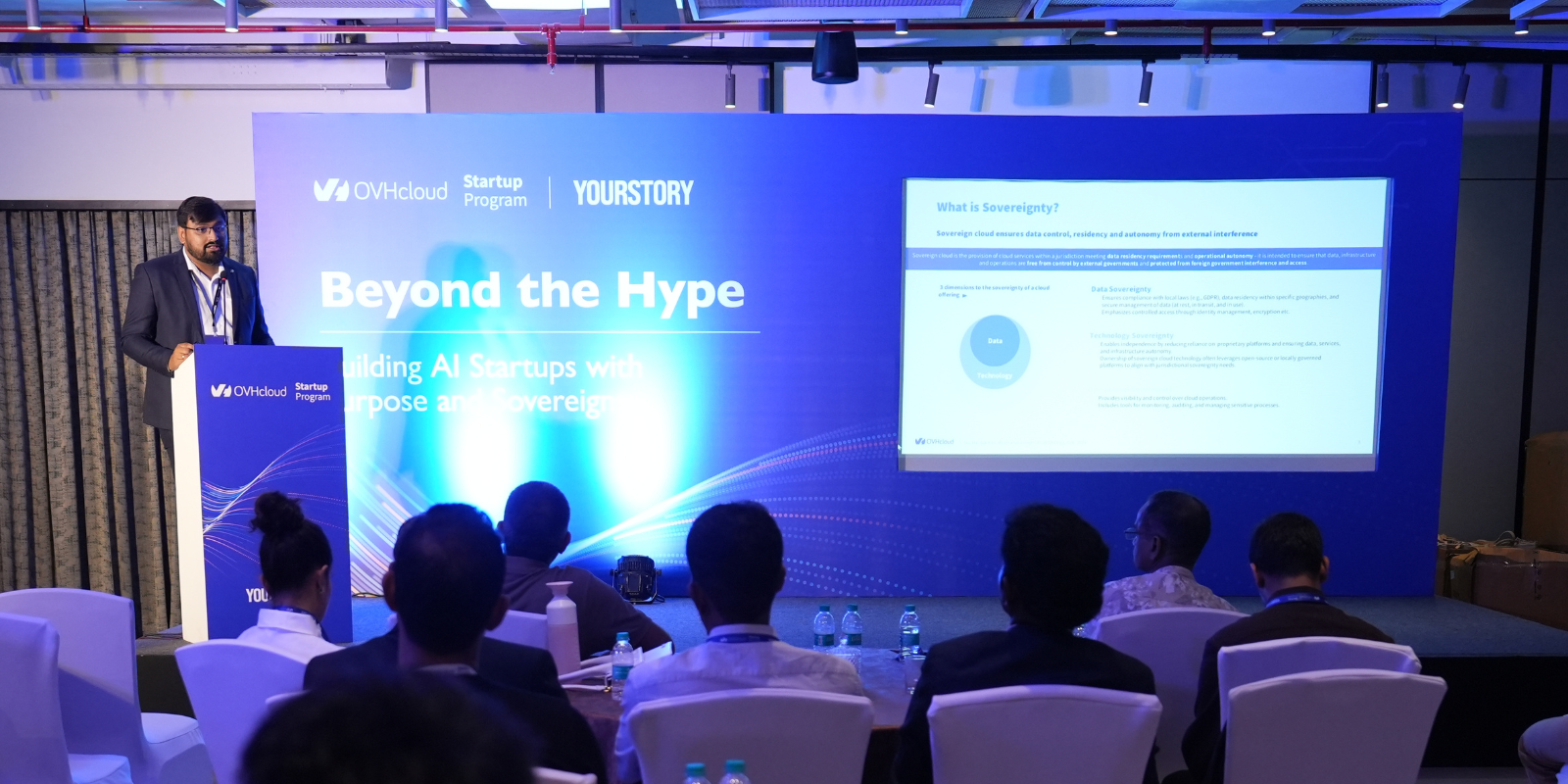
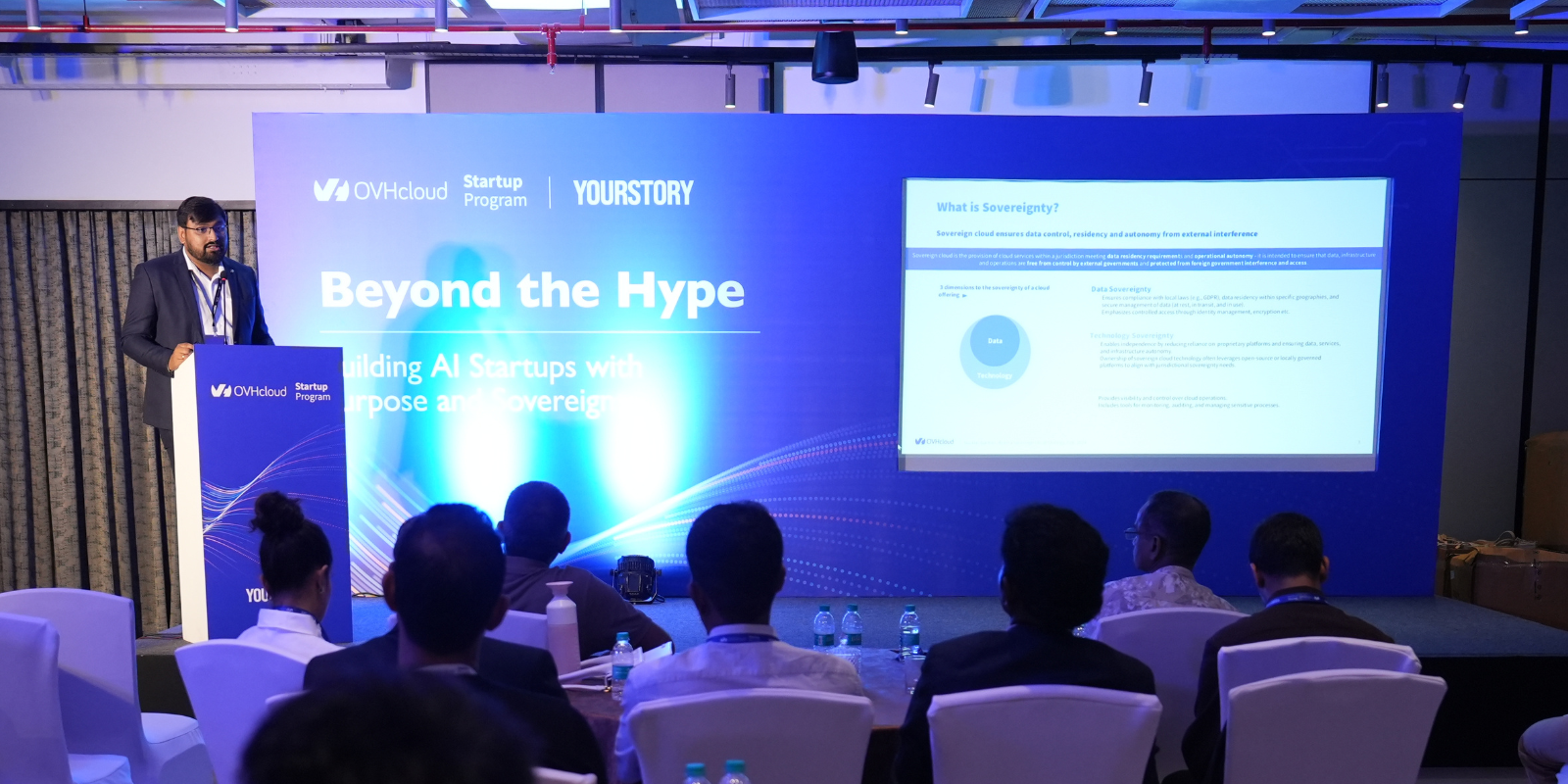
What does it take to build an AI startup that’s not only smart, but sovereign, scalable, and future-proof? That was the central question posed during a thought-provoking event, ‘Beyond the Hype: Building AI Startups with Purpose and Sovereignty’, hosted by OVHcloud, where startup founders, investors, and ecosystem leaders gathered to explore the evolving blueprint of AI innovation.
The event, moderated by Shivani Muthanna of YourStory, featured keynote speeches, startup spotlight sessions, and a dynamic panel discussion, each offering perspectives on AI’s challenges and possibilities in 2025 and beyond.
Sovereignty as a strategic imperative
In his opening keynote session, Satyam Santosh, Startup Program Lead for the APAC region of OVHcloud, called attention to the growing complexity of building AI-native businesses in a fragmented geopolitical and technological landscape.
“When you think of sovereignty, you think of freedom, control, and independence, and that’s exactly what startups need today,” Santosh said. He emphasized that digital sovereignty goes beyond data localization. “It’s about having the freedom to choose your cloud infrastructure, to move out when needed, and to control your operations end-to-end.”
According to Santosh, sovereignty comprises three pillars: data sovereignty (compliance and localization), technological sovereignty (freedom from vendor lock-in), and operational sovereignty (control over infrastructure). He outlined OVHcloud’s commitment to open, interoperable solutions tailored to the startup ecosystem.
Startup in the spotlight: From personalization to perception
The first spotlight featured Abhilash Salimath, Vice President of Sales at TrueFan, who showcased how the company uses generative AI to produce personalized video campaigns at cinematic scale for brands such as Zomato and Cipla.
“What TrueFan AI does is take personalization to a whole new level,” Salimath said. “Every individual gets personalized videos from celebrities like Ranveer Singh or Rishabh Pant, not generic ads, but content tailored in voice, language, and context.” He walked the audience through the startup’s revolutionary generative AI video platform that enables hyper-personalized celebrity videos for brands and consumers.
From major campaigns with Zomato, Hero MotoCorp, Cipla, Goibibo, and Bajaj Finserv, to creating videos in over 10 Indian languages, TrueFan has already delivered millions of AI-generated personalized videos featuring India’s top celebrities like Ranveer Singh, Rishabh Pant, Sonali Bendre, and Aamir Khan.
Salimath added, “I’ve probably created more content than Ranveer Singh has spoken in his movies; that’s the kind of scale AI unlocks.”
Now expanding internationally, Truefan is bringing AI-powered video personalization to global markets, including in languages like Bahasa and Spanish.
ToyStack and NeuroPixel: AI in everyday life
Next came ToyStack, a deep-tech B2B startup focused on AI-driven code generation and enterprise-grade software deployment. Co-founders Torun Mathias and Sravan Kumar Aditya showcased how the platform is designed not just to generate code, but to fix it, scale it securely, and integrate it into real-world business environments.
“The insight here is, if AI writes your code, you better know how to fix it,” Mathias said, referencing the limitations of existing no-code tools. ToyStack uses multi-agent orchestration, robust guardrails, and limited frameworks to create context-aware, structured, production-ready code.
Sravan Kumar detailed the orchestration architecture, emphasizing its enterprise readiness: “LLMs by nature are volatile… so we had to come up with our own orchestration flow, which can understand context and follow the standards of an enterprise-grade platform.”
With over 300 projects generated and an MRR exceeding $20,000 within a month of outbound activity, ToyStack is focusing on ‘product-led services,’ rather than offering a SaaS tool. “So our focus is services,” Mathias said, “and we’re using the product to deliver these software solutions faster, cheaper, and efficiently with consistent outcomes.”
Finally, NeuroPixel, led by co-founder and CEO Arvind Venugopal Nair, closed the segment by unveiling its breakthrough in fashion tech — photorealistic synthetic human models that eliminate the need for traditional fashion shoots. “Fashion photo shoots are very painful,” Nair said.
NeuroPixel’s solutions include model and background swaps, flat lay to on-model generation, and image-to-video synthesis, offering significant cost reduction and scalability for e-commerce brands. “The cost is as low as Rs 16 an image,” Nair noted. “That’s a stratospheric change from what people pay right now.”
The startup ensures diversity, relatability, and IP safety by passing AI-generated faces through facial recognition filters. “We also pass it through facial recognition on the internet to make sure that these faces do not exist anywhere else,” Nair explained, adding that they support clients like Myntra, Arvind Fashions, and Calvin Klein with campaign content.
Panel: What makes AI startups investable in 2025
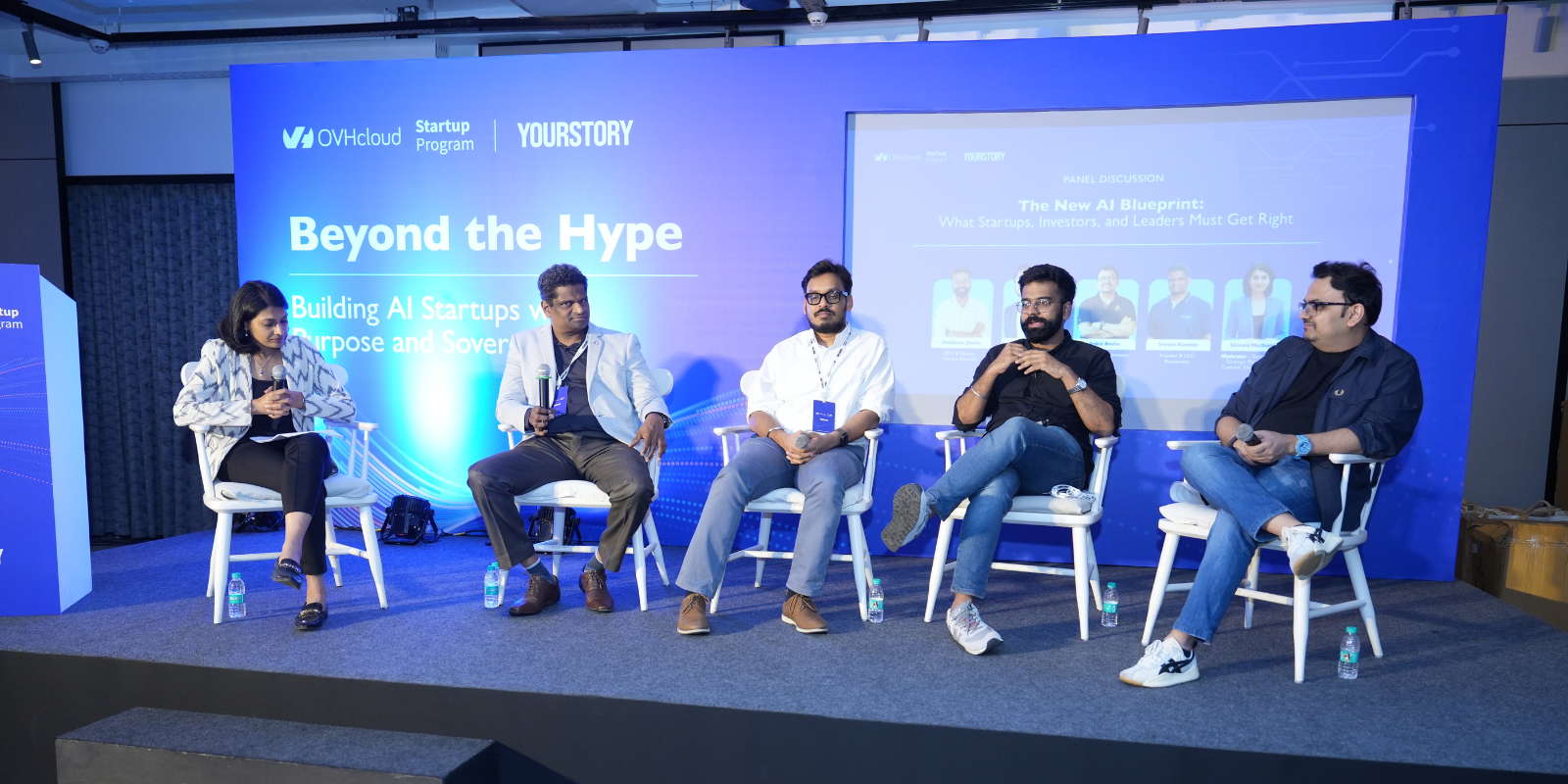
The evening’s highlight was a panel discussion titled “The New AI Blueprint: What Startups, Investors, and Leaders Must Get Right,” featuring venture capitalists and entrepreneurs shaping India’s AI ecosystem.
Shubham Jhuria, CFO and Partner at Aeravti Ventures, emphasized shifting consumer behavior: “The true change is because of consumer adoption,” he said, citing how users now spend significant time with AI platforms like ChatGPT. “Are we replacing our first thought processes by asking questions on a perplexity or a ChatGPT?”
Ankit Kedia, Founder and Lead Investor at Capital-A, discussed valuation trends, warning, “Definitely there is froth in terms of valuation! AI will become a foundational element of everything we do, but the froth is real.”
Nishant Chandra, co-founder of Newton School, shared a startup operator’s perspective. “There is always a 95% problem and the last 5% problem… we were able to get the mock interview cost, which used to cost us close to $2,000, close to Rs 50.”
Sriram Kannan, founder and CEO at Routematic, brought in a note of realism. “We are talking about a tool,” he said. “If I suddenly say I am using AI in this business, what have I changed?… It is still the same people, same driver.”
Panelists debated AI-native versus AI-enabled labels, hiring challenges, infrastructure ownership, and the need for responsible regulation. “Very soon, B.S. in computer science… is going to either get completely wiped out or… overhauled and reorchestrated with elements of AI,” Kedia predicted. Chandra added that sustainable business models still rely on “a core need, an amazing product, and a flywheel.”
As the event concluded, a common theme emerged: AI is powerful when used with clarity of purpose, rigorous discipline, and a human-first approach.
Closing reflections: building with purpose
In the closing address, DVS Shiv Kumar, OVHcloud Cloud Solutions Architect, highlighted the strength of the startup showcase and the panel’s insightful discourse. “All three startups presented engaging solutions,” he said. “The audience truly paused to absorb what was being shared, an indicator of the depth and relevance of their innovations.”
Kumar reiterated the importance of startups maintaining independence from vendor lock-ins. “Data sovereignty must be a strategic pillar for all builders,” he said. “At OVHcloud, we are committed to supporting startups with sovereign cloud infrastructure that empowers autonomy.”
The OVHcloud showcase illuminated a crucial evolution in the startup playbook — one that blends openness with resilience and innovation with integrity. As the AI ecosystem matures, founders are being called to think not just about scale, but sovereignty. And if this event was any indicator, the smartest builders of tomorrow will be the ones who take both seriously.
