

As food and grocery deliveries gained traction, food delivery and quick commerce companies began introducing electric vehicles (EVs) to their delivery fleets to reduce their carbon footprints and keep delivery costs at a minimum. However, keeping EV fleets operational requires maintaining the energy infrastructure.
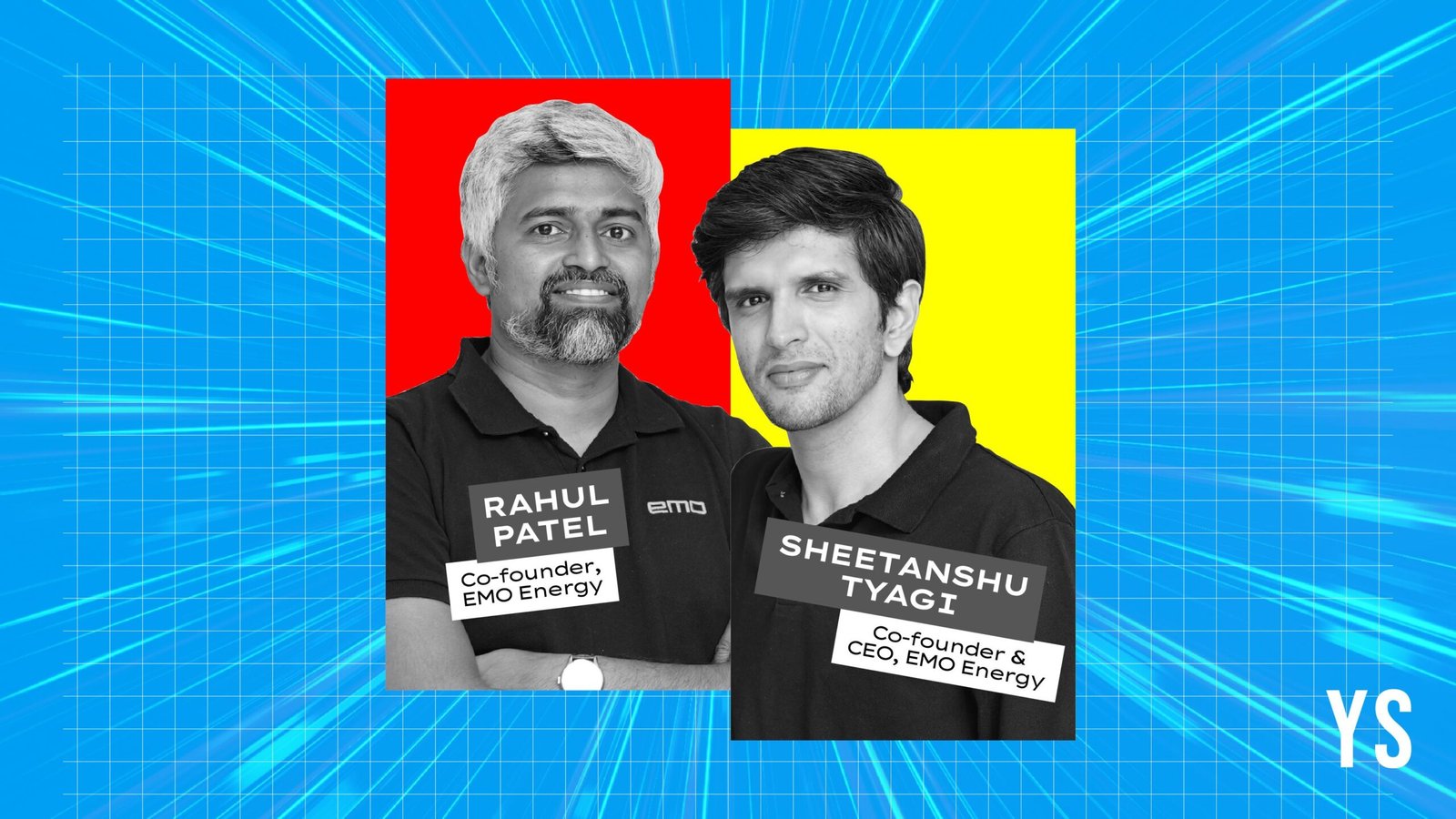
Thousands of gig workers and fleet operators face the largely invisible challenges of unreliable charging points and battery degradation, which leads to vehicles losing uptime in stop-start traffic, and consequently, companies dealing with higher costs and lost earnings. This bottleneck is what mobility engineers Sheetanshu Tyagi and Rahul Patel set out to solve with their startup, EMO Energy.
“We saw India relying on one-size-fits-all imported technology that simply didn’t work for our roads, our climate, or our people,” recalls Co-founder and CEO Tyagi. “Rahul and I wanted to change that.”
EMO Energy’s “intelligent energy” systems include AIS-certified battery packs and its proprietary ZEN stack, designed to manage battery optimisation in Indian conditions using artificial intelligence and thermal management. The deep energy-tech platform enables ultra-fast, 20-minute charging and sustains the battery for more than 1,000 charging cycles.
The Bengaluru-based startup’s systems have been deployed across electric two- and three-wheelers, and large-scale energy storage, with applications spanning quick commerce, logistics, and urban mobility.
Building for India
The idea for EMO was shaped by Tyagi’s experience with EV pioneers in the US and India, including Alta Motors, Rivian, Ather Energy, and Ola Electric. While working on their battery design, the Manipal University and Virginia Tech alum realised that much of India’s EV ecosystem was built on imported, one-size-fits-all solutions that struggled in local conditions.
“India cannot be an afterthought in electrification,” Tyagi tells YourStory. “Our heat, our stop-and-go traffic, our underpowered grids—these demand systems designed ground-up for us. Otherwise, batteries fail, chargers fail, and adoption slows.”
He teamed up with Patel, a thermal and mechanical systems specialist who had led battery programmes at Ola Electric and SUN Mobility, and General Motors Technical Centre India. They founded EMO Energy in 2022 to build high-performance, scalable energy infrastructure designed specifically for India’s last-mile ecosystem.
Full-stack energy ecosystem
EMO’s ZEN stack combines liquid-based thermal management for Indian weather conditions, an AI-driven battery management system that monitors performance, and algorithms aimed at extending battery life.
Rather than relying on passive or surface cooling, EMO’s batteries use a patented active thermal management system with liquid cooling that maintains thermal stability even in up to 45 degrees Celsius environments.
“Combined with our AI-powered battery management system, the packs self-optimise for charging rates, detect faults early, and extend usable life to over five years,” he claims.
Building on ZEN, the company introduced NEXO, a product suite that includes AIS-certified battery packs, fast-charging solutions capable of adding 50 kilometres of range in 20 minutes, and battery storage systems that can operate independently of the grid while supporting solar integration. An AI-based monitoring layer provides fleet operators with data on energy use and battery health.
According to the company, its integrated approach cuts energy consumption and lowers operating costs for dark stores, with an aim to support 20,000 delivery rides per store per month by FY26, with part of that powered by solar.
EMO has 200+ client-operated and solar-integrated dark store hubs in Bengaluru, Delhi, and Gurugram, where 900+ fast chargers are powered through a mix of rooftop solar, battery energy storage systems, and grid fallback. These dark stores are powered by EMO’s charging and energy infrastructure and are designed to meet up to 25% of their energy needs through solar.
NEXO aims to deploy across 100 dark stores in Bengaluru and Delhi-NCR, with plans to expand nationally.
.thumbnailWrapper{
width:6.62rem !important;
}
.alsoReadTitleImage{
min-width: 81px !important;
min-height: 81px !important;
}
.alsoReadMainTitleText{
font-size: 14px !important;
line-height: 20px !important;
}
.alsoReadHeadText{
font-size: 24px !important;
line-height: 20px !important;
}
}

EMO’s battery packs—featuring liquid-cooled, high-density lithium-ion NMC cells—are compatible with 12 leading EV two-wheeler original equipment manufacturers (OEMs) in the B2B logistics segment, including Hero, TVS, Numerus Motors, Revamp Moto, and Okinawa, among others. The startup supports both retrofit solutions and direct OEM integration models.
Currently, EMO’s infrastructure powers over 3,00,000 deliveries each month across 12 Indian cities, with six clients, including Blinkit, Zepto, BigBasket, Domino’s, Hero, and Kinetic. According to the startup, daily deliveries for fleet operators have risen from 78 to 92, translating into a revenue uplift of nearly Rs 1.5 lakh per vehicle annually. Its infrastructure also supports over 8,000 live EVs.
“Each partnership involves active deployment of our mobility or battery infrastructure stacks. Some, like Hero and Kinetic, also purchase battery packs as OEM clients,” the founder adds.
But building such an integrated ecosystem came with its own challenges. EMO had to overcome three major hurdles in scaling EV adoption for fleet operations.
First, imported surface-cooled batteries frequently failed in Indian heat, which the startup solved by developing its own liquid-cooled packs. Second, charging downtime and equipment theft became a concern when stations were placed outside dark stores, so EMO shifted to client-integrated charging inside dark stores. Third, NEXO solved data fragmentation across different OEMs and batteries, which were creating inefficiencies.
Market opportunities and business model
EMO Energy operates at the intersection of quick commerce, electric mobility, and energy storage.
The total addressable market (TAM) for quick commerce is projected to reach $100 billion by 2030. Within this space, EV-based logistics is expected to command a $30 billion market share, as sustainability mandates and cost-efficiency push delivery fleets toward electrification.
The company earns revenue from two main sources: battery sales and its mobility-as-a-service (MaaS) model.
Tyagi says EMO’s battery packs are designed to last over 1,000 full charge cycles, which equates to 3–5 years of intensive fleet use under Indian conditions of high heat, daily operations, and frequent fast charging.
“This durability is enabled by immersion cooling, an AI-powered battery management system, and advanced degradation modelling with adaptive charge profiles. The packs’ state of health is continuously monitored and validated through real-world fleet telemetry. After their initial 3–5 years in vehicles, the batteries are repurposed into energy storage systems, giving them an additional lifespan of up to five years,” Tyagi explains
The startup offers a subscription-based MaaS model for quick commerce and last-mile delivery firms. “Instead of buying vehicles and chargers upfront, operators can pay a recurring fee to access electric delivery vehicles powered by the company’s technology, fast-charging systems, and cloud-based fleet management software. The company handles maintenance, monitoring, and upgrades, aiming to give operators reliable fleet uptime with lower operational headaches,” explains Tyagi.
EMO Energy has raised two funding rounds to date. It secured $1.2 million in seed funding led by Transition VC and co-led by Gruhas in May 2023, followed by a $6.2-million Series A round in early 2025, led by Subhkam Ventures with participation from Transition VC. The capital is being deployed to scale its proprietary energy solutions.
“As climate tech investors, we believe India’s energy transition will be driven by solutions that are both cost-effective and scalable. Battery tech is at the heart of this transformation, and EMO stood out to us because it is solving a real, pressing problem, making existing batteries up to 50% more efficient, reducing the cost of mobility to ~ Re 1/km, and doing so with 100% safety at the core,” says Raiyaan Shingati, Co-founder and Managing Partner, Transition Venture Capital.
The startup competes directly with players including Exponent Energy, Zypp Electric, and Yulu, while also facing indirect competition from battery-swapping infrastructure providers and traditional EV leasing firms. Its differentiation lies in offering an integrated mix of hardware, software, and services through a scalable, subscription-based platform.
By FY27, EMO plans to deploy 1,00,000 more EVs and electrify 5,000 dark stores.
“India doesn’t just need more EVs—it needs a reliable energy backbone to power them. That’s what ZEN and NEXO are designed to deliver,” the co-founder says.
Edited by Kanishk Singh
