



Far above the Earth, there is a graveyard shift in motion, and it is not manned by people, but by satellites that have run out of fuel. These defunct machines drift in so-called ‘graveyard orbits’—high altitude trajectories where inoperative satellites are placed—away from their active counterparts.
However, not all dead satellites make it that far. Reports suggest that there are at least 3,000 defunct satellites in the Geostationary Orbit (GEO) and the Low Earth Orbit (LEO), posing a threat to other active satellites and adding to space junk.
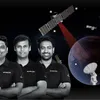
A few years ago, Indian Institute of Science (IISc) alumni Sakthikumar R, Nikhil Balasubramanian, and Mano Balaji K decided to do something about it. In 2021, they founded , a spacetech company focused on building fuelling stations designed to reduce space debris and enhance sustainable operations in outer space.
“We’re basically developing fuelling stations for orbiting satellites that are at the near end of their capacities. Those satellites can dock and get enough fuel to last a minimum of three years. This would extend its life and reduce space debris,” Sakthikumar, Founder and CEO, tells YourStory.
The founders first met at IISc, where they all worked at different times between 2011 and 2019. OrbitAID is based out of Bengaluru and has an office in Chennai. Until recently, the company was incubated at IISc, but it has since established its own research lab in Yeswanthpur in Bengaluru. The startup has a 21-member team, with Balasubramanian serving as the COO and Balaji as the CMO.
Establishing the refuelling ecosystem
In 2021, the startup developed and patented its Standard Interface for Docking and Refueling Port (SIDRP). It is a mechanism for dual docking and refuelling with two interfaces—a passive one and an active one. A satellite at the tail-end of its fuel capacity will dock on its passive side while one of OrbitAID’s tanker satellites, containing fuel, will dock on the active side.
“Once both of them are docked, fuel and power will be transferred from our tanker satellite to the other one. It will function like how USB drives function with ports. We will have control over the quantity,” Sakthikumar says.
Currently, the startup’s goal is to launch multiple tanker satellites across multiple orbits. Once a sufficient number of tanker satellites are launched, the company will establish what it calls a ‘fuelling station,’ where various satellites can come, refuel and continue on—like a Shell for the cosmos.
In addition to its flagship SIDRP platform, the startup is also developing the core technologies required for these tanker satellites to navigate to client satellites. This includes advanced space robotic devices capable of performing refuelling tasks in outer space.
.thumbnailWrapper{
width:6.62rem !important;
}
.alsoReadTitleImage{
min-width: 81px !important;
min-height: 81px !important;
}
.alsoReadMainTitleText{
font-size: 14px !important;
line-height: 20px !important;
}
.alsoReadHeadText{
font-size: 24px !important;
line-height: 20px !important;
}
}
“As more players come into the space sector, more satellites will be launched. And since a satellite can’t be reused, there is going to be a huge demand to extend the life of those satellites. If you break down the cost of deploying the satellites, 50% of it is spent in getting to launch it. So, a refuelling option would save a lot of costs,” Balasubramanian says.
Apart from refuelling active satellites, OrbitAID plans to reduce space debris by transporting defunct satellites from active orbits to the graveyard orbit. In some cases, when that isn’t an option, those dead satellites are taken on a course towards the Earth and are burnt in the atmosphere upon re-entry.
Early tests and the Indian spacetech sector
OrbitAID has conducted about two tests of refuelling and docking in zero gravity in Florida, which were successful.
“Now, we are taking things into space. Within the next four months, we are planning to launch a miniature tanker satellite and demonstrate SIDRP and the refuelling process there,” Sakthikumar says.
While the startup is in talks with multiple space organisations and companies, the launch will likely be facilitated by Indian Space Research Organisation (ISRO). It is planning to launch the first proper tanker satellite in early 2027. The company will refuel certain client satellites and stay in orbit for a few years. By 2030, OrbitAID will have deployed enough tanker satellites in space to establish its fuelling station (a network of these satellites).
At present, OrbitAID has secured three international clients, which the company refused to name. Balasubramanian believes that in the next three years, Indian spacetech companies will begin to thrive in the international market.
“Ever since IN-SPACe came to be, the Indian spacetech sector has been growing rapidly. If you see globally, India has the fifth highest (as per this 2021 report) number of spacetech companies. And a lot of these companies are reaching product-market fit and the maturity stage right now,” he says.
Sakthikumar believes that the future of Indian spacetech is bright because of a particular paradigm shift in the research world. Earlier, the scientific community would frown upon a researcher who made the choice to move to industry. But that has been changing recently and Sakthikumar, who had been an academician in IISc for about eight years, understands this situation well.
“There used to be many problems earlier and academicians weren’t able to realise their innovations on a larger scale. Nowadays, the support has increased. There’s a lot of government support as well,” he says.
Funding and the satellite servicing market
Bootstrapped with an undisclosed amount, the B2B and B2G startup raised $1.5 million in a pre-seed round led by Unicorn India Ventures, with support coming from Tamil Nadu Startup and Innovation Mission (TANSIM also known as StartupTN) in January 2025. The company is using most of the funds for R&D, and has plans to expand to a bigger facility.
Sivarajah Ramanathan, Mission Director and CEO of Startup TN, says, they opted to invest in the spacetech company for its ‘groundbreaking work democratising access to aerospace technology’.
“The company stands out with its deep-tech capabilities in satellite refueling systems and space-grade components in on-orbit servicing. OrbitAid exemplifies the spirit of next-generation Indian space tech—agile, scalable, and globally competitive,” he says.
.thumbnailWrapper{
width:6.62rem !important;
}
.alsoReadTitleImage{
min-width: 81px !important;
min-height: 81px !important;
}
.alsoReadMainTitleText{
font-size: 14px !important;
line-height: 20px !important;
}
.alsoReadHeadText{
font-size: 24px !important;
line-height: 20px !important;
}
}

According to reports, the global satellite servicing market is projected to reach $11.56 billion in the coming years by 2034. Sakthikumar believes that is a testament to the growing need for in-orbit sustainability.
“At OrbitAID, we see this not just as a market, but as a mission to make space operations smarter, longer, and cleaner.”
Directly competing with companies like Colorado-based Orbit Fab, the spacetech startup differentiates itself through its dual docking technology and broader life extension scope—delivering both with a lesser budget.
Edited by Megha Reddy
