

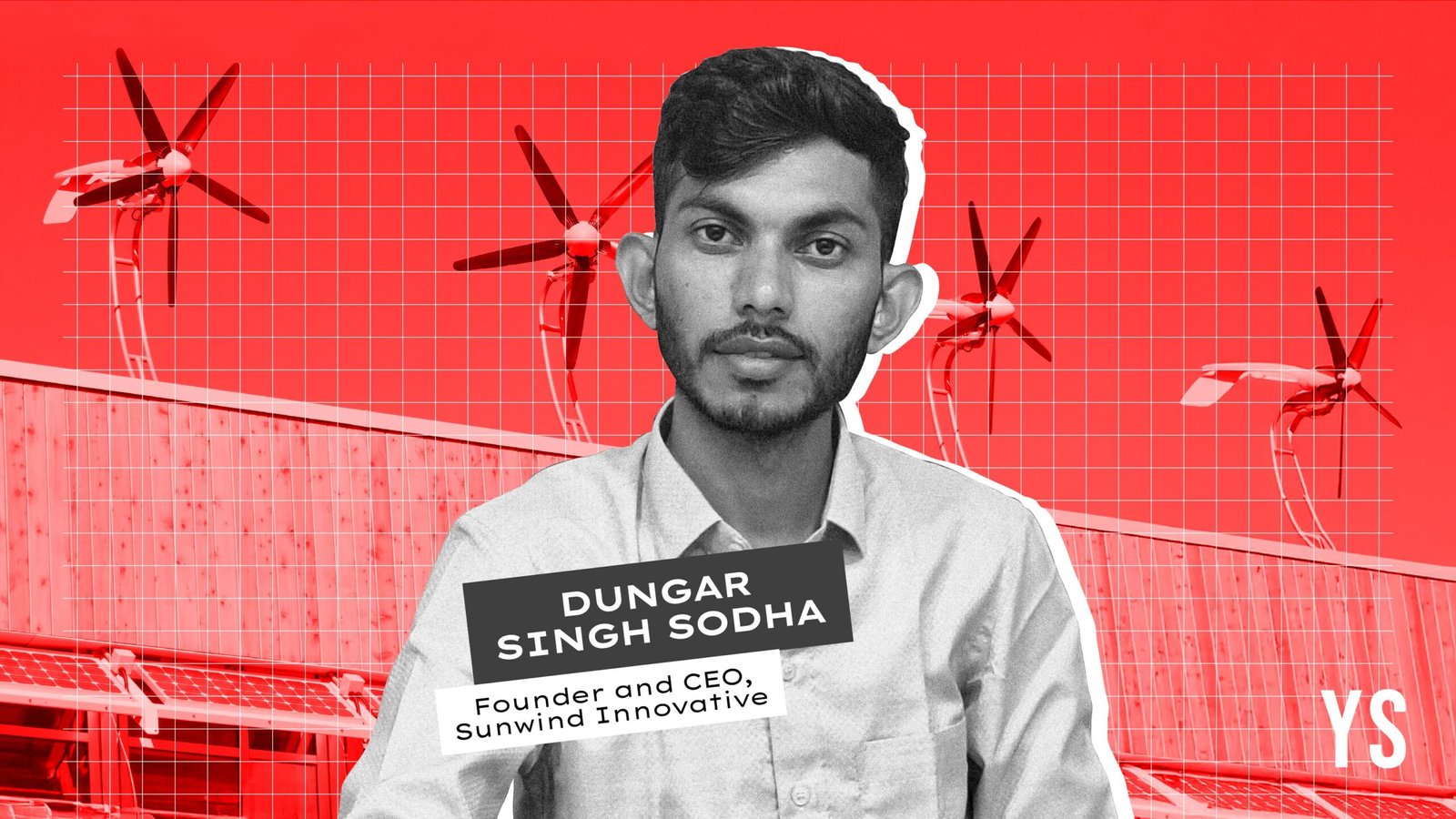
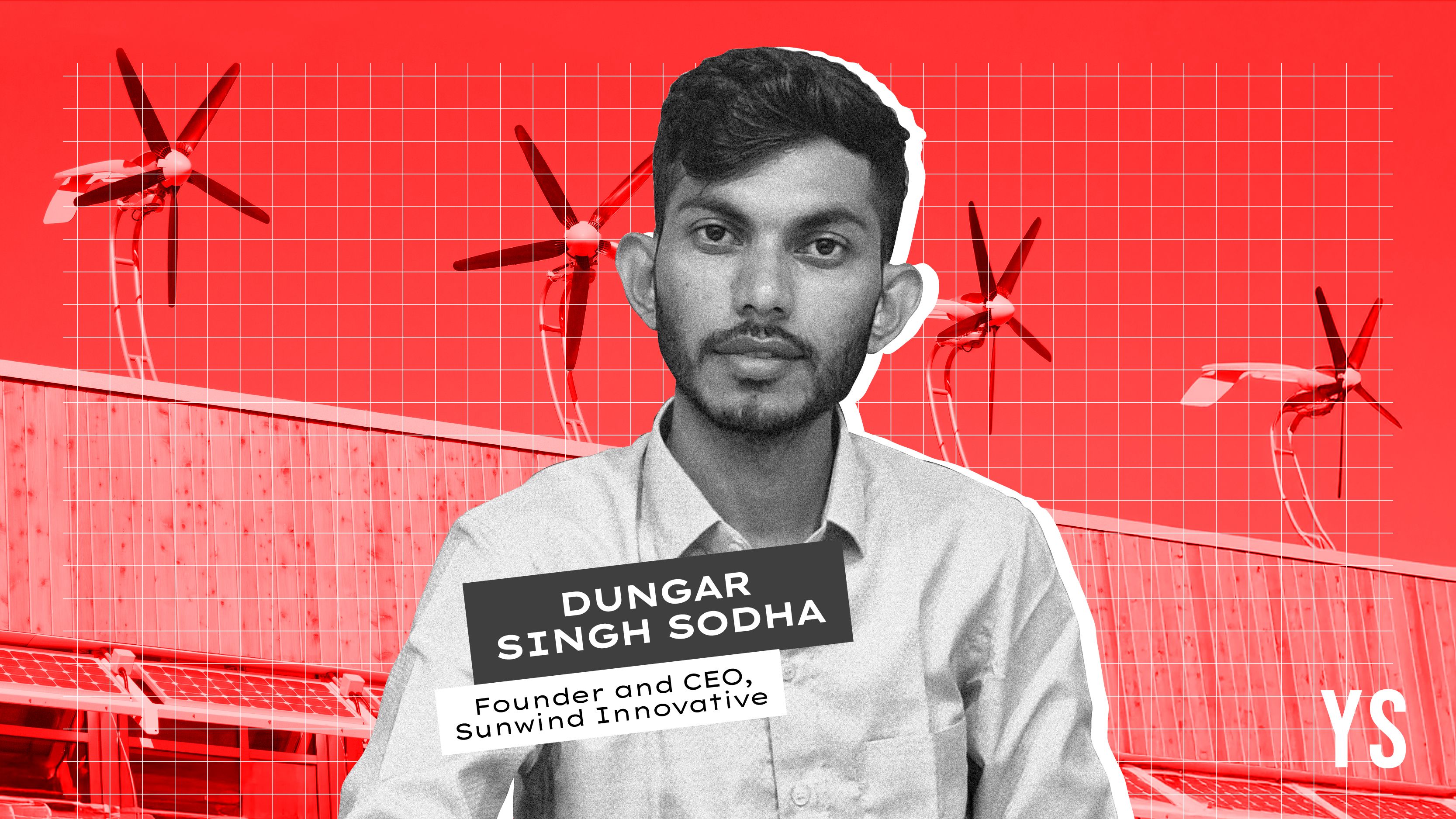
In his formative years, Dungar Singh Sodha made a solemn promise to himself that he would spend the rest of his life trying to give people what he never had: electricity.
“I grew up in Barmer in Rajasthan, where unstable electricity is a very normal thing. To this day, people there face problems with electricity, mobile networks, and such,” Sodha tells YourStory.
To study, Sodha and his friends used to generate light through a creative contraption made of an old bulb and an LED light, powered by biogas. Eventually, he left Barmer and moved to Surat, but found the Gujarat city plagued by power outages, too. During a blackout, he came across a video about windmills, which led to the idea of tapping wind turbines for energy.
“Wind is a very common factor in my state. Gales are so common there that it is easy to get lost in the desert. The problem with solar energy is that you can’t harness it all day, which is limiting,” he says.
As per reports, India ranks fourth in the world in terms of installed wind energy facilities with a capacity of 50.04 GW. While that shows promise, the industry is plagued with a number of issues concerning infrastructure, inconsistent policies, and e-waste.
With an initial investment of Rs 50,000, he founded Sunwind Innovative in 2023 as a cleantech company that designs, manufactures and installs small wind turbines for residential, commercial and agricultural purposes. Based in Surat, the energy solutions company has about 50 members, headed by Founder and CEO Sodha.
Getting into the business
To test out wind energy, Sodha and his team first built a makeshift wind turbine with aluminium sheets and fan blades, a process that took about two months. Satisfied with the result, the Sunwind team began developing the technology, manufacturing a prototype in its Surat factory.
The startup’s flagship product is the vertical-axis rooftop turbine, which is portable and easy to install. “We have designed it in a way to ensure the installation process is smooth,” Sodha says.
.thumbnailWrapper{
width:6.62rem !important;
}
.alsoReadTitleImage{
min-width: 81px !important;
min-height: 81px !important;
}
.alsoReadMainTitleText{
font-size: 14px !important;
line-height: 20px !important;
}
.alsoReadHeadText{
font-size: 24px !important;
line-height: 20px !important;
}
}

The startup sells three types of these rooftop turbines, with prices of Rs 30,000 (produces 75 units of electricity), Rs 1.18 lakh (350 units of electricity and noise-free), and Rs 1.5 lakh (also creates 350 units of electricity but the model is more robust).
It has also created a GSM-based Smart Solar Pump Controller—a tool to control the pump that irrigates a farmer’s field and runs on solar energy.
“During summer, farmers usually go to their farms very early in the morning to combat the oncoming heat. With our product, they can just sit at their homes and monitor how the pump is doing and how much water has been dispelled. A detailed report will be sent to his phone,” he says.
Farmers can operate the pump through their phones. A missed call turns on the pump and turns it off as well. When on, it sends updates to the farmer through SMS alerts, and the pump shuts automatically in case of voltage fluctuations. This ensures that the farmer doesn’t need to be tech-savvy or need a smartphone or the internet to use the service, the founder says.
Sunwind Innovative, which formally entered the market six months ago, operates on both B2B and B2C models. It has about 300 B2B clients, including renewable energy organisations like AutoDim, and companies working in the supply chain. In the B2C domain, it has almost 50 clients adopting the startup’s tech for their personal use.
“Sunwind’s on-grid turbine technology has helped many B2C clients bring their electricity bills down to almost zero. In areas with little or no power supply—such as remote farms, coastal zones, or hilly regions—our wind turbines have proven to be a reliable 24/7 electricity solution,” the entrepreneur claims
Making a mark overseas
The startup’s first client was a B2C customer based in Zambia, and Sodha credits social media for it.
“I received a direct call from industrialist Narendra Bhati, who lives in Lusaka. He had seen our products on social media and even visited our facility. Impressed with our tech, he signed up as our client,” he recalls.
The company set up a branch in Zambia in 2024 under the name Sunwind Limited, and Bhati joined it as a partner. The startup now has an extensive network of over 180 international clients across countries, including the UK, Yemen, Uzbekistan, Qatar, Abu Dhabi, the UAE, Uganda, and the Democratic Republic of the Congo, among a few others.
It has also signed an MoU of Rs 400 crore with the Rajasthan government for a state-wide project involving wind turbines.
.thumbnailWrapper{
width:6.62rem !important;
}
.alsoReadTitleImage{
min-width: 81px !important;
min-height: 81px !important;
}
.alsoReadMainTitleText{
font-size: 14px !important;
line-height: 20px !important;
}
.alsoReadHeadText{
font-size: 24px !important;
line-height: 20px !important;
}
}

In its first six months of operation, Sunwind has reported a cumulative revenue of Rs 5 crore. It is looking for external funding and aims to raise Rs 100 crore.
“Renewable energy is the future. And it’s currently expensive. We are looking to raise a large amount so we can actually achieve all our objectives. We plan to provide electricity to all those places in India that don’t have access to it. So, we have to aim high,” Sodha says.
The startup competes with companies like the Pune-based Suzlon Energy and the Chennai-based Orient Green Power. It separates itself because of its portable and hybrid turbines, low RPM output and its goal to cater to the more vulnerable members of society.
Edited by Kanishk Singh
