

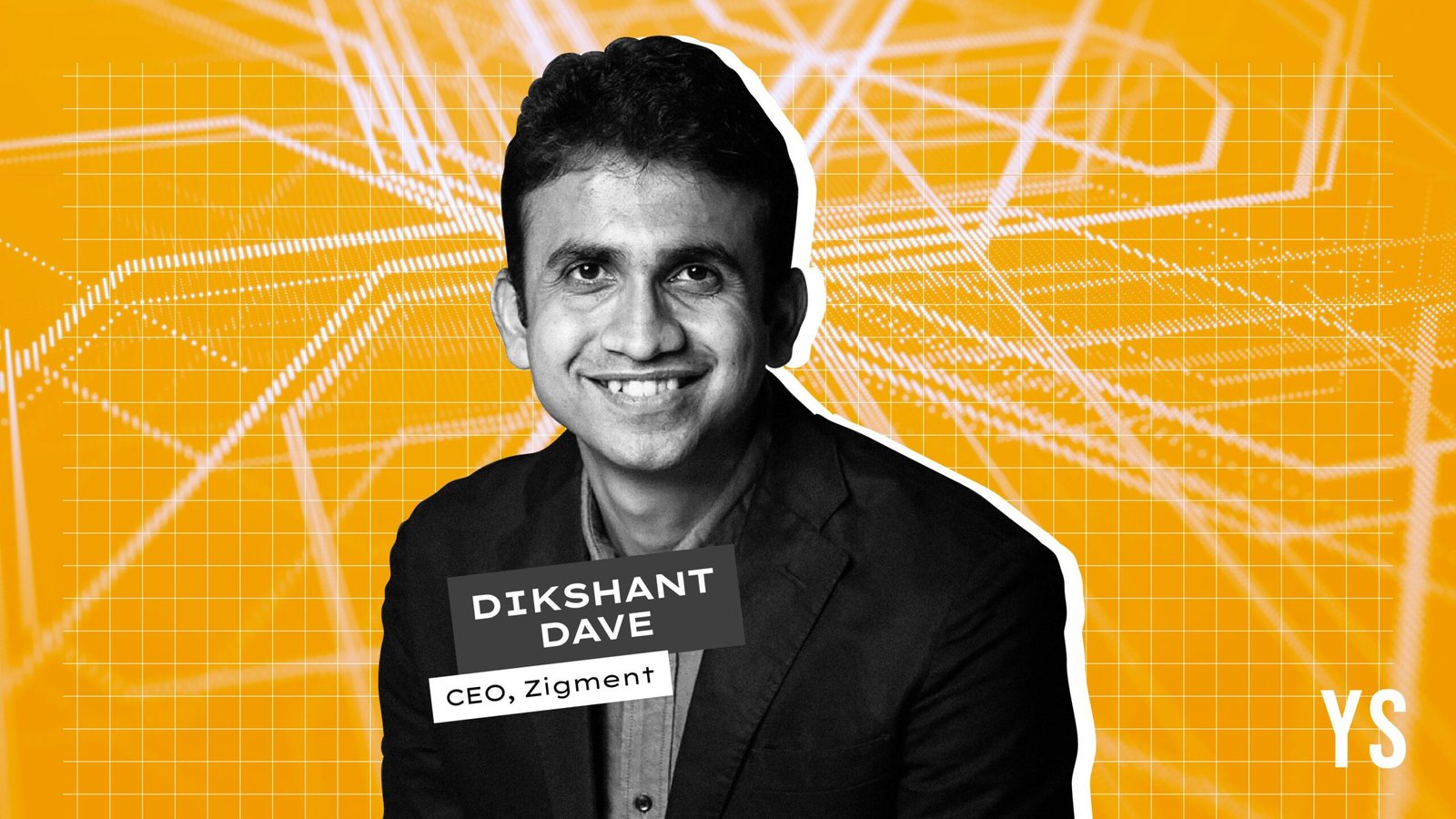

Dikshant Dave has built and exited multiple startups. His observations at one of his startups paved the way for his fourth venture, Zigment.
The idea for Zigment stemmed from his frustration with the low conversion rates at his earlier startup.
At One Balance, Dave had developed a tech platform for personalised wellness supplements. Users had to fill in a 21-question form to get a recommendation. However, in the end, it didn’t translate into action.
“People would spend eight minutes filling out the form, but they wouldn’t buy,” says Dave.
When he started calling the users himself, things changed. Eight out of 10 people he spoke to ended up buying the supplements. “My conviction as a founder made the difference,” he says.
This experience led to the launch of Zigment in 2023 with Karma Pandya, Co-founder and CTO.
Omnichannel engagement
Bengaluru-based Zigment is an AI startup that helps businesses talk to customers and increase sales through smart voice and chat agents. These agents can work on WhatsApp, calls, emails, and websites.
Zigment’s core offering is its Conversation Graph, a system that tracks every message, click, and call in a single ‘queryable’ timeline, wherein users can type prompts into a search box and quickly find specific information from past conversations. It understands user mood and intent, detects urgency or hesitation, and automatically takes the next steps, like sending a brochure or booking a demo.
“We’re not just building chatbots,” Dave explains. “Our agents orchestrate actions across systems.”
Dave, who is the CEO, leads the business side, while CTO Karma handles technology.
Zigment’s platform tackles three major problems: fragmented engagement, manual workflows, and disconnected data.
Dave says users these days interact with businesses across many touchpoints, including Facebook, Instagram, WhatsApp, SMS, phone, and websites. Most companies struggle to track these conversations in a unified way. “You message a brand on Instagram, then visit their site, and it’s like starting from scratch,” he says.
Zigment solves this by providing omnichannel engagement, automating workflow steps like lead qualification, follow-ups, and CRM updates, and unifying data from multiple systems. Its AI agents don’t just answer questions; they push the conversation forward, much like a skilled salesperson would.
This orchestration relies on agentic AI, where multiple AI agents handle different functions but work together seamlessly. For example, if a lead becomes inactive in the CRM, another agent might follow up on WhatsApp.
Zigment’s IP lies in coordinating these agents and choosing the right large language model (LLM) for each task. The company uses models like OpenAI, Claude, and LLaMA.
“OpenAI is great for conversations, Claude is better for analysing documents. We test which model works best and plug it in,” Dave says.
Zigment has built a modular system, so it’s never locked into one LLM provider.
In short, Zigment’s AI doesn’t just chat—it sells, follows up, and remembers what the customer said on Instagram and other channels.
.thumbnailWrapper{
width:6.62rem !important;
}
.alsoReadTitleImage{
min-width: 81px !important;
min-height: 81px !important;
}
.alsoReadMainTitleText{
font-size: 14px !important;
line-height: 20px !important;
}
.alsoReadHeadText{
font-size: 24px !important;
line-height: 20px !important;
}
}

Traction so far
Zigment’s first customer was Nova IVF, a chain of fertility clinics. The startup ran a pilot project, which showed strong results in converting leads. It has been working with Nova ever since.
“Fertility is a complex and sensitive topic. Their marketing head told us our AI sounded better than their call centre agents,” says Dave.
Today, Zigment serves more than 30 B2B clients, including Tata Motors, Bajaj Auto, Dr Batra’s, and US-based nonprofit Give.org. The company has also partnered with Meta and Google, making it easy for clients to integrate with their platforms. It comes with built-in support for tools like Zoho, Salesforce, and HubSpot.
The biggest challenge so far has been explaining the product clearly to potential customers. “It’s not enough to say it’s new tech. You have to show how it solves a real business problem.
“Everyone wants to adopt AI, but they need help understanding how to integrate it without disrupting current operations.”
.thumbnailWrapper{
width:6.62rem !important;
}
.alsoReadTitleImage{
min-width: 81px !important;
min-height: 81px !important;
}
.alsoReadMainTitleText{
font-size: 14px !important;
line-height: 20px !important;
}
.alsoReadHeadText{
font-size: 24px !important;
line-height: 20px !important;
}
}

Business model
Zigment runs on a SaaS pricing model. Clients pay a fixed monthly platform fee, starting at around Rs 75,000 and going up to Rs 10 lakh, depending on complexity and usage. Pricing scales with conversation volume.
“Some businesses handle 10,000 leads a month, others deal with a lakh. Our pricing adjusts accordingly,” explains Dave.
Future roadmap
The company was bootstrapped with an initial investment of Rs 20 lakh from the founders. It is now in talks with potential investors and is seeing strong interest from them.
Zigment is also exploring international expansion, particularly in the United States and the Middle East. It is finalising a project with the Dubai government, and is talking to Indian government entities as well.
The startup plans to open an office in Dubai.
The company’s future plans also include refining its voice capabilities. While Zigment’s agents can already hold Phone audio conversations and trigger backend automations such as sending WhatsApp brochures in real time, Zigment is preparing for wider deployment of its voice features. “We’ve tested internally. Now we’re close to going live with a few customers,” says Dave.
When it comes to competition, Dave points to both new and old players in this growing space. Companies such as Decagon, Sierra, and Lindy are new startups working in similar areas. Older players like Salesforce and HubSpot are also adding AI features to their existing platforms.
“Our AI isn’t an add-on. It’s the foundation,” Dave emphasises, adding, “We’re creating a new category—agentic AI for customer journeys. And we’re building the platform to lead it.”
Edited by Swetha Kannan
